Showing posts with label March. Show all posts

Tuesday, March 17, 2009

Maplin'

It's maple sugaring season here in Vermont, an activity that is undertaken when the days are sunny and above freezing while the nights still dive below that cut-off point. On Sunday we walked up the road to where neighbors were boiling off maple sap in a little gyro-gearloose open-air arrangement up on their hill. I was feeling snivelly, so had forgotten my camera.
Photobucket
Not a sugar shack, just a beautiful (real spring) placeholder

But I've written about sugaring season so many times over the years that there's little use in covering the same ground again. Still, my tastebuds are continually hungering for one or another of the uses of maple syrup I outlined in an April, 2007 Twice Bitten column you can find here. I particularly need to try Ginette's Maple Sugar Grandfather.

I was reminded of it (stay with me, here) when I was reading Amanda Hesser's column on popovers in the March 15 New York Times Magazine. She included a recipe for Sugared Puffs, wherein the popovers are finished by brushing each with melted butter and dipping in sugar and cinnamon.

I thought those would be great with maple syrup, but because I couldn't think of how to make thin popover batter hold together in maple syrup, what popped into my mind was a sturdy pate' au choux baked in maple syrup similar to Grandma's Maple Sugar Biscuits (below).

Yes, I know, I am so maple syrup addled that, describing my train of maple-syrup-thought, my words are tripping each other up.

Still, I can't resist posting this now, and if I get up my courage to bake the 'cream puff' batter in maple syrup I'll post that later. *

Two Pies & a Grandfather

Ginette Turgeon’s MAPLE RAISIN PIE

In a saucepan combine ½ cup water, 2 tablespoons cornstarch, 1 ½ cups maple syrup and 1 cup raisins, bring to a steady but not roiling boil and keep it there for 10 minutes. Pour into a 9” pastry-lined pie pan and finish with a top crust. Bake at 375 degrees until the crust is golden, about 35 to 40 minutes.

Ginette’s MAPLE SYRUP GRANDFATHER

In a deep and wide saucepan combine 3 cups maple syrup, 1 cup water and a pinch of salt and bring to a low boil and boil for 10 minutes.

Mix up the dumplings: 2 cups flour, 2 tablespoons baking powder, ½ cup butter and ¾ cup milk.

When the syrup is ready turn the heat down until you get a nice active simmer and drop the dough by tablespoons on top, cover, and continue to simmer for 20 minutes without removing the cover.

Bonnie Baird’s MAPLE WALNUT PIE

Combine 1 cup maple syrup, 4 beaten eggs, ½ cup sugar, 1/3 cup melted butter and 1 1/3 cup chopped walnuts. Pour into a single pie crust, and bake at 350 for 15 minutes, covered with a piece of foil; uncover and bake another 25 minutes.


Larry Myott’s GRAMMA’s BISCUITS AND SYRUP

Put two cups maple syrup in a 9x9 inch baking pan and heat it to almost boiling. [this can be done in the oven] Make your favorite biscuits, cut them out, and lay 9 of them into the syrup. Bake in a 400 degree oven until browned.

Dumplings or biscuits could be served with ice cream, beside a baked apple or poached pear, or perched on top of homemade chocolate pudding made with a good, dark chocolate.

*Courage, you say? Well yes, if I successfully oven-poached pate' au choux in maple syrup I might have to eat them all!

Sunday, March 15, 2009

Mexican (or not) Shrimp Quiche

Here is a little ditty I used to sing long ago, at least once a month, a melody of shrimp quiche.

Photobucket

Its concept popped into my mind last week, and thus began a search for the original recipe. I found it, with unusual success in these days of searches for lost things, and realized a few things:

First, this is Dave and Janis Murray's Mexican Quiche – it says so right there on the clipping scotch-taped to a recipe card and a quick googling found it on the web under that exact name and in all its detail (amazing world we live in);

Second, that it came from the New York Times Magazine which meant that, obviously, Dave and Janis were big food names, even though I, for one, couldn't recall anything more about them;

Third, that this recipe deviates from my usual ratio for custards of 1 cup liquid/1 whole egg/1 yolk. Well, just slightly;

Fourth, that it violates a reluctance I feel toward combining shrimp, or even any fish, with cheese. I know – that's weird, and who cares!

But finally to the real, Fifth, point: What makes it Mexican? Why, nothing more than the addition of bottled taco sauce after the thing is made, which was obviously done to extend and complement the use of chopped, canned, green chilies in the quiche itself, and that's what gives this pie its singular and memorable taste – the meaty, oceany taste of shrimp meets that sharp green taste of the chilies, all held commingled in a creamy, light filling.

Creamy? Well, let me diverge from my own opinion. The consistency of a perfect quiche or custard is, to me, not at all dense, but a combination of creamy milk and egg that remains light, so that when a fork is put down through it it separates into cubes of goodness, almost as though its molecules were long instead of round, and a sheeting effect had taken hold.

That perception goes all the way back to the heyday of the old Back Home Cafe on Center Street in Rutland (VT), when Kim, I think it was, made quiche with various fillings and they were served with Tassahara whole wheat bread and butter, and spinach salad with bleu cheese dressing. Those quiches broke apart into trembling cubes of goodness.

What is the secret to that delicacy? It's one that does not wholly and consistently reveal itself to me through various actions. Beating the eggs slowly but thoroughly, incorporating little air but combatting the inherent stringiness of the egg. Putting the prepared quiche into a very hot (450) oven for five minutes to let the bottom crust crisp and to bring the custard to a certain temperature quickly, then turning the oven down to low (325) for another 20 minutes, so as not to curdle the custard. I believe that all of these actions can determine the finished consistency, but they are not foolproof.

But, these considerations aside, on to the main event. Ladies and Gentlemen, I give you

Photobucket

Dave and Janis Murray, and their Amazing Mexican Quiche
Serves 6
Ingredients

* Pastry for a one-crust pie
* 14 shrimp, about 1/2 pound, shelled and deveined
* 1 4-ounce can green chilies, preferably chopped, about 1/2 cup
* 1 cup grated cheese, preferably half Colby and half Monterey Jack
* 3/4 cup light cream
* 3 eggs, beaten
* 1/3 cup chopped chives
* Salt to taste, if desired
* 1/3 cup sour cream
* 2 tablespoons bottled taco sauce or tomato and Serrano chile sauce

Preparation

1. Preheat the oven to 425 degrees. Line a nine- or 10-inch pie plate with the pastry.

2. Bring enough water to the boil to cover the shrimp when they are added. Add the shrimp and cook two minutes. Drain.

3. Chop eight of the shrimp into small pieces. Keep the remaining shrimp whole and set aside.

4. Scatter the chopped shrimp over the bottom of the pastry. Cover the shrimp with layers of chopped green chilies and the grated cheese.

5. In a mixing bowl, combine the cream, eggs, chives and salt and beat to blend. Pour the mixture into the pie shell.

6. Place the dish in the oven and bake 15 minutes. Reduce the oven heat to 300 degrees and continue baking 35 minutes or until the filling is set.

7. Remove the pie from the oven and let rest 15 minutes. Spoon six dollops of sour cream in a circle about halfway between the center of the pie and the crust. Dip each of the remaining shrimp in the taco sauce or tomato and Serrano chile sauce and arrange one shrimp on each dollop of sour cream. Cut into six wedges and serve warm.


My Idiosyncratic Way

Now, that by itself is perfectly wonderful. No need to change a thing. But, of course, I did.
  1. I do not use bottled taco sauce, so I didn't use any at all. But it would be great served with freshly made, creamy guacamole, or even good salsa with tortilla chips.
  2. And don't even think about using fresh peppers. It is that tangy almost metallic taste of the canned ones that is so good here.
  3. I chopped all the shrimp and used them in the pie.
  4. I did dot the top with a crème fraiche that I had already made.
  5. I did bake it in a preheated 450 degree oven for 5 minutes, turned the oven down to 325 for another 20 minutes. I'd make it 15 minutes next time.


No matter how you serve it it really is delicious.

Afterthought: I couldn't quit thinking about the Murray's, and so did some more investigation. Apparently this recipe, published in the New York Times Magazine in 1986 by James Claiborne, constituted their 15 minutes of at least New York Foodie fame. They now live in St. Louis, where they are still public people she is a home and garden reporter for Fox News and he is a meteorologist.

But what a lasting 15 minutes!

Monday, March 02, 2009

brocc reincarnate

Okay, now that everyone’s greeting me with a grin and a “Sooooooooo, you don’t like Kale either, huh?”, I’ll confess to another character flaw – and that is that broccoli, of all things, had lost its appeal to me.
“Broccoli,” you say, “well then what green vegetable’s LEFT to eat in the winter?”

Exactly!

Photobucket

The situation was dire – DIRE, I say! I used to like broccoli. Had they changed it in some way, as they changed pork? I hear the most well-intentioned people bragging about their pigs being bred for LEAN. Who in god’s name wants a pork chop bred for lean? It’s that old cholesterol scam, punishing the American palate and environment by insisting that cholesterol in one’s food translates directly to plaque build-up in one’s arteries.
But what could they possibly have done to broccoli? And why?

Suddenly, boiling it or steaming it leaves the stems as hard as something you’d chuck into the fireplace to burn all night, and the blossoms mushy. Ick. Stir frying was kind of the same thing – take your choice of well-done or woody. And where’s the taste. I roasted it, because, like Kale, roasted broccoli has lots of adherents fainting with pleasure. Didn’t turn me on. Not one iota – charred at the edges, while everything else remains challenging, unless you char it clean through, and then you’ve got, well, a mouthful of ashes.
But I love, love, love broccoli raab, that slightly bitter green that LOOKS like baby broccoli but tastes so GOOD, and tangy, the bitterness mellowed by olive oil and garlic, then brought back to kingliness by a sprinkling of hot pepper flakes. Just like Al Ducci’s, down in Manchester, does it. I could eat that all day, and sometimes do!

By the way, raab, or rapini, or even rape, is more closely related to the turnip than to broccoli, the stems are thinner than broccoli, it’s leafier, and the heads are small and numerous. You eat them all.

And the way you achieve that flavor and texture is to toss the raab into boiling salted water and bring it just back to boiling, hold it there maybe a second more, then drain it. In the meantime you’ve warmed about a quarter of a cup of olive oil in a sauté pan with a finely chopped clove of garlic. When the raab is drained, and the garlic has had time to flavor the olive oil without turning a bit brown, turn the heat to high under the pan, and when the oil is hot (don’t let that garlic turn) throw in the raab and shake, rattle and roll until the raab is hot, has cooked a couple minutes more and is, my goodness, coated with the oil. Sprinkle with salt to taste, then a teaspoon or so of hot pepper flakes, and there we go! Serve it warm or even cold. Put it in a sandwich. Al Ducci’s makes a raab sandwich on their little flatbreads that are split in half, with Al Sheps’ fresh mozzarella and lots of that garlic olive oil. It is a treat!

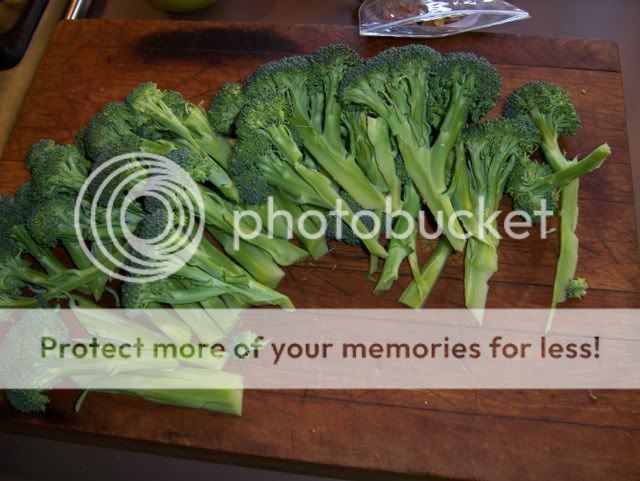
So! Why not try that same thing with regular broccoli. I trimmed the stems, peeled them, then split the stems in quarters and pulled them apart without cutting the blossoms, and proceeded. I knew it was good for supper that night, but when I found myself at the counter next day eating it cold, straight from the fridge, for breakfast, I knew I’d got it right.
Photobucket

Now if it was that good by itself, imagine how good it’d be on a pizza.

Pizza Brocc

This is a quick crust that rises usually for no more than an hour. I use half of it for one pizza, and bake off the rest as a fat flatbread. It rises quickly because of the large amount of yeast and the warm water. I sometimes use quite hot water. The unbaked portion can be wrapped securely in plastic and stored for a day and a night in the fridge. I make this with a an electric mixer using a dough hook. The metal bowl of the mixer, when fitted tightly with a plastic bag and placed in a warm place – I place it on top of the pilot light of my range grill – provides the perfect environment for rising.

For the crust:

• 4 cups flour
• 1 teaspoon sea salt
• 3 tablespoons olive oil
• 2 rounded teaspoons yeast
• 1 ¾ cups warm to hot water

Whisk the first four ingredients together, then slowly add the water while the mixer is doing its thing. Beat the dough for several minutes to develop the gluten, then place a plastic bag over the bowl and leave it in a warm place to rise.

Prepare the fillings (for one 14-inch pizza):

• ½ onion finely chopped
• 1 or 2 cloves garlic chopped fine or sliced thin
• 2 cups grated cheese (mixture of swiss and parmesan is good)
• broccoli or broccoli raab prepared as noted
• whatever else you must have – sliced black olives, slivered mushrooms, thinly sliced cooked sausage; or nothing more. Remember that too many or too much makes a sloppy pizza with unidentifiable flavors.
• Olive oil

Assemble and bake:

Heat the oven to 450 degrees. Place your pizza pan in the oven while it heats. I use a heavy cast-iron platter.
Scrape the dough out onto a well-floured surface. Cut in half, form a little loaf with one half and set aside. Roll out the other half to the size of the pan. Take the pan from the oven, drizzle with olive oil, fit the crust onto it, sprinkle with olive oil, sprinkle with salt, sprinkle with ½ of the cheese, sprinkle with the chopped onion and garlic, arrange the brocc over the top, follow with optional additions, then top with the rest of the cheese, slide into the oven, and bake for 20 to 25 minutes, until the top is browned and bubbling.

Proceed with the second pizza, or remember to wrap that dough securely in plastic (so it doesn’t burst out of loose corners) and refrigerate.

Pizza Brocc

The flatbread

When you’re ready to bake that off, say into a flatbread, take from the fridge, unwrap onto a floured surface, let it come to room temp, heat the oven and pan to 450 degrees, pat the dough into a flattened loaf maybe 8 inches in diameter, take the pan from the oven, sprinkle with olive oil, arrange the loaf on the pan, dimple the top by pressing your fingers in firmly, drizzle with olive oil, sprinkle with thinly sliced garlic, if you like, and sprinkle with salt. Bake off for 20 minutes or until bread is risen and golden.

...a good practice...

I’ve been trying to get Dennis Duhaime, the Co-op’s produce manager, to stock broccoli raab while it’s the season for it. The problem is that he stocks a specialty item and it languishes, and too often gets tossed. Not good for the Co-op’s sustainability! So make it a practice to show him you appreciate his efforts by buying something out of the ordinary when you see it. I bought escarole for that reason, chopped it, sautéed it briefly with garlic in olive oil, then stirred it into mashed potatoes in a classic preparation. I even told him I’d do a demo of broccoli raab if he’d get it in. He sold out of the raab when people could taste it and get a recipe for it. So try something new when you see it, and gradually the Co-op’s selection will broaden. Better yet, bring in a recipe or two to show people how to prepare your heart’s desire. Want to go all the way with it? Tell Dennis you’ll do a demo. That kitchen is very satisfying to work in.

...the Co-op’s own...

Peter McGann will be the guest chef on the next edition of What’s Cookin’ Rutland, to be taped before a live audience at Peg TV on March 16. Peter is the well-known-around-town instructor of the popular cooking classes in Mexican and World-Cuisine at the Rutland Co-op. He’s studied with major chefs and food people including Elizabeth Andoh (Japanese); Diana Kennedy (Mexican); and Paula Wolfert (Middle Eastern).
Peter will chat with host Whitney Lamy about the idiosyncrasies of Mexican food, as he demonstrates some of his techniques in making Chicken Enchiladas in Red Sauce. The audience will have a chance to taste his creations after the show..

What’s Cookin’ Rutland is taped at PEG TV Studios in Howe Center starting at 6PM. Doors open at 5:30 for the seating of the audience. A $10 donation is suggested, and reservations may be had by dialing 508-813-8114.

...words to end this ballad of olive oil and garlic...

“I am not trying to torture you, I promise. I know it must seem like I sit around all day, cackling evilly, stroking my black cat, scheming up ways to trick you into eating lima beans and kale, but I don’t. Cross my heart. I don’t even have a cat - although I do sometimes cackle, but never at your expense. Everything I do here, I do out of love.” Sound like anybody you know? Well, it’s not me – though I could have said it – it’s Orangette, from her blog .


I still don’t know what they’ve done to broccoli, whether it’s a conspiracy or aging tastebuds, but the right technique and enough olive oil and garlic doesn’t harm much of anything!

Sunday, March 18, 2007

We Are Tired of Our Huts

White smoke from neighbors’ chimneys plumes straight up into blue sky this morning when the dog and I go out for the paper; but there’s a softness to the air and busyness with the sound of birds. And there behind the old church across the street rises the bright shadow of Easter – not the bunny but the sun. Almost Spring Equinox.

It’s the best time of the year. The days have a long time to get longer now. Far off, in the high sun of mid-June we can allow ourselves the luxury of apprehension, for then the hemisphere begins to leak light, leading at least to November. But for now winter’s back is surely broken, and soon we’ll be allowed out of our huts!

CLEANING OUT THE LARDER

Now’s the time we clear out the cupboards and fridge, freezer and pantries of stuffs dried or frozen or otherwise preserved from an old season, free at last to use them up in frenetic anticipation of beginning the cycle anew, of preserving yet unknown things for yet another February. There’s a venison roast frozen since fall that needs to be considered before the young, copper-sheathed fiddleheads of ferns poke their curled heads out of the mud. Daytime temperatures will rise and tumble back down for night and though nothing yet visibly grows nevertheless saps and mycelium begin to flow and grow, and soon our first foraging season will begin – Sugaring! In the past, when stores had been depleted by this time, humans were known to subsist on new maple sugar for a month or so before green struck again. Religions, formed before refrigeration and on the shoulders of earlier pagan rites, actively encourage severe fasting at this time of year, culminating with feasting at the time when new young things do birth and grow.

Feasting rises the ladder of climates from south to north as the quarry rises from the earth, the waters, and the forests: Shad and its luscious roe. Bitter dandelion. Lovely wild leeks. The crenellated wild morel.

... of Cans and Bottles of Things

In this house the 2006 canned tomato sauce is gone but there’s one more bottle dated 2005: a classic example of over-hoarding – time gets away, too few mindful trips to the cellar. Perhaps, to do it justice, we’ll just drink it, with a little vodka or not. It was made from a favorite tomato called Enchantment, shaped like a paste tomato but not mealy, a little salt and basil leaves added just before the lid went on.

... of Garlic

I no longer hoard the bag of garlic that I bought from Dutchess Farm at the Market last fall, but use it like it’s going out of style, which it is, though it’s kept well upstairs in a little room we keep quite cold and dry. I used almost a whole head of garlic in last Sunday’s pot roast, while in November’s I would have been more sparing.

. . . of Strawberries

One Tuesday last summer, at the Rutland County Farmers’ Market, I bought two more quarts of those most marvelous strawberries everyone raved about. Greg Cox of Boardman Hill Farm sold them for Wood’s Market Garden in Brandon where they’d been raised under organic conditions even if not yet certified. They were huge, so sweet they needed little added sugar for shortcake. These last two quarts – I’d bought five on Saturday – were spread on a plate and frozen whole, then placed into freezer bags to eat like popsicles throughout the rest of the summer.

But so many good foods to eat all summer, and the natural instinct to hoard good things, rendered those strawberries mostly untouched by last month. Now that the next strawberry season is within imagination’s reach, I’ve begun indeed to “eat them like popsicles.” Since the texture of frozen strawberries leaves something to be desired, they’re not great on salads. Last night I made a dressing of them to go over a salad of grilled salmon and pear on fresh greens, garnished with warm goat cheese and toasted walnuts. It shed warmth (some of which was due to the rather too large pinch of chipotle pepper flakes I added) and a sense of summer on the whole meal.

The Strawberry Vinaigrette
Make this early enough for the flavors to meld.

Makes about 1 cup

6 large sweet strawberries, fresh or frozen
1 clove garlic,
½ cup cilantro
1 tablespoon shallot or onion
3 dried tomatoes

Zest and juice of ½ lime
½ teaspoon salt
½ teaspoon black or white pepper
1 tablespoon maple syrup

½ cup olive oil

In a small bowl, mush the fresh or defrosted strawberries with a potato masher.
Chop the garlic, cilantro, shallot, tomatoes, and lime zest until very fine and stir into the strawberries. Stir in the lime juice, salt and pepper, and maple syrup. Whisk in the olive oil in a very fine stream. Correct the seasonings.

Alternatively, place all of the ingredients except the olive oil in the bowl of a blender and blend until smooth, then add the olive oil in a thin stream while the blender is running. Correct the seasonings.

This would do well dipped up with tortilla chips, particularly if you did the minced version; or served in tiny cups as an amuse bouche at the beginning of a meal. In that case I would use the blender, and drizzle each tiny mouth-amuser with a little extra and very good olive oil.

... Really? Vinaigrette?

Okay, I may be playing somewhat loosely with that term. It’s certainly not a plain vinaigrette. But Larousse Gastronomique, in addition to specifying a 1:3 ratio of vinegar or other acid to oil or cream, allows other seasonings, such as herbs, garlic, or mustard, to be added. I must consult them about the addition of six large, flavorful strawberries. I never fail to realize something unexpected from the LG: Put a little salt in the bowl, they say, and then whisk in the vinegar, because salt doesn’t dissolve in oil.

EATING LOCALLY

But let’s face it, most of us don’t have larders. We might have a pantry, but what do we store in it? Cans and bags and boxes of food stuffs that overflow the kitchen cupboards, that’s what! I wonder how many people have a ham hanging in some cool dry room? (Let me know if you do!)

Nope, most of us rely on at least weekly visits to the supermarket; and don’t get me wrong, I do too, at least in the winter when most Farmers’ Markets are hibernating.

....Discovering The Co-Op, Rutland’s Natural Foods Market

One day last fall, meaning to stop at the supermarket for some serious grocery shopping on the way home from a Center Street lunch, I dropped by The Co-Op on Wales Street just to see what was up. To be honest, perhaps I just wondered what delicious offering Peter had cooked up – maybe his impossibly good Tortilla Espagnola or his signature cornbreads and salsa. I can’t remember now if it was one of Peter’s days or not, but it certainly turned out to be one of mine!

The place was colorful and warm and positively exuded good energy; the produce bright and fresh and well-stocked, much of it organically grown and locally produced. The clerks and volunteers were friendly and helpful as I chatted with them and with friends who had wandered in.

I picked up some bright yams, which I have been using for awhile instead of potatoes, and some glossy, deeply creased kale to steam and dress with Asian tastes, and to cut into strips and drop, for those last minutes, into soups; cilantro, mesclun, some cans of this and that – how about organic pineapple? I measured out some pearled barley and excellent coffee beans in bulk, chose a local cheese, an extraordinary yogurt, picked up a cleaning spray, and probably a dark-chocolate bar when I got up to the counter, where the final pleasant surprise whapped me up side the head – I’d spent far less than I would have at the supermarket.

...Consider the Yam

I think that what I’ve been buying is a garnet yam, which is really a sweet potato of the Morning Glory or Convolvulaceae family. Anyway, I grew up with them served mainly for holidays or Sunday dinners swimming in maple syrup and butter. But in recent years I’ve reconsidered them. Now, to bring out their nutty natural sweetness, I simply roast or grill them whole; or simmer them – unpeeled and cut into rounds – in salted water until tender. Quickly, I add butter or olive oil and finely chopped shallot, garlic, and parsley and mash them with a fork, not until smooth but until broken apart, chunky and mixed together with the oil and alliums which the heat of the yams will partially cook, then clap that cover back on the pan until ready to eat. They are delicious, low in calories and carbs, packed with good orange vitamins; great with grilled meats.

He who distinguishes the true savor of his food can never be a glutton;
he who does not cannot be otherwise
...

This column was first published in the Rutland (Vermont) Herald in March of 2007