![]() |
| Photo by Donna Wilkins Photography |
Wednesday, April 01, 2015
tapping into spring
Tuesday, April 19, 2011
the Noticers
I’m reminding myself to keep noticing, to be present, on these chilly damp days, and so I go out and make the rounds of the garden, of the yard, of the lake and the river, and in that way I realize the coltsfoot is blasting out its little leafless yellow flowers and the tiny white blooms of the bloodroot wrapped in their frilly leaves, like bugs in cocoons, are carpeting my yard. The sorrel is tart and lemony, peeking green out of the chopped leaves in my garden – the very earliest edible – and Egyptian onions are freshening.
And, I am reminded, Easter is coming on, isn’t it? The first Sunday after the first full moon after the spring solstice. All writhing goats and death and resurrection. And eggs and bunnies, of course. What a strange symbol of fecundity the silly pastel bunny is.
I notice the tiny vole who lay dead on his side in the coils of hose, how delicate his little claws, how curious his pinpoint of an eye. We notice the wood ducks and kingfishers on the lake, the raucous grumbling thunder of frogs mating in the bog. Nature makes herself known, pastel rabbits or not.
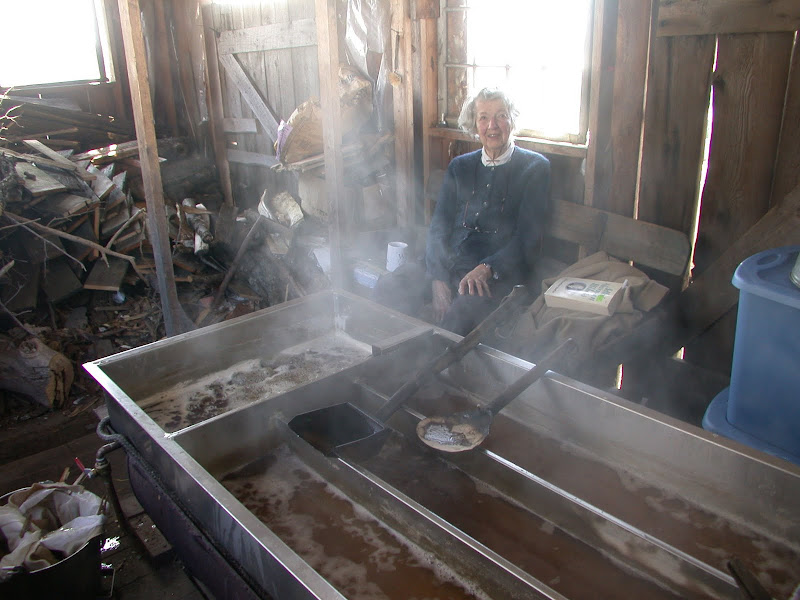
Edith Fisher Hunter, captured above by her son, Graham, at this year’s sugaring, is a powerful noticer. And she brought up four children to be noticers, and teaches the wider world to notice, too, through her books and her talks, Vermont Public Radio commentaries, and even through her preaching.
We began to exchange emails last September when I had the opportunity to tell her how much I enjoyed her VPR commentaries. There had been a recent one in which she had talked about sitting in her October garden among the overgrown asparagus fronds that had shot through them a volunteer tomato vine with tiny sweet tomatoes. Edith draws pictures with her voice, which crows and soars and teases as she brings to our notice the natural world, Aunts Mary and Margaret, Son Graham, Son William, Son Charlie, and Daughter Elizabeth. They’re all pronounced without a comma, so that their proper names seem to include Son and Daughter.
I fancied it was an old fashioned kitchen chair on which she sat in the garden. A green one.
Wonder of wonders, Edith answered me by saying that she didn’t know what had possessed her to read one of my columns awhile ago – she had never, that she knew of, ever read a food column – and didn’t find it unpleasant. I was delighted.
Edith and her husband Armstrong Hunter published the Weathersfield Weekly for 15 years. They both had divinity degrees but Armstrong’s passion was for printing. Weathersfield encompasses Ascutney and Perkinsville over in the eastern south-central edges of our state. The Weathersfield Weekly was very well thought of in Vermont and nationally, too. It made a community out of these disparate areas, and it made a center, too, right there on Center Road (which Edith pronounced “Centah” just as Hunter is “Huntah”).
Printing, and local newspapering, is all about community, isn’t it?
Once Armstrong submitted to a journalism contest an article Edith had written about the dairy industry in Weathersfield. As Edith tells it, “There were several classes to enter – publications with 100,000 circulation, those with 50,000, and those of 10,000 and under. We had 650! The winner in each class got $5 thousand and a night at the Plaza and an awards dinner. Milton Freedman won in one class, and James Fallows in another, and I won in (the under) 10,000. Pretty good company! It built my garden house and back porch.”
Edith has written half a dozen books – one of which has been in print for 47 years. Armstrong joked that it put at least two kids through college! She’s written nature columns. She’s a historian and a genealogist. She’s 91 years old. There’s no sense in hiding one’s light under a basket when one has reached that great age.
In the meantime they reared their family. “I have three lovely sons who I see almost daily and we share such wonderful memories! And they have great senses of humor. And my daughter and I email everyday,” she wrote to me. And it seemed to me that the most amazing thing that Edith and Armstrong Hunter did was to encourage their children in all their varied interests, and act as such passionate advocates for them that each has evolved into an utterly idiosyncratic individual. It seems a rich and yeasty family, all writers, social activists, and I’m not quite sure how many ministers.
The oldest is Elizabeth, a writer, a teacher, a nature columnist, who lives in North Carolina. She’s the only one who lives out of state. Graham is next – an architect, “the only one of the boys to be a Mr. Fix-It,” and the person who nursed Edith through an illness a year or so ago when she “almost flew the coop,” she told me. “For almost a year he came over and made my meals and saw me off to bed and made my breakfast.”
Next is William, whom I knew of through his Peace and Justice advocacy. He is a lawyer, a writer, and a preacher. A community activist. “A saint,” his mother told me recently, but that was because on top of all his other duties he was finding me photos and mailing me things. Thank you, Will. Charlie is the youngest and has combined fine and graphic art with music managing. And musical train tours. He’s in charge of Edith’s extensive gardens, too.
I’d been thinking about those gardens and in one email I asked Edith if I might visit come spring. It was the end of February and Edith was looking forward to beginning sugaring with Graham. “You can come see me anytime,” she answered. “ I'll hope to be spending a lot of time in the sugarhouse starting next week - I hope, hope, hope.”
Days, no, weeks, went by, and I thought of Edith in the steaming sugarhouse with “Son Graham”. And then one morning I sat down with my coffee and opened the Herald and there, with plummeting stomach, I saw Graham’s obituary!
Edith wrote right back to my email. They were in shock. Graham, who was 63, had never been sick, it had been sudden and, to all appearances, peaceful. “He and I were in the middle of a great sugaring year. We had made 8 gallons when he died and since then I have made two more.” Altogether, they would make in excess of 19 gallons of syrup for the year. One keeps on keeping on. One keeps on noticing.
Before he died, Edith wrote, Graham had planted “what looks like 1,000,000 tomato/basil/rosemary seedlings. They are up and waving their little green leaves in the sun of my kitchen. Charlie came by yesterday and planted the cauliflower, broccoli, Brussels sprouts, and cabbage, and eggplant and lettuce. But the tomato seedlings are a lovely reminder of Graham, as are the little container after container of maple syrup. What an empty place he leaves against the sky.”
And then she added, “Come by sometime next week and you can see Graham’s wonderful pan in action.”
She had told me that two years ago, “when our old pan, which was very primitive, was giving out,” Graham designed a new one and had it custom made, and then “surprised me one day by taking me out to see it already installed in our sugar house.”
I did find my way to Weathersfield that week. I have to say the visit is pretty much a blur in my mind. It was three days after Graham’s memorial service. I walked into the long east-facing enclosed porch and was greeted by a woman with the brightest blue eyes, and a sharp tongue, too. “You must be Sharon,” she said. And then, accusingly, “You don’t look anything like you’re supposed to!”
She was exactly what she was supposed to be! She wore a blue watchcap and an LLBean fleece and she was surrounded by the flats of tomato starts and, outside the windows, the birds at the feeders. Elizabeth was home and showed me the house, which appears not to’ve changed over the last century. Grandson Matthew was there. Will would wander by. Edith and I chatted and bantered. It is indeed a working, yeasty family.
Edith and I went to the sugarhouse, where I attempted to build a fire. I did not do as good a job as Graham would have done, but I felt completely at home, very happy to be so insulted and so gifted.
I will go back in the summer, I hope, to notice more, to be taught by a master-noticer.
Tuesday, March 17, 2009
Maplin'

But I've written about sugaring season so many times over the years that there's little use in covering the same ground again. Still, my tastebuds are continually hungering for one or another of the uses of maple syrup I outlined in an April, 2007 Twice Bitten column you can find here. I particularly need to try Ginette's Maple Sugar Grandfather.
I was reminded of it (stay with me, here) when I was reading Amanda Hesser's column on popovers in the March 15 New York Times Magazine. She included a recipe for Sugared Puffs, wherein the popovers are finished by brushing each with melted butter and dipping in sugar and cinnamon.
I thought those would be great with maple syrup, but because I couldn't think of how to make thin popover batter hold together in maple syrup, what popped into my mind was a sturdy pate' au choux baked in maple syrup similar to Grandma's Maple Sugar Biscuits (below).
Yes, I know, I am so maple syrup addled that, describing my train of maple-syrup-thought, my words are tripping each other up.
Still, I can't resist posting this now, and if I get up my courage to bake the 'cream puff' batter in maple syrup I'll post that later. *
In a saucepan combine ½ cup water, 2 tablespoons cornstarch, 1 ½ cups maple syrup and 1 cup raisins, bring to a steady but not roiling boil and keep it there for 10 minutes. Pour into a 9” pastry-lined pie pan and finish with a top crust. Bake at 375 degrees until the crust is golden, about 35 to 40 minutes.
In a deep and wide saucepan combine 3 cups maple syrup, 1 cup water and a pinch of salt and bring to a low boil and boil for 10 minutes.
Mix up the dumplings: 2 cups flour, 2 tablespoons baking powder, ½ cup butter and ¾ cup milk.
When the syrup is ready turn the heat down until you get a nice active simmer and drop the dough by tablespoons on top, cover, and continue to simmer for 20 minutes without removing the cover.
Combine 1 cup maple syrup, 4 beaten eggs, ½ cup sugar, 1/3 cup melted butter and 1 1/3 cup chopped walnuts. Pour into a single pie crust, and bake at 350 for 15 minutes, covered with a piece of foil; uncover and bake another 25 minutes.
Put two cups maple syrup in a 9x9 inch baking pan and heat it to almost boiling. [this can be done in the oven] Make your favorite biscuits, cut them out, and lay 9 of them into the syrup. Bake in a 400 degree oven until browned.
Dumplings or biscuits could be served with ice cream, beside a baked apple or poached pear, or perched on top of homemade chocolate pudding made with a good, dark chocolate.
*Courage, you say? Well yes, if I successfully oven-poached pate' au choux in maple syrup I might have to eat them all!
Tuesday, November 04, 2008
The Thin Place

...while the ghouls come...
I may have been testing that thin space between the worlds when I foolishly made tortillas in black bean sauce – or enfrijoladas – on Friday evening, starting them before the small monsters started knocking on the door and finishing them up after the bulk of them had visited and I’d turned out the porch light and blown out the candle in the pumpkin.
There was one perfect little spook who came in and hovered over the candy bowl until suddenly he fell to his knees and then rocked back onto his butt. “Oh no, honey,” I said, “you don’t have to worship it, just stand up and take what you want. Maybe an apple?”
“Got to poop,” the little spook said. In scant moments I had his costume off – thank god his father was standing right there – and said, “there, Daddy will take you right through there to the bathroom.” I’m trying to think then, what’s in the bathroom, loose, waiting to frighten a little guy who was overwhelmed already by the occasion. After a long time, they came out, and I gave him a lollypop that a friend had made. He grabbed it gratefully, took a bite of the soft thing, and spat it out on the hearth.
Halloween can be a trial for some of us.
...local mexican...
The worst thing about Mexican cooking is the scrim of grease that covers everything afterward – of lard if you have your authenticity and taste wits about you, or of canola if you prefer manmade crankcase oil to healthy animal fat. You wonder how the fastidious Dame Diana Kennedy – whose recipe this is – could stand having her beautiful Mexican kitchen all scummed up with grease, but her housemaid probably didn’t mind cleaning it. I don’t have one, though, and Leo was home with every flu symptom possible and touchy as a bear with an ingrown toenail. I felt like slinging the comal through the ventana.
The Tortillas in Bean Sauce – “enfrijoladas means,” says Dame Diana, “that the tortillas are immersed in a puree of beans,” but I say they are actually a kind of enchilada – were worth it, though. I wolfed them down, while Leo was merely satiated. Too bad for him!
You know, I love Mexican food but I guess it was the technique of it that made it so hard for me to follow Dame Diana’s or Rick Bayless’ recipes, as well as the terminology. That’s why Peter McGann’s Mexican cooking classes at the Co-op were invaluable. Once I saw him fry the tortillas lightly, then slide them through the sauce and fold them into enchiladas, my world of Mexican cooking brightened, as though that scrim of lard had been scrubbed off.
In “The Tortilla Book” Dame Diana explains how to make a tortilla, of course, that flat circle of yellow or white, limestone-slaked, ground corn that is the flatbread underpinning of so much of Mexican food, though most of us will buy them frozen. For those of you who are as ignorant as I was of what is meant by the various forms of tortilla, here is a short synthesis. Quotes are Lady Diana’s.
When a tortilla is “fried almost crisp and piled high with lots of shredded meat, lettuce, cheese, or whatever you have around,” it’s called a tostada. It’s like a little plate – you lift it up and eat it, and that’s why you don’t want it too crisp, or you’ll be eating the filling out of your hand. A taco, in Mexico, is a “fresh, hot tortilla rolled around some shredded meat or mashed beans and liberally doused with any one of the endless variety of sauces for which Mexico is justly famed.” Our frozen ones must be defrosted and fried gently and briefly to soften them before rolling. Or steamed.
Tortillas are sometimes cut into strips, fried almost crisp, and put into soups, or ground up when stale and formed into balls to make dumplings, after which you may call them gordas – little fat balls – kind of like my little Halloween guy. Dry soups are made by stacking tortillas and cheese and other fillings in layers in a casserole, covering with broth and baking. Chilaquiles are, in their simplest form, stale tortillas cut into wedges and cooked in a picante sauce. Sometimes served with breakfast eggs (literally, chilaquile means broken-up old sombrero). A Quesadilla is a simple snack made by folding a fresh (or flexible) tortilla around a simple filling – cheddar cheese, for instance – and griddling or frying until golden. Chalupa means “small canoe,” an oval tortilla pinched up to make a boat and filled, then fried. An enchilada is a tortilla wilted in hot fat, dipped into a cooked sauce, filled and rolled – sometimes they’re dipped into the sauce and then fried.
Dame Diana does not extend herself to explain burritos, perhaps because, as WIKI says, they’re made from a flour tortilla, not corn, that is rolled around a filling.”
But that, in a nutshell, is the simple explanation of what these things are.
For these enfrijoladas you may look on page 34 of Dame Diana’s The Art of Mexican Cooking for the original recipe, but here is my version. You’ll need 4 to 6 tortillas per person, the black bean sauce, and for garnish some shredded cheese such as Jack, Cheddar, or Feta, chopped onion, and chopped cilantro.
Take the tortillas out of the freezer and lay them out on a towel or the counter in a single thickness to let them thaw while you make the black bean sauce.
I had already cooked up a vast batch of dried black beans, but you could use canned. Mine were not old beans, and they were Vermont-grown, so I did as Lady Diana suggested, cooked them without soaking, and without any additions except plenty of water to cover. They took about an hour to cook. I added a good amount of salt – to taste – towards the end, then let them cool in the liquid before I packed what I wouldn’t use immediately in quart freezer bags and froze them.
To make the black bean sauce, melt 1/3 cup of lard (or a gasp, gag, tasteless vegetable oil) in a large heavy frying pan, preferably with rather high sides to contain splatters. When that’s hot, add all at once 3 cups of black beans and their cooking liquid. Begin to mash the beans with a potato masher or mallet or any heavy, broad, flat utensil. Think Brick here. If you lack that utensil you may put the beans and liquid into the blender and chop them before adding to the hot fat, but you won’t get the nice bean texture that way. Cook the beans over medium heat, scraping the bottom so they don’t burn, and mashing as you go. In the meantime, chop half a white onion, 2 or 3 cloves of garlic, a handful of cilantro (add a stem or two of epazote if you can get it. I can’t, and dearly want it – hint, hint), and a small hot pepper out of which you’ve scraped the seeds and membrane. I used a dried Serrano from the intense crop I grew this summer, and Dame Diana uses chiles de arbol, which I did not have. Stir this chopped mixture into the beans, and continue to cook, stir, scrape, and mash until the mixture is becoming quite dry. Add enough water, maybe a cup, maybe two, to make the mixture saucy enough to be able to dip the tortillas into it and have it coat them. Taste for salt and remedy. Turn the heat very low while you fry the tortillas.
Bring enough lard or oil to hot but not boiling in another frying pan – a medium heat will do well. If it’s too hot the tortillas will crisp, which doesn’t work, and if it’s not hot enough they’ll get soggy with grease. Fry the tortillas one by one for a few seconds on each side, until cooked but not at all crisp – indeed, they should be as flabby as one of those rubber things you use to take off bottle caps – using a wide slotted spatula to turn them, then let them drain on paper towels or a newspaper while you fry the rest.
One by one, drag the tortillas gently through the hot sauce, or place one on top of the sauce, smudge it around a bit, spoon some sauce on the top side and smear that around, and when the tortilla is nicely coated, fold in half and then half again, and place on a plate or a wide soup bowl, garnish, and serve. With a fork. Delicious. Sumptuous. Earthy. Greasy – I’m still Orange-Plussing my kitchen.
Dame Diana also calls for “a small bunch of tender avocado leaves,” which are not a local delicacy. Good luck. Perhaps if I get to somewhere they DO grow this winter, I’ll try Dame Diana’s original recipe. Loca-Voca-Do! Then I couldn’t resist using slices of avocado in the garnish!
...book party...
My friend Betty Ann Lockhart will be at Annie’s Book Stop on November 15th , at 1PM, to introduce her new book, Sugarin’ in Vermont: A Sweet History. Betty Ann’s a maple sugar sweetie, an excellent story-teller, and no-one but no-one knows what that woman knows about sugaring, its history, its sweet offspring, and its perpetrators. She was one of my sleuthing partners when I wrote about sugaring season in one of my first Twice Bittens, and helped me track down the origin of the concoction known as Maple Syrup Grandfather, or Grandperes au Sirop d’Erable. Looks like an early trip to the Winter Farmers’ Market that day, and then a stop at Annie’s!
...oh, that winter farmers’ market...
Last Saturday was the first day of the indoor market back behind the Co-op, and the place was as medieval-festive as ever. More so, in fact, because the vendors have more confidence that this is a done-deal this year and have really spiffed up their booths. There are a few new vendors – notably, we want to welcome Sarah Seward who offered a potpourri of small quiches and Cinderella pumpkins and apple pies and the absolutely best scones I have ever had the pleasure of putting my tongue to. Flaky, crumbly, handmade Maple/walnut fudge! She was there one Saturday last winter, but she says she’ll be a permanent fixture this year. The Kilpatrick brothers are back with an incredible array of vegetables – they have a fascinating story behind them that I’ll have to delve into to tell you one day. On the Edge Farm is back this winter, with assorted meats and the occasional small batch of, say, a sour cherry jam made with a little almond flavoring, that’s offered for as long as it lasts, maybe only one market day. This week I bought their Chinese spiced sausage. Lovely subtle tastes.
Many of our best summer market vendors are there – Paul Horton with his gorgeous greens and root crops – prettiest carrots I’ve ever seen, and sweet fall parsnips; Greg Cox, the genius behind the winter market, with produce, and chickens, et al – when it comes to spinach Paul and Greg will have to duke it out, or we all just have to buy from both. What a luxury.
Ann Tiplady from Red Houses Farm is there with beef and mutton, some of the best I’ve ever had. The wine guy, Ray Knutsen, is there, offering his delicious tasting-tipples of his Montcalm Reisling, as well as bottles of that and a very nice red, and a new rose. The folks from Consider Bardwell and Blue Ledge Farm segued between worlds with their magnificent goat cheeses.
Dutchess Farm will be joining us with their excellent produce soon (and to join in the spinach joust), as will Charlie Brown with his apples and cider. Pour la nonce – during fine weather, which Saturday was, sunny but chill – they continue to set up at Depot Park with a few other vendors.
The Winter Farmers’ Market. So fabulous it’s almost spooky!
...choice between two worlds...
I’ve been ignoring this fact as well as I can, but the day this column appears is election day – talk about thin places. If we are treated, hopefully not transiently, to a person, or persons who can talk intelligently and get things done and unite us, a smart human person who doesn’t rely on the politics of fear or bullying, but of reason, it will prove to be a thin place between that and the eight years of big lies and raping the American citizenry that preceded it. I have my fingers crossed, and I’m sure you do, too! And of course I know YOU will vote!
I’m indebted for the title to this column to Kathryn Davis who wrote an incredible novel entitled The Thin Place.
Tuesday, April 17, 2007
Solving a Sweet Mystery
It’s my fault it’s snowing on the snow tires I had removed yesterday, or so says Mother Nature when I give her a wake-up call.
“Who’s calling at this ungodly hour?” she demands groggily. To her credit she listens to my ensuing diatribe patiently and silently and only then does she have her say.
“I think,” she says regally – the way I love her most – “that you forget yourself! AND you forget 1997 when there was snow well into April. AND you forget to write about the mysteries of sugaring. So get on about your business, Child, THEN I’ll see about getting up; THEN we’ll talk about fiddleheads and tulips.” With that she replaces the receiver ever so gently.
I stand openmouthed and chastened as the rainy snow pours down outside and the world seems to shiver; and I think it must be SHE, lying down again and shrugging her blanket of last year’s leaves back over her shoulders. Still carrying the phone, I return to the computer beast and begin dialing.
SWEET SLEUTHING
... Ginette Turgeon
“Ginette,” I said, “would you please give me the recipe for that handsome, double-crusted Maple Raisin Pie you made for the pie auction a few years ago?” She said she would, and not long after we hung up she tapped on my door with that recipe and another one, too. “We always called this just Maple Syrup Grandfather,” she said. It was a very simple recipe – dumplings cooked in maple syrup, which sounded yummy, kind of like the doughnuts sugarers are reputed to boil in syrup right in the sugar shacks, but I was especially intrigued by the name. Ginette, who is French Canadian, didn’t know if it was a French, a Canadian, or just a family name.
... Bonnie Baird
Bonnie Baird of Baird Farm in Chittenden, told me that, thus far, she and her husband Bob have produced over 1200 gallons of maple syrup this spring, which is their average complete year’s output.
Wha...? I thought. I’d heard we’d be lucky to get half of last year’s crop! It was snowing and, though my thermometer read 40 degrees, it would drop below freezing that night. “We’re still sugaring,” said Bonnie, “but we’re on borrowed time. It should be over.”
Then she added, “We haven’t produced any fancy grade A syrup this year, no one has!” She told me that some blame the lack of that first high-sugar sap on the invasion of tent-caterpillars last summer, but Bonnie and Bob have come to a different conclusion: “Remember how December and January were very warm? Well, we think that the trees began to bud then, and that’s when you get that sap, but since we weren’t tapping then, we missed it. Everything is out of synch!”
Bonnie gave me a recipe for her favorite Maple Walnut Pie, and a promise of a Pear and Cranberry Pie recipe for a column next fall. But she had never heard of a recipe called Maple Syrup Grandfather.
You can check out Bonnie & Bob’s website at www.bairdfarm.com where you’ll be pleased to find, among other nice features, a gallery of Bonnie’s fine, evocative landscapes which can be ordered as note cards.
... Betty Ann Lockhart
I knew Betty Ann and her husband, Don, who own Perceptions, Inc, a media company, knew a lot of northern sugar makers and were working with the Vermont Maple Festival, www.vermontmaplefestival.org, which will be holding its 41st annual event April 27-29 in
“Have you ever heard of Maple Syrup Grandfather?” I asked her. She hadn’t, but she did know of a recipe called Gramma Myott’s Biscuits And Syrup, in which biscuits are laid in boiling syrup and baked. She would, however, ask around.
...Monsieur Google
In the meantime, I searched the web and put out some feelers on a few blogs and threads. Well, back came an answer -- Grandperes au Sirop d’Erable, which, with my execrable French, I make out as Grandfathers of the Syrup of the Maple, made almost the same way except the dough must be thicker, as it is formed by hand into cakes. Apparently not a family recipe but a genuine national tradition. I did not exactly find out why it’s called Grandperes, but there were a few hunches. One writer guessed, “Who gets to stand around and tend the fire as the sugar boils down? That's right, Grandpa. He's too old and creaky in the joints to fetch the sap buckets or firewood (or so he says) so, as he boils the sugar down (didja notice that all the recipes called for diluting the syrup) he pops the dumplings in and pulls them out with the skimmer when they're done.”
Another blogger said, “I've been reading Quebecois recipe sites, and the only explanation for the name I've come across is that Grandpere could eat the dumplings even if he didn't have teeth.”
Taking a gander at this recipe, sugarer Larry Myott of Ferrisburg, thought that the brown sugar that was called for was probably, originally, maple sugar.
So there we have it, Mystery Solved.
One final note: Just as we go to press, here, sugarers are calling to say that for some reason they are just, at the hinder of the season, getting Fancy Grade A Syrup. Uh oh, another mystery.
... Two Pies & a Grandfather
Ginette Turgeon’s MAPLE RAISIN PIE
In a saucepan combine ½ cup water, 2 tablespoons cornstarch, 1 ½ cups maple syrup and 1 cup raisins, bring to a steady but not roiling boil and keep it there for 10 minutes. Pour into a 9” pastry-lined pie pan and finish with a top crust. Bake at 375 degrees until the crust is golden, about 35 to 40 minutes.
Ginette’s MAPLE SYRUP GRANDFATHER
In a deep and wide saucepan combine 3 cups maple syrup, 1 cup water and a pinch of salt and bring to a low boil and boil for 10 minutes.
Mix up the dumplings: 2 cups flour, 2 tablespoons baking powder, ½ cup butter and ¾ cup milk.
When the syrup is ready turn the heat down until you get a nice active simmer and drop the dough by tablespoons on top, cover, and continue to simmer for 20 minutes without removing the cover.
Bonnie Baird’s MAPLE WALNUT PIE
Combine 1 cup maple syrup, 4 beaten eggs, ½ cup sugar, 1/3 cup melted butter and 1 1/3 cup chopped walnuts. Pour into a single pie crust, and bake at 350 for 15 minutes, covered with a piece of foil; uncover and bake another 25 minutes.
... And Grandmother, Too
Larry Myott’s GRAMMA’s BISCUITS AND SYRUP
Put two cups maple syrup in a 9x9 inch baking pan and heat it to almost boiling. [this can be done in the oven] Make your favorite biscuits, cut them out, and lay 9 of them into the syrup. Bake in a 400 degree oven until browned.
Dumplings or biscuits could be served with ice cream, beside a baked apple or poached pear, or perched on top of homemade chocolate pudding made with a good, dark chocolate.
Suddenly I feel a twinge of conscience – I have NOT tested any of these recipes for the reason that if I made them I would eat them – all of them!
Because, My! Don’t they sound good!
This column was first published in the Rutland (Vermont) Herald in April, 2007