Showing posts with label Bear Mountain Bread. Show all posts

Tuesday, January 19, 2016

manna


Making bread can be hard work. First you have to measure all this flour and decide to salt or not to salt at this stage of the game, or when, and how much sourdough (first making the sourdough, which takes lifetimes) or yeast – and if yeast what kind of yeast, the little blocks of it you get at the grocery store or the granules you get at the Co-op; then water – how much, you don’t want dough soup – and then there’s the mixing. A backbreaking undertaking. Kneading, too – you need strong hands for that, fighter’s hands. Also time, oodles of time, to let it rise and punch it back down and let it rise again. Sounds like a war, doesn’t it. And then, do you cover it or not, put it in a warm place or cool, for how long.
And then the question arises, Is it good for you? So many people seem to have some ‘gluten sensitivity to all those white carbohydrates. Even brown ones, or rye ones, or seedy. Doesn’t it all turn to sugar in the intestines? And how do they grow wheat these days, and what have they done to it before they plant it. Maybe better just to grab a loaf at the grocery store and pretend you didn’t –“Let’s don’t and say we do”, as my weary grandmother used to say. And we’re not talking Wonder bread here, we’re talking artisan-of-some-sort bread, at anywhere from $5 to $10 a pop! It’s expensive, man, and you don’t want to see it turn blue so you eat it up without further ado.
But I dunno, there’s just something about bread...  I can’t let it go, and neither can you. I know you! And that’s why I keep mentioning it, writing about it. Good bread, I say. The best bread is, I say. And that’s why I keep trying to find MY method of making it.
I make a decent pizza dough with a lot of yeast and a lot of warmth in a very short time. It can also be formed into a loaf and it tastes really good as bread – kinda like the French baguette, but I’m sure it simply is not a nutritious thing. Too danged easy. Too danged fast, too much yeast. That loaf or crust simply explodes into being!
I loved Bear Mountain Bakers’ bread and cried with the rest of you when Chris had to shut it down just months after Ray died because of the deteriorating wood-fired oven. Their bread had the physicality of their own souls and the taste of their lives, but it is no more. Grandbabies have taken Chris over. Ooh La La Bakery at the Farmers’ Market makes wonderfully seedy and chewy bread, and there are other makers, too, but something goads me into trying to make my own.
Chris gave me some of the Bear Mountain starter when she closed down. I tried that, shared it with a friend who’s keeping it going a good year after I gave it to him, but mine got away from me, and my bread in the meantime didn’t translate into Bear Mountain’s. Even Chris found it simply wasn’t the same without that big brick oven.
I’d had pretty good luck with the no-knead bread, but still wanted something more like sourdough but easier. But just as good. And nutritious.
all mixed up and ready to go
cover with a damp cloth
but not all the way
Well, hold onto your hats. I think I’ve found it. The bread I’m making now could not be easier  and its flavor is the best, with a texture so similar to Bear Mountain’s Honey Oatmeal it’s not even funny. And instead of $$$, it costs ¢¢¢.

I use a tiny amount of yeast – 1/8 teaspoon to 1 ½ pounds of flour – and I let it rise anywhere from 17 to – so far – 24 hours, and I don’t touch it or worry about it in between mixing it and baking it and I do not  add any more flour after it’s risen, so that every speck of it has been fermented. That transforms the wheat into something more easily digestible, some say, and develops the flavor exponentially.  When I put it to rest I cover it with a damp clean (duh) dishtowel, but not completely – I fold it back a tad so that whatever microbes are in my kitchen have a chance to add their power to that little bit of yeast. It takes me 10 minutes to mix it up and 5 minutes to get it in the pan when I’m ready to bake it, and it bakes for give or take 50 minutes. As I say, I don’t touch it in-between. I mix it up at my convenience, and I bake it off the same. At this rate I could make a loaf every day and give 2 out of 3 away. If we all did that we’d be able to feed the hungry. It makes a big loaf (for 2 people) so I can cut it in half and give half to a friend.
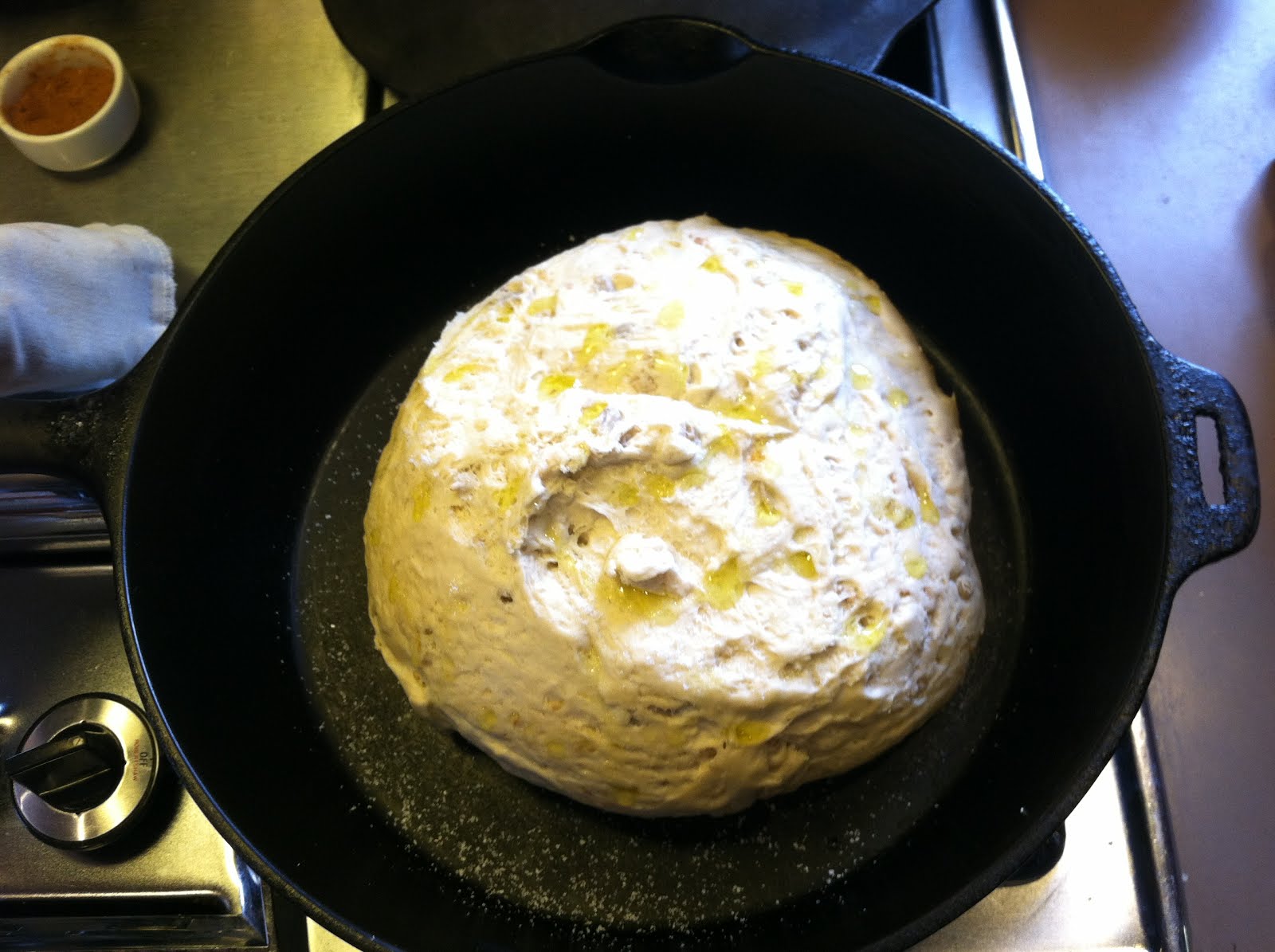
19 hours later i'm going to bake it
In the roaring hot pan, dotted with 
olive oil, sprinkled with coarse salt,
put the hot cover on and back into
the oven
half done, take it from the pan with tongs and put it back into the oven top down to finish baking


As for ingredients, so far I’ve been using King Arthur’s white but will begin to experiment with Vermont grown grains such as Gleason’s, available at the Co-op. I’ve begun to add seeds – nigella, cumin, hemp hearts, sunflower and sesame seeds, usually a combination of 2 or 3, and not too many, considering all the time the strength of their comparative flavors – and shortly I’ll begin to add in handfuls of different grains – buckwheat and rye, semolina and/or whole wheat. I haven’t added in nuts yet, nor dried fruits, but I can’t wait to experiment with them.
I use a stand mixer to make the dough, but it certainly could be done by hand. I would not use a food processor because the dough needs the action to be stretching and kneading, not cutting. I use a deep cast iron frying pan with a cover to bake the loaf in.
Here’s a basic recipe:
Sharon’s Loaf
  • 1 ½ pound flour (about 4 ½ to 5 cups)
  • 1 rounded teaspoon sea salt – don’t skimp
  • 1/8 teaspoon yeast – skimping allowed
  • scant 2 cups distilled or filtered water
Optional:
  • 3 or 4 tablespoons sunflower seeds plus 1 tablespoon sesame seeds
    or1 heaping teaspoon nigella seeds plus 2 teaspoons of cumin seed and 1 tablespoon sesame seeds.  
In the bowl of a mixer, if you have one, measure the flour, salt, yeast and optional ingredients. Whisk them up and, using a dough hook, add enough of the water to make a moist ball of dough, firm, not runny. If you add too much water just work it a little longer and it will probably come together. If that doesn’t work then add a bit more flour.
Mix it well, then set the bowl aside in a cool place. Dampen a clean dish cloth and cover most of the bowl. Leave it undisturbed for 17 to 24 hours. It will rise to at least double and perhaps even triple its beginning bulk.
When ready to bake the bread, heat a heavy covered casserole in the oven to 450°. Take the pan from the oven and scrape the dough into it– do not add anything to the dough at this point, just scrape. Don’t arrange it or tamp it down. You may drizzle it  with a little olive oil and sprinkle with flakey sea salt, put the cover back on, put the pan in the oven and bake for 25 minutes. Take the pan from the oven, the loaf from the pan (it will have almost filled the circumference of the pan, be nicely domed and the crust nicely lapped and cracked and golden brown) and put it back into the oven upside down. Turn the oven to 400° and let the bread bake for another 23 minutes. It will get dark but watch that it doesn’t burn.
Place the loaf on a rack and let it cool, if you can wait. I’m not quite sure what the difference is because the longest time i’ve waited to cut into it is maybe ten minutes.
This produces a very distinct crust that will soften when stored in a bag. The grain will be close with a nice distribution of small air bubbles. It will be moist, not dry. And the flavor will be mellow and grown-up, nicely dressed, nothing raw or fluffy about it. It keeps well.
Imagine a person living in 1375, for instance, who gathers herbs and seeds and nuts and grains and pounds and moistens and mixes and leaves to rise with microbes from his or her own environment and then bakes in embers. That’s a lot of work.
I can imagine that’s what I’m doing except that in my loaf the ingredients are much easier to obtain and I’m leaving the work to fermentation. It would be most interesting to compare loaves made in exactly this way from different environments. I imagine the taste would vary rather stunningly from your kitchen to mine, but I dare say it would all be manna from the gods.
Remember to share.

Thursday, May 31, 2012

from wood to bread: Tradition Fires the Oven at Bear Mountain


(This article was first printed in the Rutland Herald April 23, 1992. Photos by permission of AJ Marro)

“I like piddling with wood – dry wood!” Ray Powers says as he looks up from his task of shoving 3-foot-long split slabs of damp-to-wet softwood into the firebox of his brick oven on Wallingford’s Bear Mountain.

In spite of the soaking a sleet storm gave the wood the night before, Powers’ customary serenity bears only an edge of impatience and belies the diabolical aspect of the scene: flames roaring and rumbling like a volcano, stretching through the fire-hole into the oven and licking heat into its arched roof preparatory to tomorrow’s bread baking. The fire heats not only the oven, but the 15 tons of sand surrounding it, which absorb and store the heat. The interior hearth is a hefty 4x5x2.5 feet at the arch’s peak. It can handle up to 40 of the round, rustic loaves – hefty in themselves – which are baked evenly by heat radiating from the arch and by Powers’ intricate system of rotation.

A massive 9-foot cube of brick, lined by a thin layer of vermiculite, encloses the whole thing. It is a replica of a 17th century French bread oven, built in 1983 by Jim Scialo of Harmony, Maine. Powers and his wife, Christine, hired Scialo to build their oven on the recommendation of Jules and Helen Rabin of Plainfield. Scialo had built their own dome-shaped oven.

An article about the Rabins in Country Life Magazine came at a propitious moment for the Powers, who were then living in Connecticut with their two small children, Kate and John. A company cutback put Ray out of his customer relations work with General Electric Co., and suddenly old dreams surfaced, of moving to Vermont, of cooking something, of using wood.

Why wood, for heavens’ sakes? Why this long, drawn-out, demanding process of firing up the big oven with wood when gas would do just as well for the finished bread, with far less physical effort? Well, besides the pleasure of working with wood, it’s cheap. Sweet, clean “junk” softwood slabs, the rounded sides sliced off logs preparatory to cutting them into planks, are used for little else but provide good heat for the oven, burning with so much heat that there is little residue, almost no pollution, says Chris.
Besides, Ray says, “Jules uses wood.”

When Rabin was asked how he and his wife chose to use wood, the answer turned out to be simple yet intricate. “We found ourselves saddled with a wood-fired oven,” Rabin recalled in a telephone conversation. Once again, good bread had been the result of an economic cutback – this time from Goddard College where Rabin was an anthropologist. During the first OPEC oil crisis in the early ‘70s, a group of Goddard people built a community oven. It proved underused, and so the Rabins began baking bread in it.

“We feel it a pity to use exotic fuels when Vermont is so rich in wood,” Rabin said. “We burn wood in the same spirit that we recycle glass and cardboard.”

And then there is the picturesque history of baking bread with wood. In France, where it’s an art form, bakers are worried that government environmental agencies will be closing down their wood-burning ovens. But some say that in the rustic unevenness of the crust you can see the flames. And they say, incredulously, that ignorant people think that bread can be made in a machine.
***

It is Sunday afternoon. Ray will feed the firebox every 15 or 20 minutes for about six hours, until a sensor deep in the sand registers 500° and one in the oven, itself, a whopping 1,000°. Each year, he burns 25 cords of wood in this manner. Around 10pm he’ll close the dampers to the two flues that lead out the back of the oven, fit a cast iron slab over the fire hole, lever the heavy outside door down with the counterbalance, sealing the heat into the oven, and retire.

During the last few hours of firing, he’ll be joined by Chris, who will come down the few steps from the kitchen into the scrubbed, quarry-tiled bakery to begin mixing the 330 loaves of Bear Mountain Bread for tomorrow’s baking. The bakery is toasty and sweet smelling as she stone-grinds the organic whole wheat and rye flour, tips a lump of natural leaven sourdough starter into the old 80-quart Hobart mixer, and adds salt and unbleached white flour. No milk, no butter of course, and no commercial yeast.

The use of a sourdough starter, or “mother,” in place of commercial yeast is another aspect of the wood-burning baking that appeals to the Powers. It’s the way it was always done – regular yeast was not available commercially until the late 1800s. It’s a personal thing – the starter is alive, and while retaining a whiff of its origins (in this case the Rabins’ Upland Breads Bakery), it will gradually form a distinct personality where it lives. Eating bread made with it is like eating a slice of life.


The big, ponderous Hobart makes quick work of the dough as Chris flicks finishing touches of flour from a scoop, watching the dough with a critical eye as it puffs and becomes elastic. "I still like that moment the dough takes on its own identity,” she says. At that point, both of them lean over the stainless bowl and drag and roll and coax the live, swelling dough up over the lip of the bowl. Batches drop into white 50-gallon pails like bodies being dumped into a well. SCHLUMMMMPHHH! The dough smells fresh, tastes lemony. Chris saves a lump of it for Wednesday’s starter and begins to mix the whole wheat dough. It will rest and rise throughout the short night.

On Monday they rise around 4 a.m. and after swabbing traces of last night’s inferno from the oven, Chris forms and Ray bakes the loaves. “That’s when,” says Chris, “we have THE discussion: If the room/dough/oven is warm enough in winter or cool enough in summer.”

After driving up twisty Route 140 out of Wallingford, and almost straight up the steep, rutted, dead-end road the bakery inhabits, a visitor is rewarded with small pita rounds that Chris rolls out of hanks of dough and Ray Bakes, slathered with apple butter.

“Our friends from out of state think it’s so romantic that we just chucked everything and came up here to make bread,” Chris says. “But you know, sometimes it is wonderful early in the morning when the kids are still asleep. It’s romantic in a way when we’re working quietly together watching the sun come up and the birds wake.” She shakes off the thought and begins to pleat long white French loaves into a length of heavily floured canvas for the last rise. Next she forms the round loaves of country white French, raisin, whole wheat and rye, in bannetons. This spring, along with a new logo and label, designed by artist friend Clare Bornarth, which features a woodcut of a real bear, they will introduce a honey oatmeal loaf.

Chris might deny it, and Bear Mountain Road’s mud-season might make them forget it, but the couple’s story is a classically romantic one, for in the beginning they each “took to the cloth.”
Ray entered the Order of the Jesuits and taught at a Jesuit boys’ school in Baghdad through the 1950s before he became headmaster.

During the 1960s, Chris entered a missionary order of nuns. Although she knew Ray as a friend of the family, the later reality of marriage to him, a life in the country, children, and the oven itself would have required an incredible leap of faith. But leaps of faith have become familiar to them – first when Chris left the convent and went back to school to get her degree at Fairfield University, where Ray, back from Baghdad, was dean of graduate admissions. There, their acquaintance deepened into friendship and beyond.
Ray rejoined the secular world he had left so long ago and they were married in 1977.

Ray now supposes that if he had not met Chris he would still be a Jesuit. Given that history, how long could they continue to lead the middle-class life in Connecticut? The leap to Vermont, to the oven, seems much more in character. The decision, by these innately religious people, to make bread, was both pragmatic and romantic, practical and transcendent, and humorous, to boot. The former priest who would have placed wafers of bread representing the body of Christ on penitents’ tongues now kneels in the very infernal heart of the bread-making process, and the woman who married him puts the sourdough to start new life in good, earthen flour, then kneads and forms and nurtures the loaves smooth as babies’ bottoms. Why bread? Why bread, indeed.

When Ray begins baking, the oven will have lost 50° since last night, down to a comfortable 450° for the long French, and down to 300° for the last whole wheat loaves in early afternoon – a remarkably small loss when one considers the number of cool loaves constantly peeled into the oven, the number of times the small door is opened. But there IS that 15 tons of hot sand.

When the baking is done – about 1 p.m. – there’s still paperwork, meeting the UPS deadline in the evening, and Ray’s 120 mile delivery run the next day. They ship to many out-of-staters, including ones allergic to commercial yeast.

Ray will start firing again on Wednesday, and again, in summer, on Friday, to sell bread at the local farmers’ market on Saturday. He is the coordinator of the Rutland County Farmers’ Market. Chris is busy driving children to extracurricular activities and music lessons, and is one of the founders of the new Lakes Region Children’s Orchestra.

After some very lean years, the business has achieved a level of success. “We’re together and we’re doing what we want to do, as much of the time or as little as we like,” says Ray. “AND, we call our own shots.”

There must be a worm in the apple somewhere?

“Only one,” Ray allows. “Wet Wood!”

Sunday, February 15, 2009

Unctuous Crunch

Photobucket


Hard to tell, but yes, this is what remains of a bacon sandwich. And, for once, this one came out just as I desired and anticipated. I had in mind a "pressed" sandwich where the bread and bacon meld together as one; with a rime of the sweet acidy tang of mayonnaise without the actual stuff.

To that end:

I roasted bacon from On the Edge Farm in a hot oven until rendered and crisp. This is a substantial bacon, not too harshly smoked, rather delicate, in fact. Really quite delicious.

I cut, very thinly, two slices of Bear Mountain Honey Oatmeal bread, then buttered them.
Buttered the bread on a bacon sandwich? Yes, Indeedy, My Dears! For taste as well as texture. Be patient and all will come clear.

...buttered the bread, then curled and crunched about 4 substantial rashers of bacon onto the bottom slice of well-buttered (fresh baked yesterday) bread, sprinkled the bacon with a balsamic vinegar which is aged up the hill in Shrewsbury, placed the top, buttered, slice of bread on the sandwich, then, with the heel of my hand, pressed, until all was amalgamated. I cut it in half diagonally and began to nibble.
For once, I had achieved perfection.

All ingredients found at the Rutland Co-op and/or the Winter Farmers' Market (Saturdays, 10-2) OR, On the Edge Farm in Woodstock (802-457-4511); Bear Mountain Bakery in Wallingford (802-259-2321); Gordon's Pond Balsamic Vinegar in Shrewsbury (802-492-8282)