Tuesday, May 26, 2015

showers of flowers


Well, not flowers, exactly, but the leaves of flowers, because if you let them go long enough they will make flowers, as most beings in the wild will do, on their own, or in couples at least. But wait, I’m really talking about herbs – grasses and plants that are still in their baby stages just now, beginning their push toward flowering and procreation.
But really?  I’m talking about flavor, and the insanely simple but intense pleasure of walking out into the garden in the late afternoon to gather an assortment of whatever is coming up right now to shower over your supper. In this yard that would be spiky chives (some with fat purple buds already) and flat-leaved garlic chives, the rough leaves of lemon balm, purple budlets of mint, spears of Egyptian (Walking) onion thickened in the middle with their incipient babies, that when cut into unfurl into new onion shoots (how amazing).
And then you need to put your little collection down somewhere and get your garden knife in order to dig out a spear of green (immature) garlic, and gather everything up again and go on to pluck a sprig of lovage, pinch off some tarragon, then don’t forget some soft oregano leaves. Oops, back to the other side of the garden where you forgot the sour sorrel (pick off those seed-heads while you’re there), the cilantro just coming up, a feathery dill... (We would not be having those babies so early, nor be forming those seed-heads if not for that week of heavenly hot weather we had a few back.)
Whoa, that is quite the little salad you have there and you haven’t even got to the lettuce. Or the spinach. Or the baby chard or kale; nor need you get to these larger, more traditional leaves – keep just the explosively flavorful ones, put them into cold water to crisp and stay fresh for supper in half an hour or so, and then just separate them into separate leaves.
I have been saying for a while now that I’m really tired of cooking. Shhhh, I would say – don’t tell my readers. But it was true. Everything was old – I think I even mentioned here how tired I was of root vegetables and hunks of meat.
But now it’s spring nigh unto summer and we don’t have to like cooking, we could subsist on each successive seasonal food with no or just the tiniest bit of preparation AND a shower of garden herbs. The little bunch of broccoli raab I bought  from... who... at the Farmers’ Market on Saturday? I simply steamed it and then tossed it in a bit of good olive oil I’d heated with half a stalk of my green garlic and some hot pepper flakes. We ate that with a small slab of Alaskan salmon I’d gotten from the Co-op and grilled and showered with the herbs. Oh, and there were small grilled/baked potatoes from Heleba’s, too.
Lunch had been a slice of grained and seeded sourdough from the French baker next to Radical Roots at the Farmers’ Market, slathered with the pricey butter from the new Jersey Girls vendor, made at their farm in Chester, and some of their Quark, a simple farm cheese, drizzled with local raw honey from my friend, Julie, and coarsely ground pepper.  That last from Penzeys. Even that benefitted from the shower of power herbs and provided a phenomenal gustatory satisfaction.
That bread. That butter. Those tiny green things. So simple, so good!
Now I’m contemplating doing justice to the bunch of sturdy, red-veined beet greens with the tiny beets still attached. Steaming, of course. Quark does seem to enter here as well, and coarse pepper, too. Oh my yum. But I can’t forget the first sugar snap peas I got from Radical Roots, either. Perhaps they will be eaten raw along with another slice of that bread and butter. And a strew of herbs.
See? Not really cooking, just fiddling, working with the cleanest and most local of foods using the simplest of techniques.
This is the perfect time of year.
Oh, a recipe? Only if you insist – a suggestion recipe

Hot Rice to Awaken the Flavors
in Chicken Salad

Make some rice. For plain white rice bring 2 cups of water to the boil, salt it – 1 teaspoon, stir in 1 cup of rice, turn the heat to low, cover, barely simmer for 20 minutes without lifting the lid. At the end of the 20 minutes either serve, or take off the cover, cover the pan with a towel, put the cover back on. That will absorb the extra moisture and keep the rice hot.
For the chicken salad: To 2 cups of diced chicken, add half a dozen coarsely chopped black Moroccan oil-cured olives. Then add the following in small dice: 1 tablespoon preserved lemon (you may use fresh lemon zest and a bit of juice), 3 French Breakfast radishes (or any radish), a couple of cornichon, and, say, 3 tablespoons onion. Add chopped tarragon and lovage, with maybe some dill; then mix it all up with, say, ½ cup olive oil and 2 or 3 tablespoons of balsamic vinegar. After the flavors have time to mingle, serve it over the hot rice.
But wait! That’s not all: Over all, sprinkle chopped cilantro and lemon balm and rings of Egyptian onion. The heat of the rice wakes up the many tastes in this little dinner so that every bite is a study in contrasts and comfort. Drizzle with a little more olive oil over the top; course grinds of salt and pepper, too.

You will, of course, not go out and buy herbs but use the ones that grow in your own garden. Perhaps you’ll even have some basil starts. I haven’t mentioned basil because I don’t have any yet.

Grow some herbs and make some green showers of your own. Lovage, cilantro, arugula, dill, tarragon, lemon balm, sorrel, basil, parsley, mint, thyme... the list never ends. Mix and match. And when the flowers come on? Eat them, too. And then plant some more. It’s all good! 

Tuesday, May 12, 2015

primavera


Oh, the exquisite, primal beginnings of this perfect time when suddenly the garden takes pattern, given form by clumps of daff and tulips, and the hostas strengthen into shape and the royalty crab takes on a burgundy shade scattering tiny cups of flowers; and the whistle and shriek and chirp and squeegee of birds, and the chilly edge to the morning warmth, and the faint perfume of fecundity on your breath. All birth and beginnings.
And that holy trinity of morels, ramps, and fiddleheads, about which I’ve written so often over the years that I no longer worry that I crib from myself – my old readers will read as if anew and my young ones won’t have read the original.
This reminds me of the first time I succeeded in finding fiddleheads. My daughter Zoe was tiny, about two years old, and I had strung a blanket over the piano bench for her to play tent in while I snatched five minutes here and there to read a book. She may have had a friend over for a while with whom to play house. It was drizzling and dreary, and finally, going stir-crazy, we put on our boots and slickers and went out into the woods anyway.
(Many years later, approximately 25, she wrote a song with these lyrics,
“Hike up your bootstraps, Little Dove
cause we’re going on a walk today.
Buckle up your yellow slicker,
cause we’re gonna walk a long, long way.” 
I like to think that the baby memory stuck and transformed itself into something she could mindfully remember.)
Once outside we found that the rain was soft and the watery light filtered the landscape into gentle secrecy, making it gorgeous for us.
I had only read about fiddleheads before that and had the amateur’s healthy fear of poisoning ourselves by eating the wrong... fern for gawd’s sake. Still, in desperation, I munched and tasted, until I realized that the copper-sheathed curlicues barely unfurling from the mother corm were obviously the edible ones. And we picked...
Picking fiddleheads is mesmerizing, prying the coppery curls up and snapping them off until your bag is full and it is time to go. Oh, just one more, and one more...
There were years in between when the slightest intimation of foraging anything was enough to elicit the cry “Motherrrrrrrrrrrrrr!” but inevitably came the day when she showed up late to my house because she’d stopped to pick some fiddleheads on the way. All by her ownself. And last week she and her person, Jesse, himself a fisher and avid forager, showed up with fiddleheads AND ramps, and Jesse made a fiddlehead salad for Sundays at 5 at the beach, and this is how he did it. I think.
Fiddlehead Salad
Make a vinaigrette by shaking together in a small jar 2 smashed and peeled cloves of garlic, the juice and zest of 1 lime, and 1/3 to ½ cup of extra virgin olive oil. Add ½ teaspoon of sea salt. Maybe some pepper. Put the lid on and shake it up.
Wash about a quart of fiddleheads repeatedly under a hose sprayer outside in the sunshine until the copper husks have completely disappeared (they will clog up a sink quicker’n scat). Bring a pot of water to the boil, salt it adequately with a fistful of salt and when it is boiling dump in the fiddleheads and bring them back to the boil and cook them for only a minute or two. Strain them and plunge into cold water, and then drain.
Slice 3 ramps, both bulb and green leaves, and warm in some olive oil over low heat for a few minutes until slightly softened. Add to the fiddleheads in a big bowl. Toss with enough of the vinaigrette – to taste – and eat’em up. (I think he squeezed half a lemon over this finished salad.)
Jesse says, “I like simple food, simple preparations, where you can taste the real food itself.”
You could, no doubt, boil up some pasta, particularly orecchiette, the little ears, and toss them in with the fiddles, and that would, no doubt, be even better.
***
Or, you could make one of the more delicious foods you will ever eat, a
Fiddlehead and Ramp Quiche
Make a single 9 inch crust – I gave a recipe in the 4/14 column – and line a pie plate with it.
The formula for any kind of custard is 1 egg +1 yolk + 1 cup whole milk or mixture of milk and half and half. I used unpasteurized whole milk, and it was very creamy. I also added an extra yolk to help with that extra 1/2 cup of milk. The finished quiche had that wonderful custard that separates into soft rectangles of goodness. That has a lot to do with the egg/milk quality plus the regulation of temperature.
Bring the oven to 450°
Filling:
  • 1 dozen ramps OR 1 large shallot or 1 dozen scallions + 2 cloves of garlic
  • butter and olive oil
  • 2 ½ cups cleaned fiddleheads
  • 1 cup grated cheddar cheese (or more)
  • ¾ cup sliced spicy sausage, or crumbled bulk, cooked rare
  • 1 large egg + 2 yolks
  • 1 ½ cups creamy milk
  • ½ teaspoon sea salt
  • grating of nutmeg

Bring a large pot of salted water to a boil.
In a sauté pan, over low heat, sauté the ramps or scallions and garlic in butter and olive oil until limp and slightly golden. Add a little water or white wine if they’re browning too fast and aren’t getting soft fast enough. Remove from heat and let cool a bit.
When the pot of water is boiling dump in the fiddleheads, partially cover, bring back to the boil and boil for 3 minutes. Drain in a colander and spray with cold water. Shake the colander to get any excess water off, then let drain over the sink until ready to use.
Whisk the eggs together so they are well combined but not frothy, then whisk in the milk, salt, and nutmeg.
Scatter the cheese over the bottom of the pie crust, spread the ramps or onion mixture evenly over the cheese, scatter the sausage and then the fiddleheads over that, then pour over the milk/egg mixture.
Bake at 450° for 10 minutes; then turn the oven down to 325° and bake for another 20 minutes to half an hour. A silver knife will slide in and out cleanly when done.
***

Primavera. What does it really mean? Well, just spring in some romance languages. But it has shades of primate and primacy and certainly primitive. Primitive and romantic, as in a blanket in a meadow, as in crouching along tearing sweets from the wild soil. 

Friday, May 01, 2015

...detour...

Patience, readers, long overdue realization that i need to do some work on this blog so... i'm in the process. Under construction... Thanks...

Tuesday, April 28, 2015

may you eat interesting food


Maybe it’s only the time of year and the fact that this ridiculous winter simply will not give up and spring on out of here that I’m having a hard time coming up with my usual at least adequate enthusiasm for cooking supper each night. My appetite is gone for root vegetables, for instance, and a chunk of meat just seems extravagant. Gone, too, I think, are the days when we could and would settle into a big pork chop and mashed potatoes with veg. I’m simply not interested.
But one of the best places I’ve found for interesting food is the Rutland (year-around) Farmers’ Market (it’ll be moving outside to Depot Park on Mother’s Day weekend), from Peter McGann’s excellent Mexican to Young-La’s smartly named Flavors of Asia: Vermont Seoul Food, and everything in-between.
One delicious food I’ve been noodling about all winter is  Storytime Foods’ muhammara, a walnut, red pepper, and pomegranate molasses dip that is as spicy and full of flavor as you might deduce from the ingredient list. It is delectable, no getting around it. You can find a recipe on-line, but that involves several different steps, such as toasting walnuts and roasting and skinning red peppers, and even then you have no guarantee that you’ll get the same end result. They even make their own pomegranate molasses! I have an ancient bottle of that in my fridge, so perhaps next pepper season I’ll make a batch, but for now my Muhammara will come from Storytime Foods.
Get Cracking Kitchen is another intriguing purveyor. After I spotted several packets of its Chickpea Almond Crackers in a friend’s shopping bag and she told me she’d bought them out because they were so good, and gluten free, and vegan, and acceptable for diabetics, I made sure to buy a packet of them the next week, and Man, they are good! Intriguing. Just on the off chance I googled them on the web. And there they were, called Besan crackers on a lovely website, the Mindful Foodie. They’re very straight forward, containing flaxseeds and cumin as well as the two main ingredients. (The chickpea is also known as gram, garbanzo, and cece as well as besan.) However, I was certain that Grace Davy, who is the baker and cook behind Get Cracking, adds her own touches. Over the last couple of years I’ve bought several items from her, including a totally outrageously rich chocolate beet brownie that you can only eat in tiny slices. She uses 3 kinds of chocolate, she whispered to me.
So I emailed her, wondering what her aim is – besides deliciousness – in the products she creates. “You use such iconoclastic ingredients and I suspect your techniques are dissident. Are you just curious?”
Well, she got an awfully big kick out of that. And then she said, “My objective in all this is to keep my creative juices flowing and spread the creativity to my customers. I like whole grain flavors in my desserts, I like homegrown ingredients and I like details and ideas.”
And then I really like her take on competition with the other established foodsters at the Market, namely that she prefers “innovation to competition.” Continuing, “Everything at the market is good, and I came in after so much deliciousness had (already) been established, so why offer ... close choices?... I work really hard to offer things no one else does.”
I, for one, appreciate that hard work, and until I get a little more creative myself I’ll continue to let Grace put the cece in my crackers and the beets in my brownies.
***
Last couple of weeks there’s been fresh ricotta at the Farmers’ Market, and this last week I grabbed a package. Unfortunately, I can’t remember who I bought it from and there’s no label. Fresh ricotta, though! What a treat. And since I also bought two bags of fresh spinach from Radical Roots, my mind wandered to a treat I learned to make from Dancing Ewe Farm when they came to that first year of the winter farmers’ market back of the co-op several years ago. That treat being, it came to me slowly, Gnudi Spinach and Ricotta Ravioli!  Meaning, in answer to Leo’s query, Nude ravioli – the filling without the pasta purse. “Oh,” he said, “how disappointing.” Well, no, not really. Really quite grand, he would find out.
So, the recipe had disappeared from Dancing Ewe’s website but I cobbled one together in spite of the fact that the search for “gnudi ravioli” all came up in Italian so I was forced to go with gnocchi. Nevertheless, I’m here to tell you, a plate of these swimming in basil butter is not a bad thing.

Gnudi Spinach and Ricotta Ravioli

(adapted from Epicurious) Serves 2 as a main course

  • 12 ounces (2 bags from Radical Roots) fresh spinach leaves
  • 8 ounces, 1 cup, fresh ricotta cheese
  • ¼ cup freshly grated parmesan cheese (plus more to be slivered over)
  • ¼ cup all-purpose flour (plus more to roll out)
  • 1 large egg yolk
  • ½ teaspoon salt (plus more for cooking water)
  • Fresh ground black pepper
  • Fresh ground nutmeg
  • ½ to 1 stick of good butter, melted, not browned
  • 2 small bunches of baby basil (Radical Roots has these) or sage leaves

Cook the spinach in a large pot of boiling well-salted water just until wilted, stirring occasionally, about 4 minutes. Scoop the spinach out of the water, squeeze out the liquid when it’s cooled enough to handle, and chop finely. Reserve the cooking water.
Mix the spinach, ricotta, parmesan, flour, egg yolk, salt, pepper, and nutmeg in a bowl until a sticky dough forms and everything is well combined.
Dust a flat surface with flour, and working with about ¼ cup of the mixture at a time, pat it into a well-floured, fat roll, then pinch off perhaps two teaspoons at a time and roll them between your palms to form into lozenge shapes. Handle these as little as possible while assuring that they are well put together. Line them up on a cool surface.
Add enough water to the spinach water to fill the pan ¾ full and bring it to a boil.
In a sauté pan melt the butter over very low heat – even using a diffusing pad over the burner if needed, the butter should not color – and add the whole sprigs of basil or sage to add their flavor to it.
When the water is boiling, work in batches to add the nude ravioli to it. Cook until the ravioli rises to the surface then cook 4 to 6 minutes longer. Using a slotted spoon, remove the ravioli from the water, letting all the water drain off, and put them into the warm butter.
When all the raviolis are boiled and warming in the butter, place on serving plates, grind pepper over them, sliver parmesan over that, place a couple leaves of basil or sage on the top – another grating of nutmeg? – and eat up.
So that’s this week’s installment of interesting food. Catch you in a coupla!


Tuesday, April 14, 2015

nubbins and nobs in the color of green


What is happening now is that the tiniest little green things are appearing among the apparently war-struck detritus of the winter yard – the spear shaped leaves of sorrel, for instance. They’ll be ready to add their sour green notes to an omelet by next week. Last weekend I discovered the tubers of Jerusalem artichokes clinging to the ends of the woody sunchoke stems. I washed one off and cut a slice and it was sweet and crisp with that distinctly smoky taste, wonderful added to stews, made into a soup, sautéed in coconut oil until crisp on the outside and creamy in, or eaten raw with a cheesy dip of some sort. I’ll bet I’d find shoots of tarragon if I scratched around enough, and there was lots of fresh, crinkled spinach at the Farmers’ Market Saturday.
Suddenly. In spite of everything. It is (early, early) Spring.
Green and magenta knobs of rhubarb are showing through last year’s rotting leaves. It won’t be long until we can make the first rhubarb pie.
If you grew up with rhubarb you probably think of it as a treat: from the first time you toddled alone out to the patch of towering broad leaves, with their hint of strength and poison, grabbed a thick red stalk and leaned your slight weight back against it and then towed it back into the kitchen. There, a big person trimmed off the leaf for you and handed you a little dish of sugar, and you plunged the raw end of the stalk into it and took your first hardy crunch and felt the sourness and sweetness contract the corners of your eyes. You were hooked. When you got older, then, that first rhubarb pie made your eyes widen: it was Spring. You were about to taste an omen, a token, an icon, a memory, your imagination.
It’s an ancient plant – traced to 2700 BC in China, and to 1790 for the American roots – and it was used, like most bitter spring plants, as a tonic, to get the digestive system going. It’s an old-fashioned plant – you seldom see a dooryard of an old house – extant or vanished – without a lilac and a flourishing specimen of the pie plant, as it was called. How many first-haying suppers, tables crowded with dead-tired and famished haying crew, did a rhubarb pie or two, or three, not grace?
And yet I think of the rhubarb pie as the passion of a sophisticated palate that won’t be satisfied with quick and easy fixes, that appreciates the difficult art of a food that so many people relied on before things got all-sweet-all-the-time. Like the tastes of asparagus, dandelion greens, fiddleheads and ramps, not to speak of morels, we anticipate that of rhubarb with a kind of greed that comes for foods that are strangers to a world increasingly prone to a canned blurring of the seasons. They speak, gently but pungently, of spring.

The Rhubarb Custard Pie
...the crust...
My grandmother’s crust was pale, never golden, even white. She used lard, and sometimes a bit of butter. It was slightly salty, never sweet, so that it was a flaky foil to any filling. Flaky? When your teeth bit into it they slid off each other, then through with a click, as though biting into a scrumptious, slightly salty, richly greasy, layered shaley stone. It was the queen of pie crusts, the one everyone else aspired to. After Grandma died, Aunt made the pies, for her crusts were closest, even though she would grunt, "Humph, not as good as Ma's, but..."
It took me years to learn to make a good crust, and that was only after I realized I had taken too seriously admonishments not to handle it too much and so it all fell apart when I tried to roll it out. I knew this, but could do nothing about it. Every time I tried to squeeze that dough together the bones in my fingers locked up.
This is the way I make it now: Preheat the oven to 450°. Into the bowl of a food processor put 2 cups of unbleached flour (9 oz); 1 teaspoon salt; 1/3 cup cold butter cut into small chunks (3 oz); 1/3 cup of lard (3 oz). Pulse until the mixture is the size of coarse meal. Into 1/3 cup of water put two ice cubes, and, holding the ice back with your fingers, add it slowly to the flour mixture as you pulse the machine just until it comes into a smooth ball. I seldom use all the water, so go slowly and carefully. It shouldn’t be wet, but neither should it be too dry.
(To do this by hand, whisk together the flour and salt. Cut in the butter and lard until the texture is correct, sprinkle with the water, toss with a fork until the dough comes together in a ball.)
Flour a working surface, scrape the dough onto it, knead it a bit, pat into a smooth ball and divide it in half. Take the slightly larger half and roll it out and fit it into your pie pan, making sure you have a generous overlap, at least an inch. Set aside and roll out the top crust and leave it while you make the filling.
Rhubarb Filling
(Adapted from James Beard’s American Cookery)
Whisk 2 large eggs until foamy. Whisk in 1 ½ cups granulated sugar, 2 tablespoons flour, grated rind of ½ lemon or lime, and ¼ teaspoon salt (I do this all in the processor). Pour 4 (generous) cups rhubarb that has been cleaned, trimmed, and cut into 1/3 inch slices (it should be dry) into the bottom crust. Think about whether you would like to add a few leaves of basil or sprigs of tarragon to the filling now. It’s quite intriguing. Pour the egg mixture over the rhubarb, dot with about 2 tablespoons butter (don’t forget this step, as I often do) and gently position the top crust over the rhubarb. Turn the overlap of the crusts under to seal, and then crimp the edges. They’ll be nice and thick and crispy when you’re done. Vent the top crust with the shears and sprinkle with turbinado sugar if you have it.
Don’t skimp on the sugar in a pie. I use practically no sugar on an everyday basis, but pies are the kind of special occasion on which, even when sugar was valuable and hard to get, it would be used abundantly.
Bake the pie at 450° for fifteen minutes, then lower the heat to 325° and bake for twenty or thirty minutes, or until the top crust is browned, the fruit is fork tender, and the filling is bubbling.

By baking for ten or fifteen minutes at a high heat, the bottom crust has less time to get soggy and the rhubarb gets a jump-start on becoming tender before the filling has time to boil and curdle the eggs. The long low-heat baking then thickens the custard while further tenderizing the rhubarb and crisping the crust.

Wednesday, April 01, 2015

tapping into spring


Photo by Donna Wilkins Photography
Trickster returned from a long and grueling journey to find the habitation of his village gone to hell and falling down and seemingly deserted until he spied all the villagers lying hither and yon under Maple, drinking her full-fledged syrup that leaked down into their open mouths.
Incensed and full of sorrow, Trickster grabbed up the river and flowed it into Maple, diluting her sugar into sap. “There,” he told his villagers, not without a characteristic edge of evil glee, “is work to be done! From this day hence you will be called out of winter sleep by vibrant cruel sunshine in what some call this grimmest of seasons, to tap Maple, steal her sap, haul thousands of gallons of it to the fire and bring it to boil with red hottened rocks and keep it there until it is reduced to powder, the better to fit into small vessels.
“The alchemy between this season, in which it is impossible to do anything else worthwhile, and Maple, and your sweat in this first, wild, foraging time, will feed you in Aprils before any green things creep out of the muck.
“Go to it, My People!”

As so often happens, a good punishment turned out to be a blessing. Look at it this way – if you’d been hibernating in a primitive abode made of stone or animal pelts as in a cave or a tent, a yurt of some sort (or within bricks or wood-frame or logs, for that matter), and it came to be this time of year and your dried berries were giving out and the grains had become somewhat beetley, and your normal quiet cheer had receded to reveal the roots of desperation, then you would be glad, nay you would be ecstatic, when the days reached above freezing and the nights reached below, to go out into the mush by day that turned to frozen ruts by night, to slash the maples and to gather the sap in buckets or waiting troughs and to boil it down into sugar. You would be glad, you can bet, if need be, to exist on nothing else but that sweet in Aprils that were slow to show green shoots pushing up anew.
It begins, this sugaring season, with fits and starts, some false, finally true. Some days begin at -5° and are +45° by 11 am. The sun blasts through a skyblue sky and freshets run everywhere, over sun-slickered ice, muddying ruts, through the trough of ditches and from here we will hear the beginning roar of Otter Creek as the weight of it filling with melt pushes its freightedness faster and higher. All Saturday morning trucks chuckle by splashed windshield-high with a surf of mud, and through the cracks of it shine bright eyes and devilish grins. Red goosedown vests are open over black turtlenecks as the rounds of morning are made to the transfer station, the locker, to Evie’s Deli, and to the Post Office. Then, after noon, everything is nulled and silent. The chores are done and everyone is back home again, trying to find work outside.
Sugarers are lucky that way. They take their little hand-auger, their taps, their pails they’ve scrubbed, climb out along the sugarbush and make ready for the drip of the sap. Not only is sugaring something to do when that randy energy rips you from the fireside, from out the rocking chair; not only is it something to do when the earth is still inhospitable to most other activities, but it is something to do with food, so that viscerally it is perceived to be at least vestigially worthwhile.
***
Anna Fenton’s Maple Pudding Cake
Anna Fenton was a long-time maple sugar crafter and 4-H leader, and a wonderful cook besides. This is such a sweet confection that I always think it needs a baked apple or a cool fruit sauce to finish it, but on second thought we keep shaking our heads. No, that would not do. The only thing that tops it suitably is yet another spoonful of cream – unsweetened whipped cream or, better yet, one of crème fraîche. Serve it once a year and enjoy its richness. The syrup stays on the bottom, almost frying the delicate batter, then gradually seeps up into the cake. It is a simple batter in the European style of biscuit. A butterier, shorter, American biscuit dough is more traditional in community cookbooks. This serves 8 once, 4 twice, or 1 or 2 piggies
o    1 cup maple syrup
o    1 ½ cups flour
o    1 ½ teaspoons baking powder
o    ½ teaspoon salt
o    2 tablespoons melted butter, cooled
o    ¾ cup sugar
o    1 egg
o    1 cup milk
o    1 cup heavy whipping cream

Preheat the oven to 350°. Liberally butter a glass soufflé pan 8 inches in diameter, 4 inches deep (don’t scrimp on size or you will have a mess), and pour the maple syrup into it. Set aside.
Whisk together the flour, baking powder, and salt and set aside.
With a wooden spoon or large whisk, beat together the butter, sugar, and egg. Quickly whisk in half the milk, then the dry ingredients just until smooth, then the rest of the milk.
Pour this batter into the baking dish. It should reach only halfway up the sides of the dish! Drizzle the heavy cream over the batter, place in the oven and bake for 45 minutes or until a wooden pick tests not dry but baked.
Let cool at least 15 minutes, cut into eight slices and serve warm, with extra mapley stuff from the bottom spooned over the top, and a spoonful of crème fraîche if desired.

And keep an eye out for Trickster – He’s liable to eat the whole darned thing right from under your astonished eye.


Note: This column was adapted from CookSpeak: A Seasonal Narrative with Recipes by Sharon Parquette Nimtz, Issue 5: March/April 1995.  Sugaring techniques may have advanced since that ancient time.

time and space and, oh, corned beef


“Where does time go,” she pleaded plaintively. And then she continued...
We are back from Apalach, which is how we natives refer to Apalachicola, where we rose early and, turning our trenchcoat collars up against the gray drizzle, began days of eating dozens upon dozens of fresh and briny and liquory oysters, sating ourselves for the time being. And then we moved west a few feet and began walking the alternately misty and sunny, and fabulously-birded beaches of San Blas Peninsula and continuing to eat oysters and conduct our own exploration for the best hush puppies in the area. They can be so very good.  There really WAS nothing to eat besides oysters and hush puppies. Well, some breakfast shrimp and grits were pretty good.
Hanging over us all the time we were there was the need to get to the airport for our return at some point, and that airport was in a different time zone. It’s bad enough, as you probably know, thinking about a day of flights without having to worry about the spring ahead fall back syndrome without even the spring and fall. Panama City airport (Northwest Florida Beaches International Airport) is on central time and we were eating oysters on eastern time. We needed to get to the airport an hour earlier... or was it an hour later? Finally, realizing that if we left Atlanta at 4:45 and were to arrive at Panama City at 4:55 for an hour flight, then if we needed to be at the airport at 8:30 a.m. and it was a 2 hour drive, we would need to leave San Blas by 7:30. I thought about this a lot. I tried to bounce it off the others in my party but they trusted me implicitly. No one else would even entertain the thought process. Cowards!
And now what I can’t figure out is why did we make such an effort to deal with the two big quandaries of time and space just to get back here to the land of dirty snow and dried-out air. While our outermost membranes gulped gallons of moisture down there, there is nothing we can do about the frigid landscape. Except wait. And while we solved (I solved) that particular question of time, no sooner do we get back than Daylight Savings goes into effect and we lose whatever grounding we’ve gained. If any.
So it is that I find myself here needing to write a column on this snow-drizzling Ides of March, in time to get to the Paramount by 3 (which would have been 2 nine days ago) and then a celebration dinner, at Roots, the Restaurant, after the Symphony, of our 46th anniversary with friends whose anniversary is the 17th. Add to that not waking until almost 9, which would have been 8, I remind myself, 9 days ago, which was still late. It is a day all about time. And that is a fact I hope to ingest and make part of me and then forget! About it.
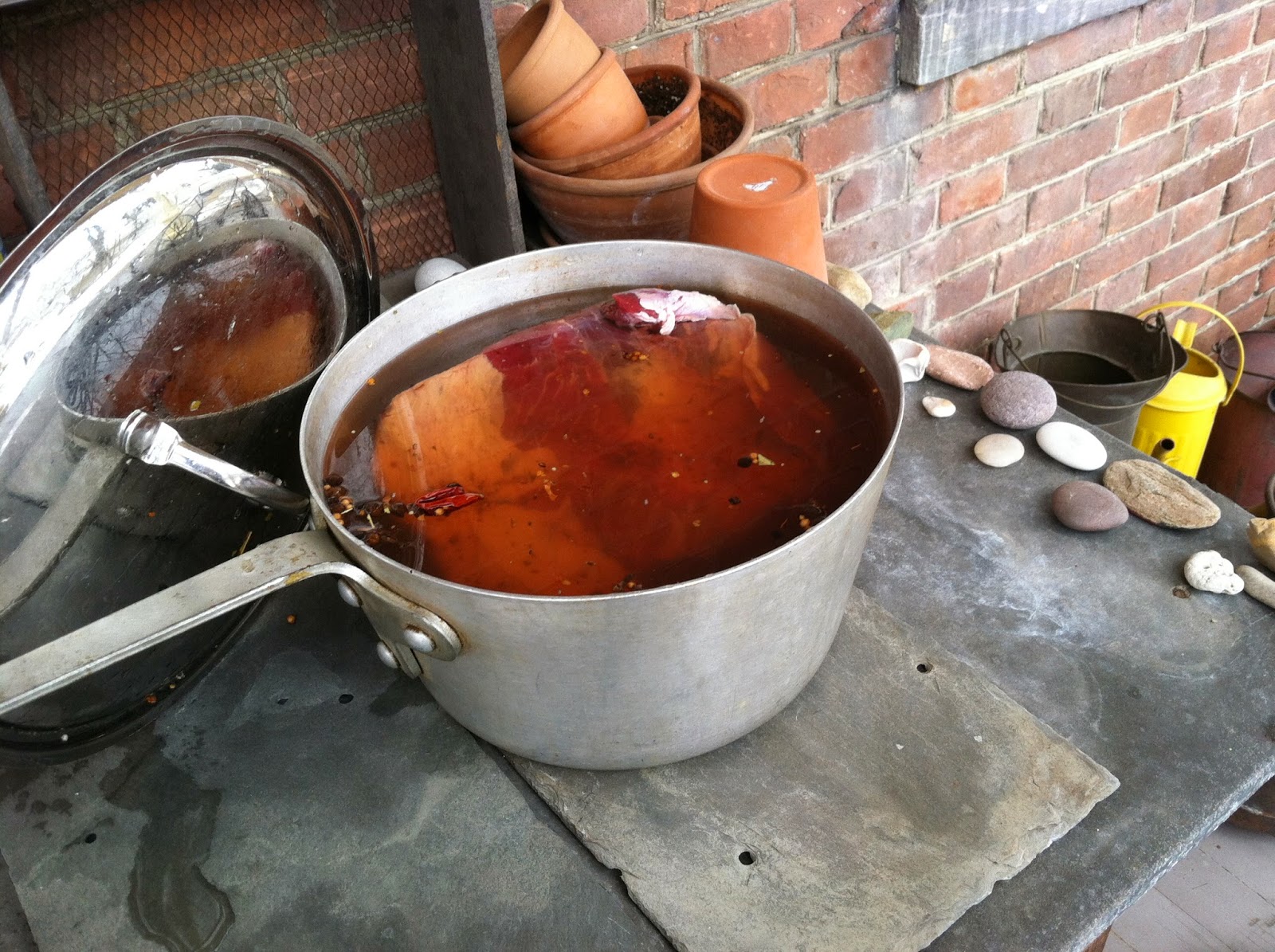
Then, of course, speaking of dates – and we were, weren’t we? (I’m beginning to feel a bit like Charles Dodson) – here comes St. Patrick’s Day on Tuesday. Let’s face it, I have not the slightest bit of Irish in me, nor does Leo, who also doesn’t appreciate Irish music one whit (while I’m not above enjoying a nice tenor), but we do like a good corned beef. Toward that goal I began yesterday, a little haphazardly, prepping for one. It won’t be done by Tuesday but it will be corned by Friday, which is as good a day to eat corned beef as any other. Corning a piece of beef is really no different from brining a chicken or turkey. Corn originally meant grain, and here we’re talking grain of salt. So what we’re doing is preserving and flavoring with salt and pickling spice.
First I bought about 5 pounds of beef brisket from Plew Farm yesterday at the Rutland Winter Farmers’ Market, then I went to the Co-op and obtained some pickling spice. I left the brisket out to thaw when I got home and did manage to make a brine and put it outside to cool.
All the while I’d been mulling over using pink salt – the nitrite salt used for curing, which gives corned beef its distinctive color and flavor – or celery seed, which contains its own significant amount of nitrite. But I did not have enough celery seed, nor could I find the ratio of celery seed needed for the amount of pink salt called for. I may go to the locker tomorrow and see if I can get some pink salt. I don’t see what the problem would be in adding it after the fact.
In bed last night I remembered that I had forgotten to put the thawed brisket in the brine, indeed could not remember putting it in the fridge, but instead of getting up and checking on it – control freak that I am – I decided Leo must have put it in the fridge when he did the dishes after supper, and I allowed myself to go back to sleep.
He had. I put it to brine this morning.
Home-Cured Corned Beef
The following recipe is adapted from Charcuterie: The Craft of Salting, Smoking and Curing by Michael Ruhlman
For the brine:
1½  cups kosher or sea salt (a pure salt, with no additives)
½ cup sugar
4 teaspoons pink salt (sodium nitrite), optional
3 cloves garlic, minced
2 tablespoons pickling spice
1 5-pound beef brisket
For the cooking:
1 carrot, peeled and roughly chopped
1 medium onion, peeled and cut in two
1 celery stalk, roughly chopped
2 tablespoons pickling spice
In pot large enough to hold brisket, combine 1 gallon of water with kosher salt, sugar, sodium nitrite (if using), garlic and 2 tablespoons pickling spice. Bring to a simmer, stirring until salt and sugar are dissolved. Remove from heat and let cool to room temperature, then refrigerate until chilled.
Place brisket in brine, weighted with a plate to keep it submerged; cover. Refrigerate for 5 days.
Remove brisket from brine and rinse thoroughly. Place in a pot just large enough to hold it. Cover with water and add remaining pickling spice, carrot, onion and celery. Bring to a boil over high heat, reduce heat to low and cover. Simmer gently until brisket is fork-tender, about 3 hours, adding water if needed to cover brisket.
Keep warm until ready to serve. Meat can be refrigerated for several days in cooking liquid. Reheat in the liquid or serve chilled. Slice thinly and serve on a sandwich or with additional vegetables simmered until tender in the cooking liquid.
***
This turned out very very good, in spite of professionals telling me I'd have just a glorified pot roast  it had the characteristic corned beef texture and taste, it just wasn't pink! I'll never buy corned beef again. 

“Remember,” she finished, “you can make this at any time. As a matter of fact, just forget about time. Think about cold and warmth. Make it when it’s cold because – now add space into the equation – it can reside on the porch instead of the fridge while it’s brining.” No longer was she plaintive. 

Monday, March 09, 2015

going to oyster town

Boss Oyster is so large they can afford this oyster washer. Oysters go in on this end, are tumbled and sprayed and come out clean on the other. Beyond is the Apalachicola River and beyond that the Bay.

We’re just about to fly out of Rutland airport for a warmer (as opposed to hot) climate – to the Panhandle of Florida, to the little town of Apalachicola. My son-not-exactly-in-law, recently back from the south, explained to me that’s proof that the Appalachians should be pronounced in that southern way, with the soft a, AppalAHchia, instead of AppalAYchia, because that little town provided a kind of southern stem of the mountains that we know and love: the Apalachicola People would travel up to the mountains to hunt and fish, then retire smartly to winter in comparative comfort: Apalachicola is better known for its bays and rivers and gulf shore. And oysters.

Yes oysters, and I intend to eat so many of them in the coming days that I won’t need to stop into Green Mountain Fresh on State Street anytime soon for a secret feast. (You can do that, you know, stop in and order a half dozen or so freshly opened oysters and sit there and slurp them up with the horseradish sauce or not. You could even do it at three o’clock in the afternoon if you pleased. You could take a friend with you, or friends, or not. You can rely on Ingrid’s discretion.)

Anyway, I’m on tenterhooks about whether or not the flight will leave because don’tcha know, snow is forecast for Wednesday (this will be in the past by the time you read it). Do you ever remember winter being so reliably frigid – between 5° and 15°, with very few even 20° days? Except according to my south porch thermometer which often tells me it’s in the thirties out there and it is until you get to the end of the porch and the wind smacks you back into the house to get some real clothes on!

I was thinking that there’s not really all that much to say about oysters except that they’re all at least a bit different according to where they’re found. One of the biggest regrets of my life is about the time when I was in my twenties and sitting in a little roadhouse right on the Chesapeake Bay and some friends came up with fresh dug oysters from the bay and offered to share with me and I refused. This little northern brat was not going to let that slime down her gullet. I wasn't exactly stupid, just ignorant: Had no idea what I was missing.

What else would you say about oysters except that maybe you could ruin them by cooking them or putting too much glop on them? A bit of lemon juice is as far as I want to go and that only after I've slurped down a couple of the briny, liquory lovelies all by their own selves.

But then I looked up our very own Rowan Jacobsen who wrote The Geography of Oysters, and he maintains that Apalachicola oysters are one of the 3 very best in the country, along with Damariscotta’s Glidden Points and Totten Virginicas from Washington State. And he says this about Apalachicola itself, 
“this is one of those few towns that considers breakfast part of the oyster day. I began my morning with a dozen on the half-shell at Caroline’s, and followed that up with Oyster Cakes ’n Eggs (grits on the side, naturally). But I could have easily gone for the oyster omelet, or waited a few hours and tried the oyster tacos, oyster jambalaya, chargrilled oysters, or oysters & artichokes poached in champagne and served in puff pastry.”
Caroline’s is the adjunct restaurant of the Apalachicola River Inn where we are staying. Are we lucky or not.
So I guess I’m wrong – I’d forgotten that I do love them crispy fried and now I may learn to love them poached in sparkling wine. But eventually Jacobsen comes back to my point of view when he begins to talk about the offerings from the legendary Boss Oyster: “Boss has several pages worth of oyster recipes, everything from oyster po’ boys to oyster stew, plus they’ll Gild the Lily and pile chives, ponzu, wasabi, and flying fish roe on your raw oysters, but really, with oysters this fresh, you should probably accent them with nothing more than a Dos Equis.”
Yes Man!

About Apalachicola itself, Jacobsen says, 
“What makes Apalachicola even better is that it is about 80 miles from Anywhere, which keeps most highly annoying tourists away. The few who make it here are already in the know. And what they know is that if your idea of a good time is to hang out in a small town with a working waterfront…. and where oysters are not a precious luxury but part of the fabric of town then Apalachicola just may be the best place on earth.”  
I certainly would agree with that. Reminds me of my joy hanging around the lobster boats on Maine’s Monhegan Island.

He also says that tonging oysters in April was pure bliss, but the oysterman he was with said that summer, “95 degrees, no wind,” is brutal, and winter is even worse.” Note that I’ll be there end of February, first of March. We’ll see!

One last quote? Rowan Jacobsen maintains that – in 2012 at least – Apalachicola oysters were $8 a dozen. And we’re gonna be there – god willin’ and the crick don’t rise – on Thursday. But I won’t relax until I’m sitting on that plane hearing the lovely tractor-like roar of the motor revving up to lift us all off the ground and into the air. I still don’t believe that’s possible, do you? Let’s face it, if anything goes wrong y’all will have heard the news by now.


And that would be a shame because that would mean I would die famished for oysters. And if you are, too – craving oysters, I mean – get yourself on down to Green Mountain Fresh on Thursday or Friday and have a dozen. It won’t quite be the same – I doubt you’ll get flying fish roe on top of them; and do be sure to take your own Dos Equis.
These were grilled with Parmesan and as a second choice over the best – raw – really wonderful!