
“Where does time go,” she pleaded plaintively. And then she continued...
We are back from Apalach, which is
how we natives refer to Apalachicola, where we rose early and, turning our
trenchcoat collars up against the gray drizzle, began days of eating dozens
upon dozens of fresh and briny and liquory oysters, sating ourselves for the
time being. And then we moved west a few feet and began walking the alternately
misty and sunny, and fabulously-birded beaches of San Blas Peninsula and
continuing to eat oysters and conduct our own exploration for the best hush
puppies in the area. They can be so very good.
There really WAS nothing to eat besides oysters and hush puppies. Well,
some breakfast shrimp and grits were pretty good.
Hanging over us all the time we were
there was the need to get to the airport for our return at some point, and that
airport was in a different time zone. It’s bad enough, as you probably know,
thinking about a day of flights without having to worry about the spring ahead
fall back syndrome without even the spring and fall. Panama City airport
(Northwest Florida Beaches International Airport) is on central time and we
were eating oysters on eastern time. We needed to get to the airport an hour
earlier... or was it an hour later? Finally, realizing that if we left Atlanta
at 4:45 and were to arrive at Panama City at 4:55 for an hour flight, then if
we needed to be at the airport at 8:30 a.m. and it was a 2 hour drive, we would
need to leave San Blas by 7:30. I thought about this a lot. I tried to bounce
it off the others in my party but they trusted me implicitly. No one else would
even entertain the thought process. Cowards!
And now what I can’t figure out is
why did we make such an effort to deal with the two big quandaries of time and
space just to get back here to the land of dirty snow and dried-out air. While
our outermost membranes gulped gallons of moisture down there, there is nothing
we can do about the frigid landscape. Except wait. And while we solved (I
solved) that particular question of time, no sooner do we get back than
Daylight Savings goes into effect and we lose whatever grounding we’ve gained.
If any.
So it is that I find myself here needing
to write a column on this snow-drizzling Ides of March, in time to get to the
Paramount by 3 (which would have been 2 nine days ago) and then a celebration
dinner, at Roots, the Restaurant, after the Symphony, of our 46th
anniversary with friends whose anniversary is the 17th. Add to that
not waking until almost 9, which would have been 8, I remind myself, 9 days
ago, which was still late. It is a day all about time. And that is a fact I
hope to ingest and make part of me and then forget! About it.
Then, of course, speaking of dates –
and we were, weren’t we? (I’m beginning to feel a bit like Charles Dodson) –
here comes St. Patrick’s Day on Tuesday. Let’s face it, I have not the
slightest bit of Irish in me, nor does Leo, who also doesn’t appreciate Irish
music one whit (while I’m not above enjoying a nice tenor), but we do like a
good corned beef. Toward that goal I began yesterday, a little haphazardly,
prepping for one. It won’t be done by Tuesday but it will be corned by Friday,
which is as good a day to eat corned beef as any other. Corning a piece of beef
is really no different from brining a chicken or turkey. Corn originally meant
grain, and here we’re talking grain of salt. So what we’re doing is preserving
and flavoring with salt and pickling spice.
First I bought about 5 pounds of beef
brisket from Plew Farm yesterday at the Rutland Winter Farmers’ Market, then I
went to the Co-op and obtained some pickling spice. I left the brisket out to
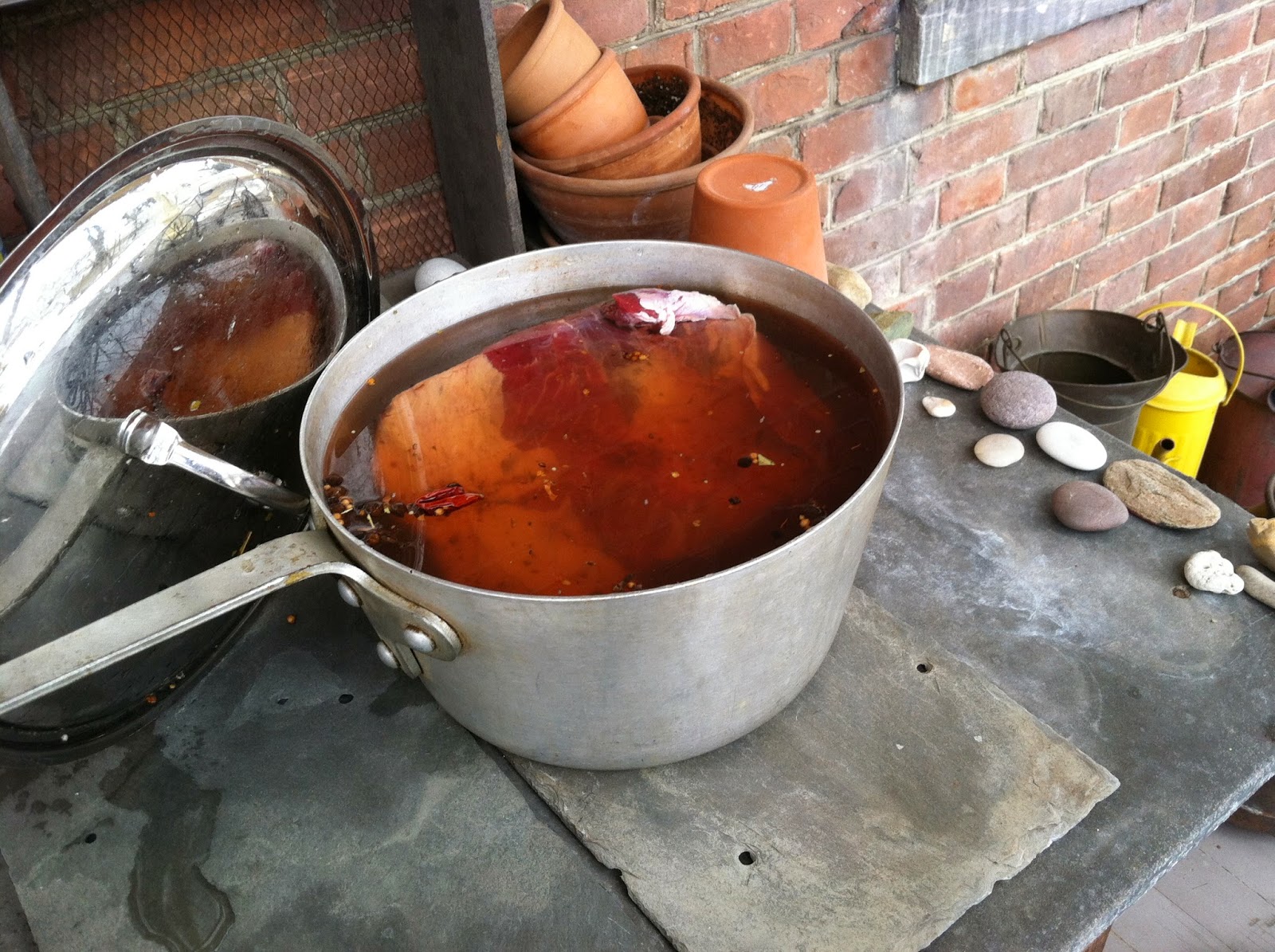
thaw when I got home and did manage to make a brine and put it outside to cool.
All the while I’d been mulling over
using pink salt – the nitrite salt used for curing, which gives corned beef its
distinctive color and flavor – or celery seed, which contains its own significant
amount of nitrite. But I did not have enough celery seed, nor could I find the
ratio of celery seed needed for the amount of pink salt called for. I may go to
the locker tomorrow and see if I can get some pink salt. I don’t see what the
problem would be in adding it after the fact.
In bed last night I remembered that I
had forgotten to put the thawed brisket in the brine, indeed could not remember
putting it in the fridge, but instead of getting up and checking on it –
control freak that I am – I decided Leo must have put it in the fridge when he
did the dishes after supper, and I allowed myself to go back to sleep.
He had. I put it to brine this
morning.
Home-Cured
Corned Beef
The following recipe is adapted from Charcuterie: The Craft of Salting,
Smoking and Curing by Michael Ruhlman
For the brine:
1½ cups kosher or sea salt (a pure
salt, with no additives)
½ cup sugar
4 teaspoons pink salt (sodium nitrite), optional
3 cloves garlic, minced
2 tablespoons pickling spice
1 5-pound beef brisket
For the cooking:
1 carrot, peeled and roughly chopped
1 medium onion, peeled and cut in two
1 celery stalk, roughly chopped
2 tablespoons pickling spice
In pot large enough to hold brisket, combine 1 gallon of water with
kosher salt, sugar, sodium nitrite (if using), garlic and 2 tablespoons pickling
spice. Bring to a simmer, stirring until salt and sugar are dissolved. Remove
from heat and let cool to room temperature, then refrigerate until chilled.
Place brisket in brine, weighted with a plate to keep it submerged;
cover. Refrigerate for 5 days.
Remove brisket from brine and rinse thoroughly. Place in a pot just large
enough to hold it. Cover with water and add remaining pickling spice, carrot,
onion and celery. Bring to a boil over high heat, reduce heat to low and cover.
Simmer gently until brisket is fork-tender, about 3 hours, adding water if
needed to cover brisket.
Keep warm until ready to serve. Meat can be refrigerated for several days
in cooking liquid. Reheat in the liquid or serve chilled. Slice thinly and
serve on a sandwich or with additional vegetables simmered until tender in the
cooking liquid.
***
This turned out very very good, in spite of professionals telling me I'd have just a glorified pot roast – it had the characteristic corned beef texture and taste, it just wasn't pink! I'll never buy corned beef again.
“Remember,” she finished, “you can make this at any time. As a matter of
fact, just forget about time. Think about cold and warmth. Make it when it’s
cold because – now add space into the equation – it can reside on the porch
instead of the fridge while it’s brining.” No longer was she plaintive.


