Showing posts with label Michael Ruhlman. Show all posts

Wednesday, April 01, 2015

time and space and, oh, corned beef


“Where does time go,” she pleaded plaintively. And then she continued...
We are back from Apalach, which is how we natives refer to Apalachicola, where we rose early and, turning our trenchcoat collars up against the gray drizzle, began days of eating dozens upon dozens of fresh and briny and liquory oysters, sating ourselves for the time being. And then we moved west a few feet and began walking the alternately misty and sunny, and fabulously-birded beaches of San Blas Peninsula and continuing to eat oysters and conduct our own exploration for the best hush puppies in the area. They can be so very good.  There really WAS nothing to eat besides oysters and hush puppies. Well, some breakfast shrimp and grits were pretty good.
Hanging over us all the time we were there was the need to get to the airport for our return at some point, and that airport was in a different time zone. It’s bad enough, as you probably know, thinking about a day of flights without having to worry about the spring ahead fall back syndrome without even the spring and fall. Panama City airport (Northwest Florida Beaches International Airport) is on central time and we were eating oysters on eastern time. We needed to get to the airport an hour earlier... or was it an hour later? Finally, realizing that if we left Atlanta at 4:45 and were to arrive at Panama City at 4:55 for an hour flight, then if we needed to be at the airport at 8:30 a.m. and it was a 2 hour drive, we would need to leave San Blas by 7:30. I thought about this a lot. I tried to bounce it off the others in my party but they trusted me implicitly. No one else would even entertain the thought process. Cowards!
And now what I can’t figure out is why did we make such an effort to deal with the two big quandaries of time and space just to get back here to the land of dirty snow and dried-out air. While our outermost membranes gulped gallons of moisture down there, there is nothing we can do about the frigid landscape. Except wait. And while we solved (I solved) that particular question of time, no sooner do we get back than Daylight Savings goes into effect and we lose whatever grounding we’ve gained. If any.
So it is that I find myself here needing to write a column on this snow-drizzling Ides of March, in time to get to the Paramount by 3 (which would have been 2 nine days ago) and then a celebration dinner, at Roots, the Restaurant, after the Symphony, of our 46th anniversary with friends whose anniversary is the 17th. Add to that not waking until almost 9, which would have been 8, I remind myself, 9 days ago, which was still late. It is a day all about time. And that is a fact I hope to ingest and make part of me and then forget! About it.
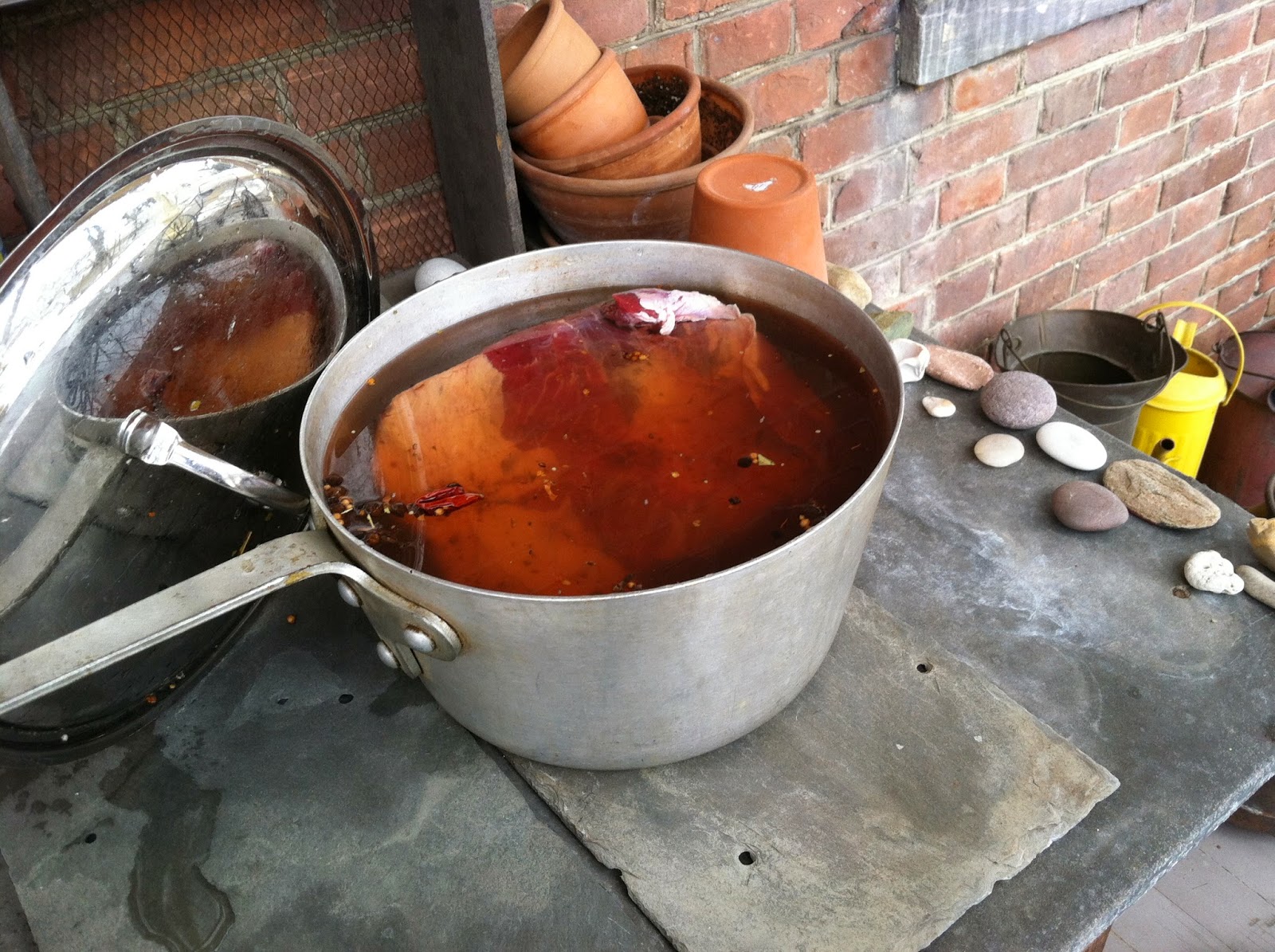
Then, of course, speaking of dates – and we were, weren’t we? (I’m beginning to feel a bit like Charles Dodson) – here comes St. Patrick’s Day on Tuesday. Let’s face it, I have not the slightest bit of Irish in me, nor does Leo, who also doesn’t appreciate Irish music one whit (while I’m not above enjoying a nice tenor), but we do like a good corned beef. Toward that goal I began yesterday, a little haphazardly, prepping for one. It won’t be done by Tuesday but it will be corned by Friday, which is as good a day to eat corned beef as any other. Corning a piece of beef is really no different from brining a chicken or turkey. Corn originally meant grain, and here we’re talking grain of salt. So what we’re doing is preserving and flavoring with salt and pickling spice.
First I bought about 5 pounds of beef brisket from Plew Farm yesterday at the Rutland Winter Farmers’ Market, then I went to the Co-op and obtained some pickling spice. I left the brisket out to thaw when I got home and did manage to make a brine and put it outside to cool.
All the while I’d been mulling over using pink salt – the nitrite salt used for curing, which gives corned beef its distinctive color and flavor – or celery seed, which contains its own significant amount of nitrite. But I did not have enough celery seed, nor could I find the ratio of celery seed needed for the amount of pink salt called for. I may go to the locker tomorrow and see if I can get some pink salt. I don’t see what the problem would be in adding it after the fact.
In bed last night I remembered that I had forgotten to put the thawed brisket in the brine, indeed could not remember putting it in the fridge, but instead of getting up and checking on it – control freak that I am – I decided Leo must have put it in the fridge when he did the dishes after supper, and I allowed myself to go back to sleep.
He had. I put it to brine this morning.
Home-Cured Corned Beef
The following recipe is adapted from Charcuterie: The Craft of Salting, Smoking and Curing by Michael Ruhlman
For the brine:
1½  cups kosher or sea salt (a pure salt, with no additives)
½ cup sugar
4 teaspoons pink salt (sodium nitrite), optional
3 cloves garlic, minced
2 tablespoons pickling spice
1 5-pound beef brisket
For the cooking:
1 carrot, peeled and roughly chopped
1 medium onion, peeled and cut in two
1 celery stalk, roughly chopped
2 tablespoons pickling spice
In pot large enough to hold brisket, combine 1 gallon of water with kosher salt, sugar, sodium nitrite (if using), garlic and 2 tablespoons pickling spice. Bring to a simmer, stirring until salt and sugar are dissolved. Remove from heat and let cool to room temperature, then refrigerate until chilled.
Place brisket in brine, weighted with a plate to keep it submerged; cover. Refrigerate for 5 days.
Remove brisket from brine and rinse thoroughly. Place in a pot just large enough to hold it. Cover with water and add remaining pickling spice, carrot, onion and celery. Bring to a boil over high heat, reduce heat to low and cover. Simmer gently until brisket is fork-tender, about 3 hours, adding water if needed to cover brisket.
Keep warm until ready to serve. Meat can be refrigerated for several days in cooking liquid. Reheat in the liquid or serve chilled. Slice thinly and serve on a sandwich or with additional vegetables simmered until tender in the cooking liquid.
***
This turned out very very good, in spite of professionals telling me I'd have just a glorified pot roast – it had the characteristic corned beef texture and taste, it just wasn't pink! I'll never buy corned beef again. 

“Remember,” she finished, “you can make this at any time. As a matter of fact, just forget about time. Think about cold and warmth. Make it when it’s cold because – now add space into the equation – it can reside on the porch instead of the fridge while it’s brining.” No longer was she plaintive. 

Monday, July 12, 2010

an assortment of weeds

  
I love these few hot days mid-summer when the house is dim and cool and the garden is bright and hot and I wander between the two with stops each way for the hourly-changing shady reading spot on the porch or deck, happily torn between writing, weeding, and reading. There's dirt under my nails, sweat running down my neck, and streaks of lily pollen and blackcap juice on my shorts and tee. I am minimally ecstatic.
On one of those trips inside I inspect my friend El's excellent blog, Fast Grow the Weeds dot com, wherein a professional woman lives (close to where I grew up) in Michigan with her husband and child and various animals and gardens. She works from her home office at an entirely separate job while experimenting with eating close-to-completely-off-the-land -- mostly her own -- with local and area supplementation. This involves season-extension and preserving and what does not sound like, but we know is, an immense amount of work. Her latest addition is a goat, her latest activity is making cheese. It seems no hardship to her and hers, but, conversely, a joy. 

On her blog she has quoted Patience Gray in a permanent sidebar:
Good cooking is the result of a balance struck between frugality and liberality...[i]t is born out in communities where the supply of food is conditioned by the seasons. Once we lose touch with the spendthrift aspect of nature's provisions epitomized in the raising of a crop, we are in danger of losing touch with life itself. When Providence supplies the means, the preparation and the sharing of food takes on a sacred aspect. The fact that every crop is of short duration promotes a spirit of making the best of it while it lasts and conserving part of it for future use. It also leads to periods of fasting and feasting...
Patience Gray in the introduction to Honey from a Weed (New York: Harper & Row, 1986)
It is not the first time I have found like-mindedness between us. I was struck by the pertinacity of this thought to our local food culture of today, and in no time at all I had put my hands on this book so lovingly perused over the last two decades. It will stay out of the bookcase for weeks now as I taste its sweetness once again. Until, in fact (if I know myself), the snow flies.

On another topic, Michael Ruhlman posted a Zucchini Fritter recipe just now and he has several curves on it. It is here.

Tuesday, October 06, 2009

That last summer sweetness

It's Fall, folks, Autumn, but without our big freeze yet, this is the time to take full advantage of all the fresh tastes you can.

Last Summer Sweetness
Some of the summer etables still available pending the big freeze. Eat 'em up!!

I had the most perfect tomato the other day. It was an enormous Brandywine, perfectly ripe, grown by the Tomato Lady at the Farmers’ Market. I made a BLT for Leo with Bear Mountain honey/oatmeal bread, bacon from the pork people in Clarendon – J&S Davis – and iceberg lettuce grown by Paul Horton at Foggy Meadow Farm in Benson.

For me I made a BLT salad, because I’m not eating bread right now, nor potatoes, rice, nor pasta. No starchy things, in other words, nothing that can easily turn to sugar, and NO sugar. It was so good, that luscious tomato all juicy and sweet, and the crunchy, icy, substantial lettuce, and the salty crisp baconness, all dolloped and dotted with mayo. I ate and ate and ate.

“Iceberg lettuce!” you exclaim. “But how outré!”

Well. Maybe. But possibly trend-setting, I’d like to suggest!

I was re-minded of my predilection for the crisp-tender sweetness of that round balled lettuce – with leaves so substantial you can wrap a slice of ham with a slather of mayo in them and forego the bread while you munch – last late-spring when I sat on the deck leafing through the May issue of Saveur Magazine. Yes, there was a photo of Her Majesty The Ice Queen, as they called it, looking luscious with blue cheese, radishes and scallions.

Iceberg was the only lettuce to be had when I was growing up. Those big pale green balls would come home from the grocery store every week, the stem would be thumped on the counter to remove it, and it would be stored in a – get this – Tupperware container made especially for it! We ate it every night, usually with bottled red stuff called French Dressing. It was sweet. We liked it. Candied lettuce! Often, though, budding little gourmet that I was, I would top a crisp cold leaf of it with half a canned peach and a dollop of Hellman’s – not mayo, but – was it called “Salad Dressing”? It looked like mayo but it was sweeter. I think it’s still around. If company was coming, a plump red maraschino cherry would sit atop the whole elegant thing... “Just like downtown,” my mom would say.

Suddenly, sitting there in the backyard in that long beginning twilight that is early summer, I yearned for iceberg lettuce, but I would have to go to the grocery store to get some, and it would have been grown in California or even China, and I didn’t want it that bad. The Farmers’ Market overflows with gorgeous, splendiferous greens, and that’s what I buy.

But. That next Saturday I couldn’t help but ask Paul whether or not he’d ever thought of growing iceberg lettuce. He’s very open to growing new things, even asks for suggestions, and I never hesitate to oblige. “Hmm,” he said with interest, “I haven’t. But it’s not a bad idea. I’ll order some seed.”

We’ve had lots to think about over the summer, but the other Saturday I revisited the subject: “I did grow some,” Paul told me, “But the heads didn’t form up very well – maybe it was that last heat we had, or maybe all the rain early on – but it tastes good and it’s been going into the salad mix.” So I bought some of the salad mix and enjoyed it that way.

The next week, though, “Oh, I’ve got something for you,” Paul said, and handed me a ... real... head of iceberg!

Last Summer Sweetness
Tomato Lady's Brandywine Tomato and Paul Horton's Iceberg Lettuce

Now I can’t tell you how much pleasure that head of lettuce has given me. I know that sounds pathetic, but I live a simple life, with simple tastes and ... well, nevermind! But, it was perhaps at least partly responsible for my eating low-carb for a few weeks here, as I could see how I could do without some of those starchy enclosures, how a leaf of this crisp stuff could cup a tuna or egg salad or support that BLT salad I began with, tastily, crisply, and absolutely healthily. I feel better already.

As I spoke to some other farmers, including Greg Cox of Boardman Hill, and read up about the history of the lettuce, I found few facts but much conjecture. Greg told me that iceberg was the original desert lettuce, bred to survive the trip across the country from Sonoma County where it was grown, which is probably why it didn’t thrive in our cold, rainy summer. I read that it traveled heaped with ice chips, from whence comes its name, and that it was the picking of this lettuce that led, in the 70s, to Caesar Chavez calling for a boycott to protest the working conditions of California lettuce pickers.

The main point to me, though, and what makes me feel less than proud of my hunger for iceberg, is that it was bred for long-distance travel, and I have simply given up on long-distance foods. I said to Paul, I don’t know why I’m writing about iceberg lettuce when I have just finished the only head of it that anyone’s likely to see...” He had a thoughtful look in his eye. “Maybe I’ll try it again, make it the first seed planted, maybe in March next spring.”

So that’s okay – as a long-time local-eater (before localvore was coined) I know that I can’t have everything I want exactly when I want it. I can wait. In the meantime there are other crisphead lettuces. A silky butterleaf is as encompassing if not as crisp, and we’ll have lovely spinach all through the winter, most likely.

And, truth to tell, this diminuendo of eating mainstream carbs has paid its benefits – I no longer have an insatiable urge to eat more and more; to, in the midst of a meal, be planning the NEXT meal! Because that’s what sugar does to you, you know, it makes you want MOWAH, as Oliver so plaintively pled in the midst of his pallid porridge.

So now it’s time to allow in starchier veggies, such as beans and lentils. They’ll taste sweet enough, because when you cut out the blatant sugars in your food the subtle sweetnesses that remain step up to the plate. How to get your sugar fix? Go without carbs for awhile and a bowl of split pea soup will taste like ambrosia. A very thin slice of Bear Mountain Honey Oatmeal sourdough bread will be orgasmic! Slathered, I don’t have to tell you, with butter.

So forget about iceberg lettuce for now, wait for spring and see what Paul’s efforts bring, and truly enjoy those wonderful tomatoes that are still vine-fresh as I write. Eggplants. Peppers. Go hog wild on those things while they last.
**
Corn on the cob is getting scarce, but when you can find it it’s starchy and sweet, maybe a little tough for some of you dainty cob-gnawers out there, but it’s great scraped off the cob (maybe with a round cookie-cutter?), perhaps scored with a knife, first, so as to get its milkiness in with the kernels, then baked with lots of butter in a hot oven for half an hour, 45 minutes. Caramelized, you’ll think you’ve died and gone to corn heaven.

My latest favorite rendition of this is from Michael Ruhlman’s blog – his wife is a photographer and the photo made me want to fly down to Manchester to get myself a corn scraper just like Michael’s. If you have one you don’t have to use a cookie cutter or a knife:

Baked Buttered Corn
adapted from Michael Ruhlman
These are the ingredients for four servings:
- 8 ears of corn
- 4 tablespoons butter, cut in 4 pieces
- salt and pepper to taste

Scrape 6 ears of corn using a corn cutter, [but we’ve talked about this, right?] so the kernels are opened and all their sweet starchy juices fall into a bowl (you can also slice the kernels with a knife and scrape the ears that way or you could probably use a box grate. Cut the corn from the remaining two ears into the same bowl. Season well with salt and pepper. Pour the corn into a baking dish (choose a dish or individual ramekins that will give you a depth of a couple inches). Push the butter into the corn and bake uncovered at 425 for 30-40 minutes.

Last Summer Sweetness
The more common scene: Sarah Seward's Farm Stand, East Wallingford. Gorgeous Fall.

Monday, February 02, 2009

popcorning

...you heard it here...

Learn to cook! Teach your kids to cook! That’s been my refrain during all the years I’ve been writing – and thinking – about food. I was pretty much ignored, but nowadays we hear it shouted from every omnipresent food show, television, radio and print columnists. Okay, so now we’re getting the message – Don’t rely on faceless industry to create and wrap and market your food for you. Just THINK of all the hands, the grimy corners, the exotic processes, the unfriendly bacteria and rat feces that become interested in being on our tables if we don’t relentlessly search out and buy the best raw materials we can find.
Let’s face it – if we don’t learn to spend some time, money, and effort on what we put into our mouths, we’re going to be sicker oftener. Today it’s peanut butter, yesterday it was tomatoes, or was that peppers, maybe salsa – Oh, god knows WHAT it was that gave us the tummy ache, the Johnny-quick-steps, the need to spend long hours worshiping at the porcelain goddess! And that’s not to mention the long, slow, downward tilt to our overall health.

Learning to prepare those ingredients is almost the least of it. Who couldn’t, in an afternoon’s time, learn to steam a vegetable, prepare a basic starch, add a bit of protein, combine it all with something unctuously oily, and serve it up.

Photobucket


...POP...

But, I digress. I have become aware that people don’t know how to pop their own popcorn, and rely instead on bags of that awful stuff mixed with weirdly aromatic powders that you stuff into a microwave. Imagine!
Since I don’t own a nuclear fission appliance, I make my own popcorn, and our lives are so simple that Leo and I find endless fascination in watching corn pop ever since I started using a wide and deep sauté pan with a – voila! – glass cover!

In case you are one who doesn’t yet know – or has forgotten – how to pop your own corn – Shame! – this is the way it’s done.

First of all relentlessly search out the best popcorn. We like to get a winter’s supply in the fall from Williams Farmstead just north of Rutland. If we don’t get enough our lives become desperation-on-wheels until we find another source. Recently, I revisited organic corn sold in bulk at the Co-op and discovered it was REALLY good – tender kernels and very few unpopped when you’re done.

Start with a cold pan, cold oil, and cold corn. This way the corn warms gradually with the pan and the oil so that the insides come to popping temperature before the outside crisps and holds the pops in. This makes a tenderer popcorn, too. I use a wide deep sauté pan, set it over high heat, scoop in a couple of tablespoons of coconut oil, lard, or olive oil – what do we THINK people used for this purpose before the cereal growers started pressing their seeds under tremendous pressure, using enormous heats? – cover the bottom of the pan thoroughly with popcorn, so you can’t see any pan bottom, put on the see-through cover, and shake. If you keep an eye on the corn through the glass cover as it starts to pop you will see how important it is to shake the pan – the kernels on 1/3 of the perimeter begin to darken and pop sooner than the others, and by shaking, you mix all the colors and temperatures together.
One of my favorite bloggers, Michael Ruhlman, talks about wanting all his popcorn kernels to pop at once. I haven’t achieved that prodigious feat yet, and neither has he.


Once the popping slows to POP..POP..........POP..................pop, turn off the heat, pour into a large wooden bowl, put the pan back on the burner (remember, no heat), scoop in a couple of tablespoons of butter and put the top back on. While the butter sputters and melts in the hot pan, grind a good amount of salt over the popcorn, grate over it a plethora of cheese – Parmesan is awfully good – shake the bowl vigorously to disseminate the salt and cheese through the hot popcorn, then pour the butter over the corn, scoop a goodly amount of corn up in the pan and shake it around to scour the pan of butter (not to waste a drop of this dear stuff), pour back into the bowl, shake the bowl again, and serve with napkins.

For a sweeter alternative, after the corn is in the bowl and salted, turn the heat on under the pan again, pour in a third of a cup or so of maple syrup, bring it to a roiling boil – this takes only a moment – hold it there for another moment, then turn off the heat, take the pan from the burner, toss a lump of butter into the hot maple syrup and swirl it around until it’s melted, pour over the corn and scour the pan with the corn as before.

(Once you’ve finished the popcorn you’ll probably wander out to the kitchen and spy that pan and take a rigorous index finger to lick out the dregs of buttered maple syrup – and that might be the best treat of all.)

...the ghost of W...

Sometimes, instead of grating cheese over the popcorn, I like to scatter small chunks of bleu cheese or Roquefort over the top. Roquefort is, without doubt, and with no lessening of my regard for our wonderful Vermont cheeses, my all-time favorite cheese, already very expensive and getting more so as time passes.

This is why.
Long ago the European Union banned American hormone-treated beef on the grounds that it was unsafe to eat, showing once again their good sense. In a 1999 retaliation, Washington imposed a 100% tariff on European truffles, ham, chocolate, mineral water, sausages, some fruits and vegetables, as well as Roquefort cheese. That last is a pungent, salty, creamy, green-veined cheese made in the French region of Roquefort from unpasteurized ewe's milk. Now, with a backhanded, rude gesture as he walked out the door, G.W. Bush has tripled the tariff on Roquefort – from 100% to 300%. I’m angry (not exactly a new emotion from me for him), and I’m glad to see that the French are outraged. “There's no way the E.U. will reverse its ban on hormone-raised beef that consumers here don't want,” said one official. And there is hope that the Obama administration will reverse the tariff.

...a new bleu...

But in the meantime, and even forever after, I’ve found another, wondrous, cheese. Woodcock Farm Cheese Company, from over Weston way, set up at the Winter Farmers’ Market a few weeks ago (through the Co-op’s Wales Street Entrance, Saturdays, 10-2), and among their (East Friesian) sheep’s milk cheese offerings is a blue cheese with enough blue and green veining through its decidedly creamy yellow body to satisfy the most exacting of blue-cheese lovers. There’s buttermilk there. It’s creamy in texture, which makes it seem mellow, but it has a pungency that lingers in the nose and on the palate. Even the thin, somewhat leathery rind is toothsome.

What is that saying – Cheese is milk’s leap towards immortality. I’m looking at this nibbled wedge of cheese sitting here above my keyboard and in front of the monitor – doing my final taste test at 9:30 in the morning – and the truth of that is forcefully brought home to me.

The blue cheese isn't mentioned in the link to Woodcock Farm above, because it's a new effort. Call them and ask, or just show up at the Winter Farmers' Market.
***
And no, you are NOT to go out and buy a glass-topped pan for popping corn. Just trust my words, and shake!

Monday, November 24, 2008

squeezing out thanks

Photobucket
Judy Dow upper left and right, Mr. Labate middle,Justin Morse, new principal of Wallingford Elementary
on lower left, and Julie Kuhn Fredette, Wallingford's art teacher, lower right


It was a serendipitous time of year for my new friend Judy Dow to be holding a short residency at Wallingford Elementary School. It’s Thanksgiving season, after all, and Judy, as A Child of the Dawn, which is what “Abenaki” means, a Native American, one called Indian by most of America, and therefore a partner with the Pilgrims on that first Thanksgiving Day, was about to dispute some of our soft and mushy feelings about the history of that holiday that some of us might hold.
Judy pronounces Abenaki in a way I’d never heard before – ahBENicki. She told me in her soft, drole voice that the pronunciation depends upon which family you come from, what strain of Abenaki produced you, and hers is French from over the border.

In her early 50s, with a round face, large, expressive eyes, and dark braid that hangs down at least to her waist, Judy is a master teacher and an award-winning artist whose hand-woven baskets are currently on a three-year national museum tour. The art teacher at Wallingford, my friend Julie Fredette, wrote the Vermont Arts Council grant, funded by the Vermont Folklife Center and the National Endowment for the Arts, that brought Judy to Wallingford for a second residency to teach the third and the sixth grades weaving and other Native American arts, and, as well, a few home truths.

Friday afternoon I entered Chris LaBate’s 6th grade class and looked over some of Judy’s primary sources, such as the letters that William Bradford wrote when he was Governor of Plimouth (sic)Colony. I took some notes, while she handed out Thanksgiving story books to the children, and then she said, “Please open your books and find words or pictures that exemplify Myth Number 1 - that the First Thanksgiving occurred in 1621,” and the children did. Then Judy explained that for as long as people have existed they have given thanks and feasted in the giving of them and that “to refer to the harvest feast of 1621 as ‘the first thanksgiving’ disappears Indian peoples in the eyes of non-Native children.”

Regarding another myth – that the colonists came seeking freedom of religion in a new land – Judy explained that by 1620, hundreds of Native people had already been to England and back, most as captives, so the Plimoth colonists knew that there were people who lived on this land, but since they had not put up “private” and “no trespassing” signs or wrecked it in any way... but what Judy said was that “nevertheless, their belief system taught them that any land that was ‘unimproved’ was ‘wild’ and theirs for the taking; that the people who lived there were roving heathens with no right to the land.” Some religious freedom, huh?

She explained that when the storybooks tell of the “Pilgrims” (never did the Plimouth settlers call themselves “Pilgrims” – another myth), “found” corn they actually had found the seed corn that the Natives had buried to save for spring planting, and took it away with them. At the same time they “found” several graves and “brought sundry of the prettiest things away” from a child’s grave.

Myth # 11 says, “Thanksgiving is a happy time.” Judy explained that for many people Thanksgiving is a time of mourning, of remembering how a gift of generosity was rewarded by theft of land and seed corn, and of remembering the extermination of many Native people via disease and guns. “As currently celebrated in this country, Thanksgiving is a bitter reminder to Native peoples of 500 years of betrayal returned for friendship and generosity.”

At the end, one little girl asked, “How did all these untruths get started, and why don’t we all know the real truth.”
Mr. LaBate said, simply, “The victor writes the history.”

As for the food the “Pilgrims” and “Indians” ate at that “First Thanksgiving”? It was probably venison (the Natives brought five deer), wild fowl, and a dried corn pounded and boiled into a thick porridge called nasaump, and, possibly, cooked, mashed pumpkin. There would have been no bread nor biscuits because there was no wheat. There were no potatoes nor even sweet potatoes, since they didn’t appear in New England until the 18th century. There would have been no fruit, for most had gone by, no clams because it was too cold to dig for them, no fish because the season was closed, and no boats nor traps for trapping lobster. There was no sugar, so cranberries were out except, perhaps, for the most dour, and no pumpkin pie.

Judy Dow returned home to Essex on Friday Evening. She expects a house full of extended family this weekend, and there’s something about building a longhouse.

...support your local restaurant, of course...

We find ourselves in the position of having to rescue businesses and people we didn’t want in our lives anyway. As far back as the sixties, I looked at those little beetle shaped cars that were appearing on the roads and said – that’s what I want! Guess what, American Car Companies never built them. ACC built BIG. ACC built gas-guzzlers. They built and aggressively sold those big honking vehicles with the enormous carbon footprints that make it impossible for our small cars to drive down the road without the fear of being runover by one teenager in charge of one of those things and a cellphone at the same time.
“And,” says Leo, “they sold like hotcakes!”
Well, there is that!

Nevertheless, there are some businesses we can support, and we’d better support them if we want them around when this awful spiraling mess is sorted out.
Talking to restaurant owners and chefs nowadays, I hear words like “shocking,” “flabbergasted,” and “floored,” about the downturn in business.
Say you usually go out to dinner on Friday night, and one Friday you look at the headlines about GM and investment bankers, and you say, “Hon, maybe we better tighten our belts a bit. Let’s see, what can we eliminate?” Say you usually toddle on down to Sabby’s, or Hemingways, or the Victorian Inn, or Tapas on Friday nights. You might say, “Hell, we don’t need to do that. We can cook something at home. If we get desperate we can go to MickieD’s and get us something cheap.” Say two or three parties have this discussion amongst themselves. SabSal’s Café Inn is now down three or six customers in one week. You think that doesn’t hurt? You think ONE doesn’t hurt?
It hurts.

So here’s my suggestion. While you’re having a candlelit conversation at your favorite restaurant, talk about continuing to support your local farmers and the financially challenged people in your neighborhood and state. Make out a check – for $50, for $10, for $5 – to the Vermont Foodbank , call your town office and find out what is being done to feed and help the poor people in your own community. You never know when it’ll be YOU who needs help.

Shop at the Winter Farmers’ Market and the Co-op – don’t leave your farmers in the lurch or they won’t be there when you deem your finances in order. And then, buy into the Localvore Thanksgiving that I wrote about last week or so.
Finally, we can’t forget to support the Paramount Theater with our presence. We’ve put a lot of effort into getting it on its feet but it doesn’t have a lot of resources in times of downturn. Comfort it with your presence and your money.

And then, adopt a cat – get rid of those mousetraps.

As my friend Wendy Jackson of the Red Brick Grill in Poultney told me with characteristic frankness, “We’d love to see you but, if we don’t, pretty soon you won’t be seeing us.”

...better times aren’t here again, but they’re on the way...

You may, like me, have read the Letter to the next Farmer in Chief that Michael Pollan wrote in the New York Times Magazine on October 12 but, like me, you may not be able to keep the talking points close to hand. To that end, Michael Ruhlman, one of my favorite bloggers, writers, and food activists condensed those points and posted the following on his blog. Cut it out and hang it on your fridge:

  1. —Train a new generation of farmers, spread them throughout the land, and make farming a revered profession.
  2. —Preserve every acre of farmland we have and make it accessible to these farmers.
  3. —Build an infrastructure for a regional food economy—one that can encourage and support the farms and distribute what they grow (rebuild or create regional distribution systems).
  4. —Provide cities grants with which to build structures for year-round farmers markets.
  5. —Ease federal production regulations, designed to control multi-national food companies but that hog tie small producers.
  6. —Create local meat-inspection corps so that we can create more regional slaughter facilities, perhaps the biggest impediment to our being able to find local hand raised meat. (This is huge.)
  7. —Establish a grain reserve to prevent huge swings in commodity markets.
  8. —Require federal institutions that prepare food (school lunches, prisons, military bases, etc.) to buy a minimum percentage of that food locally.
  9. —Create a Federal definition of food, to encourage people to think about what is food and what is not, stuff we consume that has no caloric value (“junk food” should not be considered food).
  10. —Food stamp debit cards should double in value when swiped at a framers’ market; give farmers’ market vouchers to low-income women and children (why does he exclude men, I wonder; a different subject perhaps).
  11. —Make changes in our daily lives: teach children how to cook; plant gardens in every primary school and equip them with kitchens; pay for culinary tuitions (or forgive loans) by requiring culinary graduates to give some service back to such undertakings such as teaching kids how to cook; increase school lunch spending by $1 a day; grow more of our own food and prepare and eat our food together at a table; accept the fact that food may be more expensive and eat less of it.
  12. —Make our food production system as transparent as possible: have a second calorie listing how many fossil fuel calories went into its production so that consumers could discourage production of fuel expensive food by not buying it.
  13. —Finally, there should be a White House vegetable garden and our President should set the first example. Our founding fathers were largely farmers. This would be a good symbolic return.
...now about that longhouse...

I asked Judy if her family and friends just ignored the 4th Thursday in November, and she wrote back to me Saturday morning: “We do celebrate thanksgiving. We always celebrate the weekend before the National Thanksgiving day. Of course we are thankful for a bountiful harvest just as others are. We moved out into the woods Friday night. We built a long house for about 15 people to sleep in. Most of the man power comes from my husband's boy scout troop. We spent the day building tables and preparing food for the feast tomorrow. I just came in to clean three 25 pound turkeys. Tomorrow about 5:30 in the morning we will start the turkeys, prepare the venison stew, cook the baked beans, squash, gravy, pumpkin fry bread, stuffing, wild rice and berries and desserts. Everything will be cooked outside over an open fire or in a ground pit. About 12:30 PM we will be joined by friends and family for dinner. There will be about 70 people. You are more than welcome to come if you would like.”

I would have loved to’ve been there, wouldn’t you?