Tuesday, August 04, 2015

vitality veracity


I lie about my garden all the time, if not overtly then at least covertly. I allow you to imagine my wafting lofting hillocks and berries and greens and pods just bursting with color and clarity and taste. And no weeds.
What was it last time? Oh, peas. Well, they were quite wonderful, but then it got so exasperatingly hot, and then it poured. Another thing I allow you to think, really exhort you to do, too, is that I get out there every day to see what needs to be done. You can’t garden from behind your desk. Sometimes days slip by so fast, almost as fast as weeds grow and so do zucchinis.
The other day a friend stopped by and wanted to see the garden. How embarrassing! The peas should have been pulled this long time if only to allow the Brussels sprouts and broccoli to get some sun and perhaps begin to thrive. The lettuce has been allowed to bolt, weeds are taking over the herb beds, the kale is blowsy and tough, the chard has gone wild, and tomatoes need to be tied up higher. Zucchini is in logs and its enormous leaves are shading the eggplant. Even the grass needs to be mowed.
The mere thought of all that work makes me sag. Some people need a pool boy. I need a garden girl.
Thank goodness for the farmers. I mean really. Thank God For The Farmers. Those hardy fighters that started the first farmers’ market back in the early ‘70s – that would be the nineteen 70s. It was tough going. They – the growers and their eaters – really had to fight the city to find a place to set up, and then a larger space, and then even larger. The starters were Jeff Bender, Andy Snyder and jonny-come-lately Greg Cox. Along came Steve Chamberlain of Dutchess Farm, and Ray and Chris Powers powering their Bear Mountain Bread stand.
Because of them – and others – my fridge now contains slim little French green beans, a pint of tiny patty pan squash with their blossoms, 17 pounds of Pratico tomatoes waiting to be frozen, a lovely large cauliflower, a magnificent ovoid purple eggplant.
A fresh chicken went into a strong brine yesterday as soon as I got it home from Market, and then onto the grill last night. This would not be the picture without comparative newcomers Alchemy Gardens, Grabowskys (grilled corn on the cob, too), Radical Roots, and who had those beautiful little beans? It might have been Scott Hewitt from Fields of Manna in Wallingford. Or maybe it was Singing Cedars from Benson. Plew Farm has fresh chicken all summer, they told me. Larson’s Farm is able to sell raw milk from the Market due to new licensing laws.
Plethora, Baby! Plethora!
My only problem now is how am I going to eat all this stuff. And, what with planning and cooking, where am I going to find the time to mow and weed?
Nice thing about this kind of plethora is it all needs to be very simple. Simplicity allows the wonderful fresh taste to come through.
So, I won’t lie to you, I rely on some quick sauces and cool techniques to get through this so-highly-prized time of year.


#1: The first is quick fried tempura.  Eggplant, green tomatoes, just-ripe tomatoes, zucchini, okra, those little patty-pans with their blossoms on. I slice them – not the okra or patty-pans – dip them into a tempura batter and fry them in some lard, or coconut oil, or a mixture of butter and olive oil. I don’t deep fry them, just pour in a kind of lavish amount of oil. Garnish them with little Thai (or other) basil leaves. Eat’em up.

Elizabeth David’s Tempura Batter
This is an excellent coating. I think it’s the oil in the batter that keeps the coating on the food rather than in the grease:
Take 4 ounces of flour, about a cup, and put it into a bowl. Add 3 tablespoons of olive oil and a teaspoon of salt, then gently and slowly whisk in “3/4 teacup of tepid water”, or until the mixture is about the consistency of somewhere between thick cream and half and half. Let it sit for a while to let the gluten relax, and, when you’re ready to use it, whip one egg white and fold it in. Dip your food into it and fry it up.
I’ve been using 2 egg whites lately, and I think it makes a better covering.

#2: The other day I had some friends over on the spur of the moment, or hour, and I hustled up a few tidbits quickly to nosh on. One of them was zucchini cut into sticks to be dipped into this dressing. It got accolades. It has no added salt but it is salty enough. Probably because of the Hellman’s.

Creamy Dill Dressing
Whisk together ½ cup Hellman’s or homemade mayonnaise, ½ cup sour cream, 1/3 cup dill weed, chopped fine, 1 clove garlic, chopped fine. Allow the flavors to marry, and serve it up.


#3: And this! Kind of a first-timer, the first time, I think, that my dotter Zoe arrived with a jar of homemade stuff and off-handed it to me without much ado and... it was wonderful – as dressing, as dip, as marinade, as eat it with a spoon. My little string beans, lightly steamed, buttered, are going to love this drizzle. The recipe is from her friend Caroline’s Aunt Jane. Caroline lives in North Carolina. I don’t know where Aunt Jane lives. Make it!


Aunt Jane’s Ginger Dressing
      • 3 inches of ginger, grated (minimum)
      • 4 (or more) garlic cloves, finely chopped
      • ½ cup tamari
      • ½ cup olive oil
      • ¼ cup raw apple cider vinegar
      • ¼ cup or more tahini
      • 1/3 cup raw honey
      • 1/2 teaspoon cayenne
      • ½ cup water
There are no directions, but I think I’d put this all into a blender and process it, in which case nothing would have to be finely chopped.
***
Yes, it’s been a long, worthwhile road from that first Farmers’ Market up to the present when it’s accepted as one of the premier events on a Saturday – outside in Depot Park in the summer and in the Vermont Farmers’ Food Center in the winter. Wednesday late afternoons present a smaller version.
Now, if the City would only recognize how important the Market is to Downtown, and put the benches back so longtime supporters like me – who are, after all, not as vital as we were in the ‘70s – could take a rest in the midst of the festivities, that would be nice. And smart. And maybe the gravel that has supplanted the grass could be dealt with in a splendid way? Get with the celebration, City Guys!
The next step in this glorious food revolution is to continue renovating the Vermont Farmers’ Food Center to make it truly a center for food for the entire area.  Greg Cox and his Board of Renown is on that like stink on a pig. Important revelations and revelry are on tap for this Sunday, the 16th.
$20 a ticket, friends, all proceeds to go to building a shared use commercial kitchen and processing facility, and a large scale storage and aggregation infrastructure. A biomass Heating System is in the works, as is a community teaching kitchen.

Okay, and now, no lie, I need to get out there and weed!

Tuesday, July 21, 2015

pea epiphany


One of the glories of summer is pea vines and their end purpose, peas, and I’m talking about peas safely nestled juicy and tightly in non edible pods, real shelling peas, the only kind I’ve ever grown. Perhaps this phenomenon will be more understandable when I tell you I have never owned a microwave, either. Isn’t that just amazing? I’m a gardening and cooking Luddite.
Leo is the pea-planter. This is because the act of gardening, to Leo, means planting. Never mind the fall cleaning and putting to bed, the seed ordering, the spring weeding, the deciding where things should be located this year as differentiated from past years... no, gardening is for planting, and he starts yearning to put seeds in the ground in April. Plus, he has a somewhat elaborate system of 4 foot tall fencing cylinders that need to be staked down for the peas to grow on, and only Leo knows their secret. And so, this year, when he said he wasn’t going to plant peas because he’d had no luck with them the last couple years, I had already made the bed for them, spring weeds out, soil loosened and quiveringly receptive.
I was disappointed but had done nothing about it when Zoe came out and said, “Did you plant your peas yet?” I gave her the news and she said, “No peas! What nonsense. Do you have any pea-seeds?” I said yes I did but they were two years old, and she said, “What are we waiting for?” So she fetched a bag of compost from the pile by the fence and drizzled a good amount from a cut corner of it in 8 different hills in a row and I worked it into the soil and fetched the seeds and she planted them in eight circles and got her dad to erect his pea towers, all in the time it would have taken Leo and me to argue about whether it was worth it or not.
I swear, each and every one of those peas sprouted and grew, and for the past week that’s all I’ve been doing is picking peas and sitting in the hammock and shucking them and eating them and throwing the shucks in the lilac tangle. Good compost.
Well, that’s not all I’ve been doing but it’s been a pleasurable thing to do.
This year’s peas form just one more story. Here are two I’ve told before but are – in my opinion – worth repeating:
Once, long ago, my friend Carol spent a good long hour or so at our lawn sale sitting on my front stoop shelling peas from her own garden into a big green bowl. Plink, plink, they went, slowly covering the bottom of the bowl. She’s never going to fill that bowl, I thought. But steadily she worked, and steadily the emptied pods towered beside her; slowly the peas mounted in the bowl. That night she served them simply steamed in a lettuce leaf, a pad of sweet butter topping them, salt and pepper, in that same green bowl. The bowl was at most half full. It was a beautiful sight, the peas delicious, and my realization, that something as precious as fresh peas should never overflow, one that I’ve never forgotten.
Isobel G Nimtz drawing
That memory reminds me of M.F.K. Fisher’s paean to peas in An Alphabet for Gourmets, when she recalls a difficult feast enjoyed with family and friends over a campfire on a Swiss mountainside where she and her husband were building a house. I rummage on my bookshelves and settle down to read the passage. “...what really mattered, what piped the high unforgettable tune of perfection were the peas, which came from their hot pot onto our thick china plates in a cloud, a kind of miasma, of everything that anyone could ever want from them, even in a dream. I recalled the three basic requisites, according to Fanny Farmer and Escoffier [they must be very green, they must be freshly gathered, and they must be shelled at the very last second of the very last minute], and again I recalled Sidney Smith, who once said that his idea of Heaven (and he was a cleric!) was pate’ de foie gras to the sound of trumpets. Mine, that night and this night, too, is fresh green garden peas, picked and shelled by my friends, to the sound of a cowbell.”
And that, my dear reader, is the way peas should be shelled – by your friends.
I’ve grown lazy, or at least simplified what can be simplified while retaining the best of itself, and this year I have not shelled peas in any quantity – I have even been known to take a basket of the first ones – fresh picked – to a gathering at the beach for everyone to shell their own.
I did shell enough for two omelets, which was not very many.
Pea-ifany Omelet
Serves 1
Have everything ready before you start because this omelet goes very fast once you pour the egg into a hot pan.
  • 1 teaspoon olive oil
  • 1 teaspoon butter
  • 2 large eggs, whisked with a fork until not stringy
  • 1/3 cup freshly shelled peas
  • 1/3 cup freshly grated gruyere (or other) cheese
  • 2 tablespoons freshly picked mint, chopped
  • Sea salt and freshly ground pepper.
Heat a small skillet or omelet pan – about 9 inches – over high heat until hot, then add the olive oil and butter and heat until hot. Pour the eggs in all at once and with a spatula lift the edges all around and tilt the pan to let the liquid flow under the cooked egg just until semi-solid then sprinkle in the peas, cheese and mint, cook for a moment and then carefully fold the omelet in half with the spatula and let cook another minute. Very carefully flip the omelet onto the other side and cook a moment more, then slide onto a plate, sprinkle with the salt and pepper, garnish with a bit more mint and/or cheese and serve.
When I’m serving more than one omelet, I cook each one consecutively.
***
But here is what has become one of my favorite ways of treating those peas:  pick a big mess of them and throw them all at once – unshelled – into a very hot, dry, wok and stir fry them until they are charred and juicy, then toss them with plentiful coarse sea salt, put them into a big bowl and take them to the beach as your offering. You eat them like you eat an artichoke leaf or edamame, scraping the tender peas and juices out with your teeth and discarding the pod. Make sure the discarded pods are plainly identified as inedible, and, um, Used!

So that’s about it for peas for another year. I’m going to invite three little girls who really enjoyed eating the charred peas from the pod the other night to come over some day next weekend and help me harvest the last of them. We’ll toss them in a hot wok and perhaps have another epiphany! 

Tuesday, July 07, 2015

feed your head

Lewis Dodgson would have felt at home in this pile of stones and tiger lilies across from my house


One of the most astonishing questions I’ve been asked lately is, “Where do you want us to put the porta-potty?”
“I don’t want you to put a porta-potty anywhere,” I answered. And then, “What porta-potty.”
“Well,” Charlie said, rolling his eyes toward the porta-potty truck that I’d just noticed out on the street, “There are five men here, and nature calls, or at least it may. Unless you want them using YOUR bathroom...”
Since my office is between the kitchen and the bathroom, I told them where to put the porta-potty, in no uncertain terms, and they put it there, and all the following questions, from other people, have been “WHAT is going on at your house? You have a...”
“Porta-potty,” I supply.
Dirty grins.
Especially since the scaffolding is all hidden on the other side of the house now and the porta-potty stands alone. Just like the Cheese, in the Dairy-O.
Speaking of cheese... or perhaps I shouldn’t.

Perhaps I should speak of compost, instead. It’s all part of the same system. I wouldn’t need a porta-potty if these men didn’t eat, and what do they eat? They eat what comes from the earth or they eat what eats what comes from the earth, grows in the soil, and what is soil but a lot of micronutrients that come from the stars and from the compost; and that compost is composed of all the things that are supposedly used up – dead 
 leaves, grass clippings, vegetable leavings... and manure. Which, with a little microbial action come back as a fertilizer to grow things out of the soil again. Life, used up – death, but not really – then life again. At least that’s the way it always worked before Monsatan came along (it’s all very religious, isn’t it?). Which brings us back to the porta-potty. Or not.
The other day I was listening to the radio and I heard the novelist, Margaret Atwood, talking about age and she said something to the effect that ‘young people worry a lot more than we do because they don’t know their own life’s plot yet.” Yep, it could be anything. And it started me thinking.
All of my life I have known that there is really nothing, basically, when you get right down to it, more important than food. At this realm, at this layer of existence... food is supreme. It’s one thing you can do something about, practically. We need it three times a day or at least once every few days, we cannot live without it, and we have been given such bushels of nonsense and ill-truths about it by government and corporations and even doctors, because none of them knows anything about food and its relationship to the human body, that somebody has to try to keep the puzzle pieces straight, and talk about it and give it – food – the respect it deserves. The most we know is that real food comes from the soil and the better the soil the better the food. It’s important to remember what real food is, to keep the consciousness of it through the dark years. So that’s been my path. Nice to recognize it. Thank you Margaret Atwood.
Food connects everything. I heard Meighan Kelley belt out White Rabbit, that old, great, Grace Slick song, at a RAFFL benefit at Mary Ashcroft’s Standing Stones the other afternoon, and that, of course, put me in mind of Lewis Carroll and Charles Dodgson and Alice, and how logical everything really is but not in the way we think it is. Lest you think that Alice in Wonderland has nothing to do with food remember the pills, and the tea parties, and the little/big drinks. And of course there were, er, ah, those little girl picnics on the river.
Connectivity. RAFFL is all about food and farming and feeding. Meighan? I’ve known her since before she was born with that amazing power of voice. She now works for my old friends who gave us hippy-types a place to gather in Rutland back in the ‘70s, and who are now giving community a place to gather in Hinesburg. That would be Will and Kathleen Patten, the old, original Back Home Café on Center Street in Rutland, and now the Hinesburg Public House.  Grace Slick was loud and original and had nothing to do with food that I know of – none of us did back then – and the grin slid off the Cheshire Cat until only it remained. Mary Ashcroft’s husband, Harold Billings, was fascinated with the stones and collected them and stood them on a hillock behind their house and studied practical astronomy for placing them. Mary herself gave Radical Roots a start. And I sit here writing about porta-pottys and standing stones in a food column.
That’s the thing, Food is connection. Food is real. There couldn’t be anything more real than the box of new red potatoes, smaller than tennis balls, at the Rad Roots stand at Saturday’s Market. I scoffed ‘em right up, and it was only later that I decided to tenderly boil them in well salted.... well, let me just make up a recipe here and now. You deserve it for at least trying to follow my train of thought here.
a salad of new potatoes with feta

·         New red potatoes – 1 lb+, equal to or smaller than a golf ball
·         Salted water to cover
·         Olive oil – ¼ cup or more good tasting, best virgin
·         Garlic cloves – 2 or 3, chopped
·         Snow peas – two handfuls, stemmed and strung, then cut into ½ inch pieces
·         Tiger Lily pods – a dozen, sliced in 1/4 inch slants
·         Scallions or Egyptian onions – ¼ cup sliced at a slant
·         Tarragon leaves
·         Mint leaves
·         ½ cup feta cheese pinched into pieces
·         Coarse sea salt
·         Fresh ground pepper
·         Vinegar, cider or balsamic – optional
Swish off the potatoes in cold water to clean, put them into a large saucepan and cover with water. Add 2 teaspoons of salt, cover at a slant, bring to a boil, turn the heat down to medium high to keep them at a low boil.
In the meantime, pour the olive oil into a serving dish, add the garlic, peas, lily pods* and scallions. If you’re using the Egyptian onions, peel a handful of the tiny top bulbs and cut in half and add to the bowl. Then slice some of the tenderer stalks and add them to the bowl. Add the tarragon and mint. Stir this all up so the flavors permeate the oil. Actually, this would be good to do an hour before cooking the potatoes.
When the potatoes are tender to a table fork, drain them and put the pan over a very low flame until they are completely dry. Be careful not to scorch. Then add them to the bowl and toss with this delicious oil. Let them cool to room temperature and toss with the feta cheese. You may want to break some of the potatoes roughly in half with the tines of a fork.  You may want to add a few drops of cider or balsamic vinegar. Salt and pepper to taste.
If you don’t grow the perennial Egyptian “Walking” onions, please see me. Because you should.
Can you eat lily pods? Of course you can. Just remember that one will make you larger, two will make you small. And Remember what the Dormouse said/Feed your head!
***
All kidding aside, the guys who are working on our house replacing roof slates and painting the high points and trim are professional all the way, acceptable to have around, and are, porta-potty excepted, just super. I know they’ll forgive me for making them the butt of this column. No pun intended, of course. Or perhaps they’ll imitate the Red Queen and say “Off with her head!”

Tuesday, June 23, 2015

ramshackling


One of the most astonishing questions I’ve been asked lately is, “Where do you want us to put the porta-potty?”
“I don’t want you to put a porta-potty anywhere,” I answered. And then, “What porta-potty.”
“Well,” Charlie said, rolling his eyes toward the porta-potty truck that I’d just noticed out on the street, “There are five men here, and nature calls, or at least it may. Unless you want them using YOUR bathroom...”
Since my office is between the kitchen and the bathroom, I told them where to put the porta-potty, in no uncertain terms, and they put it there, and all the following questions, from other people, have been “WHAT is going on at your house? You have a...”
“Porta-potty,” I supply.
Dirty grins.
Especially since the scaffolding is all hidden on the other side of the house now and the porta-potty stands alone. Just like the Cheese, in the Dairy-O.
Speaking of cheese... or perhaps I shouldn’t.
Perhaps I should speak of compost, instead. It’s all part of the same system. I wouldn’t need a porta-potty if these men didn’t eat, and what do they eat? They eat what comes from the earth or they eat what eats what comes from the earth, grows in the soil, and what is soil but a lot of micronutrients that come from the stars and from the compost; and that compost is composed of all the things that are supposedly used up – dead leaves, grass clippings, vegetable leavings... and manure. Which, with a little microbial action come back as a fertilizer to grow things out of the soil again. Life, used up – death, but not really – then life again. At least that’s the way it always worked before Monsatan came along (it’s all very religious, isn’t it?). Which brings us back to the porta-potty. Or not.
The other day I was listening to the radio and I heard the novelist, Margaret Atwood, talking about age and she said something to the effect that ‘young people worry a lot more than we do because they don’t know their own life’s plot yet.” Yep, it could be anything. And it started me thinking.
All of my life I have known that there is really nothing, basically, when you get right down to it, more important than food. At this realm, at this layer of existence... food is supreme. It’s one thing you can do something about, practically. We need it three times a day or at least once every few days, we cannot live without it, and we have been given such bushels of nonsense and ill-truths about it by government and corporations and even doctors, because none of them knows anything about food and its relationship to the human body, that somebody has to try to keep the puzzle pieces straight, and talk about it and give it – food – the respect it deserves. The most we know is that real food comes from the soil and the better the soil the better the food. It’s important to remember what real food is, to keep the consciousness of it through the dark years. So that’s been my path. Nice to recognize it. Thank you Margaret Atwood.
Food connects everything. I heard Meighan Kelley belt out White Rabbit, that old, great, Grace Slick song, at a RAFFL benefit at Mary Ashcroft’s Standing Stones the other afternoon, and that, of course, put me in mind of Lewis Carroll and Charles Dodgson and Alice, and how logical everything really is but not in the way we think it is. Lest you think that Alice in Wonderland has nothing to do with food remember the pills, and the tea parties, and the little/big drinks. And of course there were, er, ah, those little girl picnics on the river.
Connectivity. RAFFL is all about food and farming and feeding. Meighan? I’ve known her since before she was born with that amazing power of voice. She now works for my old friends who gave us hippy-types a place to gather in Rutland back in the ‘70s, and who are now giving community a place to gather in Hinesburg. That would be Will and Kathleen Patten, the old, original Back Home Café on Center Street in Rutland, and now the Hinesburg Public House.  Grace Slick was loud and original and had nothing to do with food that I know of – none of us did back then – and the grin slid off the Cheshire Cat until only it remained. Mary Ashcroft’s husband, Harold Billings, was fascinated with the stones and collected them and stood them on a hillock behind their house and studied practical astronomy for placing them. Mary herself gave Radical Roots a start. And I sit here writing about porta-pottys and standing stones in a food column.
That’s the thing, Food is connection. Food is real. There couldn’t be anything more real than the box of new red potatoes, smaller than tennis balls, at the Rad Roots stand at Saturday’s Market. I scoffed ‘em right up, and it was only later that I decided to tenderly boil them in well salted.... well, let me just make up a recipe here and now. You deserve it for at least trying to follow my train of thought here.


As I get older I’m finally learning to let others make decisions without a lot of suggestions and tweakings from me. I’m finding that really relaxing.  
A couple years ago I was putting the finishing touches on a very simple dinner for just the four of us, when I noticed dotter Zoe fashioning a table covering out of many seldom-used lace-edged, embroidered, and/or pulled-thread table scarves and doilies that I’ve acquired over the years.
“I know you’re thinking ‘what a ramshackle tablecloth,’” Zoe said, “but relax! You might come to think of it as charming. Because when do we ever get to enjoy this handiwork.” And it was charming, especially when we used Grandma’s Limoge on it. We left it there until Ramadan or at least until Zoe got on a plane back to North Carolina.
Now she lives here again, and when she said wasn’t it time to go strawberry picking I didn’t say I thought it was too early, I said Yes. And when she said we’d go down to Danby I didn’t say Oh I always go to North’s, I only asked which farm and when she said Yoder’s I nodded, mentioning that I knew that Ryan and Rachel would have grown their strawberries organically even though they would not have had them certified organic, because that was expensive.
You do want them organically grown, because conventionally grown strawberries are liable to have been sprayed with really ugly pesticides and fungicides. Never trust mid-winter California strawberries for heaven’s sake.
I confess I began to fret a bit: What if Yoder’s Farm was too hard to find; what if the strawberries were too small and far between; what if they were not as tasty as others? What if it rained?
“Oh, do relax,” I told myself. “Be in The Moment. What does it matter?”
We had a few minutes of uncertainty about the exact location of the farm, but I knew where the Smokey House Farmstand was, just past Danby Four Corners and down Danby Mountain Road a bit, and we knew Yoder’s had to be somewhere near. It was, and was identified by a large PARKING sign as well as a very faint signal on Zoe’s iPhone. 
We were the second car. One of the most satisfied people I’ve ever met in my life was just leaving with her flat heaped with incredible strawberries. We found the field itself was just steps away on a plateau surrounded by a whole range of rugged green mountains – the sun shone golden, the sky dark blue and clear, a breeze blew, the strawberries were so large and tasty and sweet and juicy and plentiful I almost cried.
When I’d eaten my fill and filled my flat – adequately but certainly not over-achieving – and my back and knees were crying enough, Zoe was simultaneously ready to go with a heaped flat and we paid – $3 a pound! Which I thought very reasonable. On the way home she wondered what people in olden times would have done about strawberries. Gorged themselves in season, we decided. Fermented some, we thought. And dried them, no doubt. If they had sugar, jams would have been made.
I left them covered with a newspaper on the porch that night and next day washed my cache lightly, then sat on the deck and de-stemmed them. It was another lovely day – who cares if it ever reaches 80°.  I ate one every time I walked by the big bowl of them in the kitchen. I froze 3 or 4 quarts, made strawberry shortcake with James Beard’s Cream Biscuits that night, and the next day mixed the remaining ones with heavy cream and sugar and froze them into ice cream. Way to take advantage of a short strawberry season!
***
When I started out today, I really wanted to write about avocados but how could I when there were these strawberries? So I’ve been spending this Father’s Day trying to find a segue into avocados. I asked Their Father who art Leo about the problem: “How many gallons of water does it take to grow a strawberry,” was his koan.
So I’m going to do what writers are always told not to do: Quote myself.
“Oh, do relax,” I told myself. “Be in the moment. What does it matter?”
I forgot to say that I made a strawberry salsa, with tomatoes and jalapenos and cilantro. And an avocado (segue accomplished!).
You don’t need a recipe for that, or for avocado toast, but a push in that direction might be in order. Because that, too, is delicious if not particularly seasonal.
Toast or griddle or grill a piece of grainy, seedy bread. Butter it liberally. Halve an avocado, cut one half into slices in the shell with a table knife, scrape it out onto the toast, squash down with the tines of a fork, salt and pepper liberally, and eat it. That’s what I had for breakfast/brunch before we went strawberry picking, and when Zoe came out and said she was hungry I knew she wanted me to make her an omelet with sorrel but I made her the avocado toast instead. And then I had to make her another. Lucky I had lots of avocados because she was hungry for another AFTER strawberrying so I made one more and we shared it.


Perhaps this had gotten lodged in my mind after my friend Barbara brought her version to one of our Fridays@Fives. Her dish that evening consisted of thin, grilled, oiled slices of baguette piled with mashed grilled avocado and grilled slices of shiitake, topped with snap peas thinly sliced at an angle She scattered baby mesclun over the top. It was a beautiful presentation and delicious as well. 

She adapted it from this (rather fussy) recipe:
Warm Avocado Tartine with Morel Mushrooms and Pea Salad
Recipe adapted from Ben Ford, Ford's Filling Station, Los Angeles, CA
Yield: 2 servings
Ingredients:
·         ¼ pound morels—cleaned, trimmed and sliced into rounds
·         5 tablespoons, plus 1 teaspoon, olive oil, divided
·         2 garlic cloves, 1 smashed, 1 left whole
·         1 teaspoon fresh thyme, finely chopped
·         Kosher salt and black pepper, to taste
·         1 avocado, halved and seeded
·         1 tablespoon, plus 1 teaspoon, fresh lemon juice, divided
·         Two ½-inch slices of whole wheat bread
·         1 cup (about 3 ounces) snap peas, stemmed and thinly sliced at an angle
·         ½ teaspoon finely grated lemon zest
·         3 tablespoons hazelnuts, roasted and chopped
·         1 tablespoon honey
·         Flaky sea salt, to top

DIRECTIONS
1. In a mixing bowl, toss the mushrooms with 1 tablespoon of the olive oil, the smashed garlic clove and the thyme. Heat a grill pan over medium-high heat and add the mushrooms. Season with salt and pepper and sauté, stirring occasionally, until the mushrooms are tender, 6 to 8 minutes. Remove and discard the garlic.

2. Meanwhile, brush the avocado halves with 1 tablespoon of the olive oil and grill alongside the mushrooms, flesh-side down, until lightly charred, 2 to 3 minutes.

3. Remove the mushrooms and avocado and set aside.

4. Scoop the avocado into a bowl and smash with 1 tablespoon of the lemon juice, 1 tablespoon of the olive oil and salt. Set aside.

5. Using a pastry brush, brush both sides of the bread with 2 tablespoons of the olive oil. Grill until the bread is lightly charred, 2 to 3 minutes on each side. Remove and scrape both sides of the bread with the whole garlic clove. Season with salt.

6. In a small mixing bowl, combine the snap peas, remaining lemon juice, lemon zest and 1 teaspoon of the olive oil. Season with salt and toss.

7. Spread the avocado mash on top of the toast. Top with the morels, pea salad and hazelnuts. Serve the toasts with a drizzle of honey and a sprinkle of flaky sea salt.

***

FYI: According to Mother Jones magazine, one strawberry requires 0.4 gallons of water, which would be about 13 gallons per pound. One pound of avocados takes 74.1 gallons. Just ramshackling here...


Tuesday, June 09, 2015

no morel in these mushrooms


Morels, hateful to say, exist in a state of non this year, or if they exist they are those yucky little thin and smooth skinned ones that hardly seem to be morels – and those I only saw in a photo on Facebook; who knows if they really did exist. It was that burst of heat a few weeks back that did them in, and the arid May. Morels need a mellow rain preceded by April and followed by a humid heat – a morel-breeder, we call it. And you need to spot one to begin to believe your own eyes, and bend over, and with your nose pointed at the one you saw you let your eyes roam in a circle and they seem to pop up before you. Instantaneously. If you’re lucky.
These eyes have not spotted one morel this year and so my contention is that they do not exist. It is not quite too late, though, and hope still blooms, if dowdily.


Not really as a substitute for morels but good in their own right are the shiitakes I’ve been buying at the Farmers’ Market from Heather and Jim at Foggy Meadow’s stand and, although they are grown purposefully on logs and can be gotten at any time of the year, I’m finding them very tasty. Leo was gone for a few days and, finding myself able to feed myself what and when (not to mention where) I wanted without considering anyone else, one night I fed myself shiitakes in cream, Thomas’s heavy cream, with good buttered toast from the French baker at the Market. At about 8:30 at night. While watching Still Alice – which wasn’t a very good movie, in my opinion, compared to the book.
But, what was I saying?

 Oh right. You might think that was a recipe for indigestion and you might be right. I believe I took a teaspoon of Yoder Farm raw cider vinegar in a little glass of water a while after that extravaganza, in the way I’ve come upon to keep the body alkalinity in balance with the stomach’s acidity. All was good.
Speaking of heavy cream – and I did back in October of 2010, in a column about Thomas Dairy– dotter Zoe and I were down in Cape Cod (we left the day after Leo got back from the Northeast Kingdom – which provided a nice vacation from each other for both of us), when she picked up a pint of Kimball Brook Farm Heavy Cream for our morning coffee. We were glad to see an excellent Vermont product on shelves at the Cape, but we did wonder at the print on the bottle – it said it was homogenized! Heavy cream needn’t – indeed, cannot – be homogenized because homogenization means putting back together the centrifugally separated cream and milk in certain percentages to make skim, 1%, 2%, half and half, in such a way that they won’t separate again. It’s done by passing the liquid under high pressure through a tiny orifice, making the fat globules smaller, increasing their number and surface area, which keeps them suspended throughout the more watery substance and prevents the cream from rising to the surface (and there is some evidence that the smaller globules of fat produced in this process are able to get caught on the walls of the arteries and can clog them). Heavy cream has nothing to be combined with so the word homogenized on the carton is nonsensical. Sure enough, when I got in touch with Cheryl DeVos at Kimball Brook I found that the label is standardized, with just the name of the item – in this case heavy cream – differentiated.
It is the process of homogenization that has made me advocate for non-homogenized cream-line milk from dairies, and Kimball Brook offers an excellent one but you have to ask your grocer to stock it. That Thomas’s doesn’t offer one has proven to be less important with the advent of the new raw-milk rules passed by the state in this last legislative session that make it possible to buy raw milk – naturally unhomogenized, naturally cream-line, naturally unpasteurized – at Farmers’ Markets. I bought some Saturday in Rutland from The Larson Farm. Talk about fresh. Talk about creamy. Talk about mouth feel. Well. Quit talking and drink. It’s delicious, and healthy in ways differently from other foods.
If you have a distrust of unpasteurized milk but still want unhomogenized, please ask your grocer to stock Kimball Brook’s cream-line. Because, if no one buys it they won’t make it.
The Cape provided us with a powerful dose of ocean that we badly needed, and we came back from all that beautiful blue to beautiful green Vermont in time to get to the Market where I bought the good milk and even more shiitakes from Heather and Jim. I think I’ll make a pizza with them tonight – sauté them first in olive oil with some of my green garlic, a plethora of them, really; and strew them thickly on the pizza dough (over some fresh oregano leaves) with some added sliced green garlic, then towards the end of baking strew grated parmesan and a few drops of heavy cream over to finish baking. That sounds good, doesn’t it?
So now, a recipe. How about one for
A Cream of Mushrooms
for one
Take the stems from 4 ounces of shiitake mushrooms (or other mushrooms, or mixture of mushrooms, but not morels*). Put the stems in a saucepan and cover with water and bring to a low boil or a high simmer and leave them there for half an hour, adding water to keep them covered. Reserve.
Slice the shiitake tops and add them to a sauté pan over medium heat into which—when it’s hot –  a knob of butter has been melted with a glug of good olive oil until the oil becomes wavy. Once the slices are added turn the heat to low and let them simmer until they have let off any liquid and, in turn, simmered the liquid back off. Then add a glug – 2 tablespoons, say – of sherry or marsala or port or... something flavorful, and strain in the reserved shiitake stem broth and cook until almost dry. Season with salt and freshly ground pepper to taste. By all this adding liquid and cooking it off, we’re concentrating flavor.
Meanwhile, make some good toast and butter it well and cut it into fingers.
Finally, add heavy cream to the mushrooms – as much as you like: do you want a sauce or a soup? – and heat until just beginning to bubble. Grate some nutmeg over it. Stir it in.
Ladle the mushrooms into a sauce dish or soup bowl, scrape the pan out good, place the mushrooms on a tray with a nice napkin. Put the toast on a plate on the tray. Pour a glass of wine or sherry and place it on the tray. Do you have a flower? Take the tray to your favorite space at the moment and be mindful of every bite.

*Morels –should you be lucky enough – should be sliced in half, the critters brushed out of the stem and the craters; dusted with flour, and fried in butter until crisp. That is all. Respects must be paid. 


Tuesday, May 26, 2015

showers of flowers


Well, not flowers, exactly, but the leaves of flowers, because if you let them go long enough they will make flowers, as most beings in the wild will do, on their own, or in couples at least. But wait, I’m really talking about herbs – grasses and plants that are still in their baby stages just now, beginning their push toward flowering and procreation.
But really?  I’m talking about flavor, and the insanely simple but intense pleasure of walking out into the garden in the late afternoon to gather an assortment of whatever is coming up right now to shower over your supper. In this yard that would be spiky chives (some with fat purple buds already) and flat-leaved garlic chives, the rough leaves of lemon balm, purple budlets of mint, spears of Egyptian (Walking) onion thickened in the middle with their incipient babies, that when cut into unfurl into new onion shoots (how amazing).
And then you need to put your little collection down somewhere and get your garden knife in order to dig out a spear of green (immature) garlic, and gather everything up again and go on to pluck a sprig of lovage, pinch off some tarragon, then don’t forget some soft oregano leaves. Oops, back to the other side of the garden where you forgot the sour sorrel (pick off those seed-heads while you’re there), the cilantro just coming up, a feathery dill... (We would not be having those babies so early, nor be forming those seed-heads if not for that week of heavenly hot weather we had a few back.)
Whoa, that is quite the little salad you have there and you haven’t even got to the lettuce. Or the spinach. Or the baby chard or kale; nor need you get to these larger, more traditional leaves – keep just the explosively flavorful ones, put them into cold water to crisp and stay fresh for supper in half an hour or so, and then just separate them into separate leaves.
I have been saying for a while now that I’m really tired of cooking. Shhhh, I would say – don’t tell my readers. But it was true. Everything was old – I think I even mentioned here how tired I was of root vegetables and hunks of meat.
But now it’s spring nigh unto summer and we don’t have to like cooking, we could subsist on each successive seasonal food with no or just the tiniest bit of preparation AND a shower of garden herbs. The little bunch of broccoli raab I bought  from... who... at the Farmers’ Market on Saturday? I simply steamed it and then tossed it in a bit of good olive oil I’d heated with half a stalk of my green garlic and some hot pepper flakes. We ate that with a small slab of Alaskan salmon I’d gotten from the Co-op and grilled and showered with the herbs. Oh, and there were small grilled/baked potatoes from Heleba’s, too.
Lunch had been a slice of grained and seeded sourdough from the French baker next to Radical Roots at the Farmers’ Market, slathered with the pricey butter from the new Jersey Girls vendor, made at their farm in Chester, and some of their Quark, a simple farm cheese, drizzled with local raw honey from my friend, Julie, and coarsely ground pepper.  That last from Penzeys. Even that benefitted from the shower of power herbs and provided a phenomenal gustatory satisfaction.
That bread. That butter. Those tiny green things. So simple, so good!
Now I’m contemplating doing justice to the bunch of sturdy, red-veined beet greens with the tiny beets still attached. Steaming, of course. Quark does seem to enter here as well, and coarse pepper, too. Oh my yum. But I can’t forget the first sugar snap peas I got from Radical Roots, either. Perhaps they will be eaten raw along with another slice of that bread and butter. And a strew of herbs.
See? Not really cooking, just fiddling, working with the cleanest and most local of foods using the simplest of techniques.
This is the perfect time of year.
Oh, a recipe? Only if you insist – a suggestion recipe

Hot Rice to Awaken the Flavors
in Chicken Salad

Make some rice. For plain white rice bring 2 cups of water to the boil, salt it – 1 teaspoon, stir in 1 cup of rice, turn the heat to low, cover, barely simmer for 20 minutes without lifting the lid. At the end of the 20 minutes either serve, or take off the cover, cover the pan with a towel, put the cover back on. That will absorb the extra moisture and keep the rice hot.
For the chicken salad: To 2 cups of diced chicken, add half a dozen coarsely chopped black Moroccan oil-cured olives. Then add the following in small dice: 1 tablespoon preserved lemon (you may use fresh lemon zest and a bit of juice), 3 French Breakfast radishes (or any radish), a couple of cornichon, and, say, 3 tablespoons onion. Add chopped tarragon and lovage, with maybe some dill; then mix it all up with, say, ½ cup olive oil and 2 or 3 tablespoons of balsamic vinegar. After the flavors have time to mingle, serve it over the hot rice.
But wait! That’s not all: Over all, sprinkle chopped cilantro and lemon balm and rings of Egyptian onion. The heat of the rice wakes up the many tastes in this little dinner so that every bite is a study in contrasts and comfort. Drizzle with a little more olive oil over the top; course grinds of salt and pepper, too.

You will, of course, not go out and buy herbs but use the ones that grow in your own garden. Perhaps you’ll even have some basil starts. I haven’t mentioned basil because I don’t have any yet.

Grow some herbs and make some green showers of your own. Lovage, cilantro, arugula, dill, tarragon, lemon balm, sorrel, basil, parsley, mint, thyme... the list never ends. Mix and match. And when the flowers come on? Eat them, too. And then plant some more. It’s all good! 

Tuesday, May 12, 2015

primavera


Oh, the exquisite, primal beginnings of this perfect time when suddenly the garden takes pattern, given form by clumps of daff and tulips, and the hostas strengthen into shape and the royalty crab takes on a burgundy shade scattering tiny cups of flowers; and the whistle and shriek and chirp and squeegee of birds, and the chilly edge to the morning warmth, and the faint perfume of fecundity on your breath. All birth and beginnings.
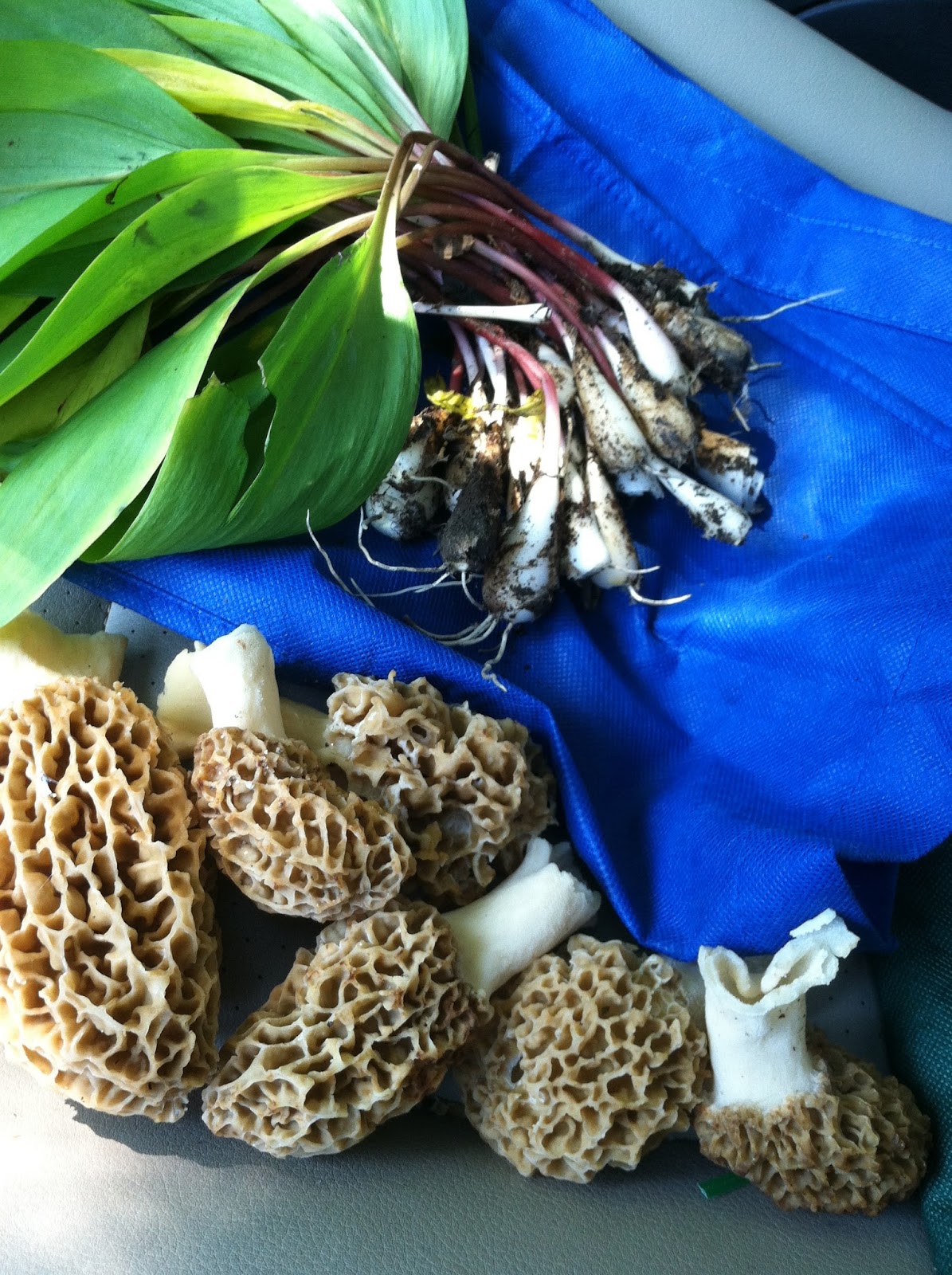
And that holy trinity of morels, ramps, and fiddleheads, about which I’ve written so often over the years that I no longer worry that I crib from myself – my old readers will read as if anew and my young ones won’t have read the original.
This reminds me of the first time I succeeded in finding fiddleheads. My daughter Zoe was tiny, about two years old, and I had strung a blanket over the piano bench for her to play tent in while I snatched five minutes here and there to read a book. She may have had a friend over for a while with whom to play house. It was drizzling and dreary, and finally, going stir-crazy, we put on our boots and slickers and went out into the woods anyway.
(Many years later, approximately 25, she wrote a song with these lyrics,
“Hike up your bootstraps, Little Dove
cause we’re going on a walk today.
Buckle up your yellow slicker,
cause we’re gonna walk a long, long way.” 
I like to think that the baby memory stuck and transformed itself into something she could mindfully remember.)
Once outside we found that the rain was soft and the watery light filtered the landscape into gentle secrecy, making it gorgeous for us.
I had only read about fiddleheads before that and had the amateur’s healthy fear of poisoning ourselves by eating the wrong... fern for gawd’s sake. Still, in desperation, I munched and tasted, until I realized that the copper-sheathed curlicues barely unfurling from the mother corm were obviously the edible ones. And we picked...
Picking fiddleheads is mesmerizing, prying the coppery curls up and snapping them off until your bag is full and it is time to go. Oh, just one more, and one more...
There were years in between when the slightest intimation of foraging anything was enough to elicit the cry “Motherrrrrrrrrrrrrr!” but inevitably came the day when she showed up late to my house because she’d stopped to pick some fiddleheads on the way. All by her ownself. And last week she and her person, Jesse, himself a fisher and avid forager, showed up with fiddleheads AND ramps, and Jesse made a fiddlehead salad for Sundays at 5 at the beach, and this is how he did it. I think.
Fiddlehead Salad
Make a vinaigrette by shaking together in a small jar 2 smashed and peeled cloves of garlic, the juice and zest of 1 lime, and 1/3 to ½ cup of extra virgin olive oil. Add ½ teaspoon of sea salt. Maybe some pepper. Put the lid on and shake it up.
Wash about a quart of fiddleheads repeatedly under a hose sprayer outside in the sunshine until the copper husks have completely disappeared (they will clog up a sink quicker’n scat). Bring a pot of water to the boil, salt it adequately with a fistful of salt and when it is boiling dump in the fiddleheads and bring them back to the boil and cook them for only a minute or two. Strain them and plunge into cold water, and then drain.
Slice 3 ramps, both bulb and green leaves, and warm in some olive oil over low heat for a few minutes until slightly softened. Add to the fiddleheads in a big bowl. Toss with enough of the vinaigrette – to taste – and eat’em up. (I think he squeezed half a lemon over this finished salad.)
Jesse says, “I like simple food, simple preparations, where you can taste the real food itself.”
You could, no doubt, boil up some pasta, particularly orecchiette, the little ears, and toss them in with the fiddles, and that would, no doubt, be even better.
***
Or, you could make one of the more delicious foods you will ever eat, a
Fiddlehead and Ramp Quiche
Make a single 9 inch crust – I gave a recipe in the 4/14 column – and line a pie plate with it.
The formula for any kind of custard is 1 egg +1 yolk + 1 cup whole milk or mixture of milk and half and half. I used unpasteurized whole milk, and it was very creamy. I also added an extra yolk to help with that extra 1/2 cup of milk. The finished quiche had that wonderful custard that separates into soft rectangles of goodness. That has a lot to do with the egg/milk quality plus the regulation of temperature.
Bring the oven to 450°
Filling:
  • 1 dozen ramps OR 1 large shallot or 1 dozen scallions + 2 cloves of garlic
  • butter and olive oil
  • 2 ½ cups cleaned fiddleheads
  • 1 cup grated cheddar cheese (or more)
  • ¾ cup sliced spicy sausage, or crumbled bulk, cooked rare
  • 1 large egg + 2 yolks
  • 1 ½ cups creamy milk
  • ½ teaspoon sea salt
  • grating of nutmeg

Bring a large pot of salted water to a boil.
In a sauté pan, over low heat, sauté the ramps or scallions and garlic in butter and olive oil until limp and slightly golden. Add a little water or white wine if they’re browning too fast and aren’t getting soft fast enough. Remove from heat and let cool a bit.
When the pot of water is boiling dump in the fiddleheads, partially cover, bring back to the boil and boil for 3 minutes. Drain in a colander and spray with cold water. Shake the colander to get any excess water off, then let drain over the sink until ready to use.
Whisk the eggs together so they are well combined but not frothy, then whisk in the milk, salt, and nutmeg.
Scatter the cheese over the bottom of the pie crust, spread the ramps or onion mixture evenly over the cheese, scatter the sausage and then the fiddleheads over that, then pour over the milk/egg mixture.
Bake at 450° for 10 minutes; then turn the oven down to 325° and bake for another 20 minutes to half an hour. A silver knife will slide in and out cleanly when done.
***

Primavera. What does it really mean? Well, just spring in some romance languages. But it has shades of primate and primacy and certainly primitive. Primitive and romantic, as in a blanket in a meadow, as in crouching along tearing sweets from the wild soil. 

Friday, May 01, 2015

...detour...

Patience, readers, long overdue realization that i need to do some work on this blog so... i'm in the process. Under construction... Thanks...