Showing posts with label Thomas Dairy. Show all posts

Tuesday, June 09, 2015

no morel in these mushrooms


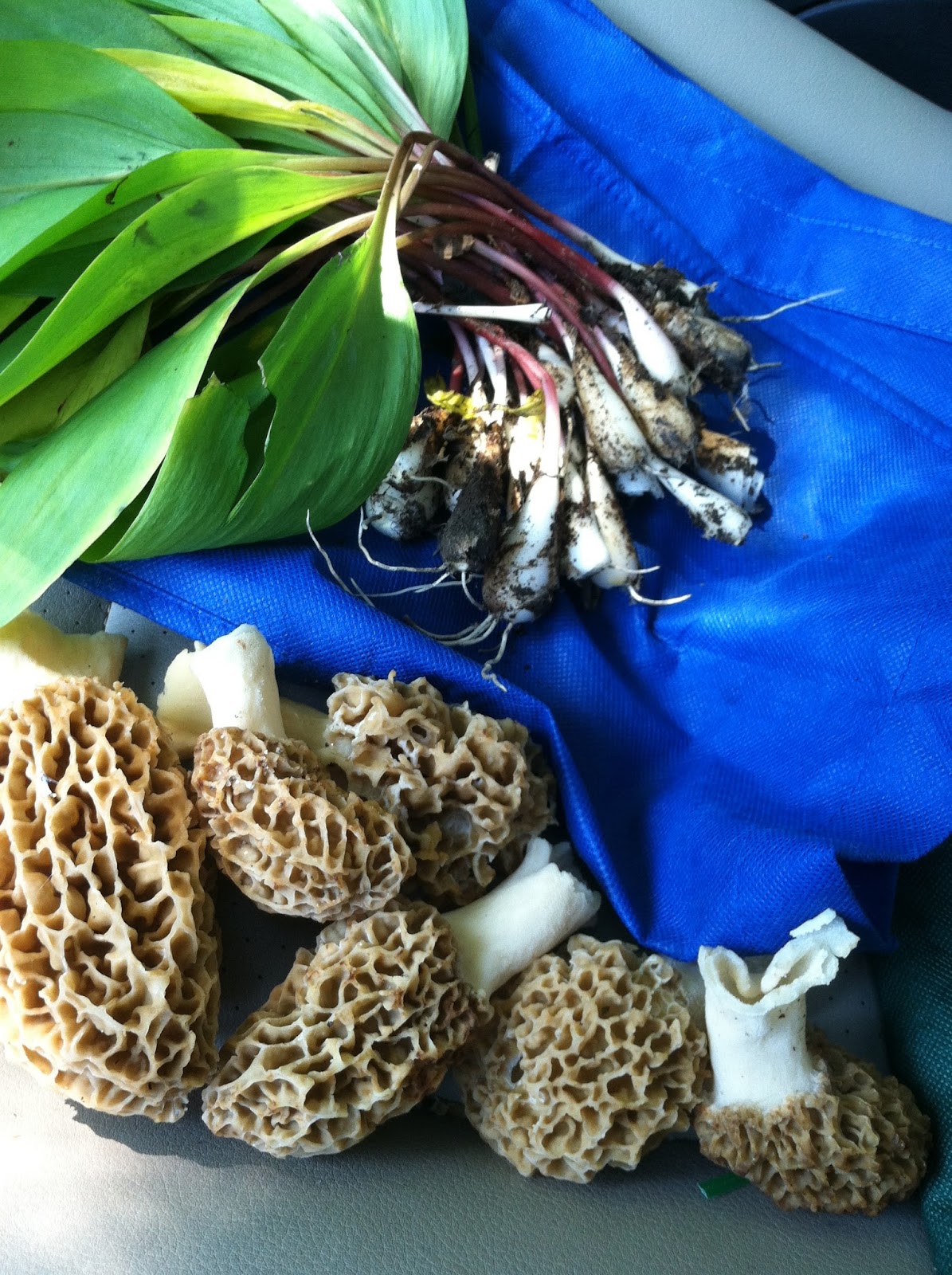
Morels, hateful to say, exist in a state of non this year, or if they exist they are those yucky little thin and smooth skinned ones that hardly seem to be morels – and those I only saw in a photo on Facebook; who knows if they really did exist. It was that burst of heat a few weeks back that did them in, and the arid May. Morels need a mellow rain preceded by April and followed by a humid heat – a morel-breeder, we call it. And you need to spot one to begin to believe your own eyes, and bend over, and with your nose pointed at the one you saw you let your eyes roam in a circle and they seem to pop up before you. Instantaneously. If you’re lucky.
These eyes have not spotted one morel this year and so my contention is that they do not exist. It is not quite too late, though, and hope still blooms, if dowdily.


Not really as a substitute for morels but good in their own right are the shiitakes I’ve been buying at the Farmers’ Market from Heather and Jim at Foggy Meadow’s stand and, although they are grown purposefully on logs and can be gotten at any time of the year, I’m finding them very tasty. Leo was gone for a few days and, finding myself able to feed myself what and when (not to mention where) I wanted without considering anyone else, one night I fed myself shiitakes in cream, Thomas’s heavy cream, with good buttered toast from the French baker at the Market. At about 8:30 at night. While watching Still Alice – which wasn’t a very good movie, in my opinion, compared to the book.
But, what was I saying?

 Oh right. You might think that was a recipe for indigestion and you might be right. I believe I took a teaspoon of Yoder Farm raw cider vinegar in a little glass of water a while after that extravaganza, in the way I’ve come upon to keep the body alkalinity in balance with the stomach’s acidity. All was good.
Speaking of heavy cream – and I did back in October of 2010, in a column about Thomas Dairy– dotter Zoe and I were down in Cape Cod (we left the day after Leo got back from the Northeast Kingdom – which provided a nice vacation from each other for both of us), when she picked up a pint of Kimball Brook Farm Heavy Cream for our morning coffee. We were glad to see an excellent Vermont product on shelves at the Cape, but we did wonder at the print on the bottle – it said it was homogenized! Heavy cream needn’t – indeed, cannot – be homogenized because homogenization means putting back together the centrifugally separated cream and milk in certain percentages to make skim, 1%, 2%, half and half, in such a way that they won’t separate again. It’s done by passing the liquid under high pressure through a tiny orifice, making the fat globules smaller, increasing their number and surface area, which keeps them suspended throughout the more watery substance and prevents the cream from rising to the surface (and there is some evidence that the smaller globules of fat produced in this process are able to get caught on the walls of the arteries and can clog them). Heavy cream has nothing to be combined with so the word homogenized on the carton is nonsensical. Sure enough, when I got in touch with Cheryl DeVos at Kimball Brook I found that the label is standardized, with just the name of the item – in this case heavy cream – differentiated.
It is the process of homogenization that has made me advocate for non-homogenized cream-line milk from dairies, and Kimball Brook offers an excellent one but you have to ask your grocer to stock it. That Thomas’s doesn’t offer one has proven to be less important with the advent of the new raw-milk rules passed by the state in this last legislative session that make it possible to buy raw milk – naturally unhomogenized, naturally cream-line, naturally unpasteurized – at Farmers’ Markets. I bought some Saturday in Rutland from The Larson Farm. Talk about fresh. Talk about creamy. Talk about mouth feel. Well. Quit talking and drink. It’s delicious, and healthy in ways differently from other foods.
If you have a distrust of unpasteurized milk but still want unhomogenized, please ask your grocer to stock Kimball Brook’s cream-line. Because, if no one buys it they won’t make it.
The Cape provided us with a powerful dose of ocean that we badly needed, and we came back from all that beautiful blue to beautiful green Vermont in time to get to the Market where I bought the good milk and even more shiitakes from Heather and Jim. I think I’ll make a pizza with them tonight – sauté them first in olive oil with some of my green garlic, a plethora of them, really; and strew them thickly on the pizza dough (over some fresh oregano leaves) with some added sliced green garlic, then towards the end of baking strew grated parmesan and a few drops of heavy cream over to finish baking. That sounds good, doesn’t it?
So now, a recipe. How about one for
A Cream of Mushrooms
for one
Take the stems from 4 ounces of shiitake mushrooms (or other mushrooms, or mixture of mushrooms, but not morels*). Put the stems in a saucepan and cover with water and bring to a low boil or a high simmer and leave them there for half an hour, adding water to keep them covered. Reserve.
Slice the shiitake tops and add them to a sauté pan over medium heat into which—when it’s hot –  a knob of butter has been melted with a glug of good olive oil until the oil becomes wavy. Once the slices are added turn the heat to low and let them simmer until they have let off any liquid and, in turn, simmered the liquid back off. Then add a glug – 2 tablespoons, say – of sherry or marsala or port or... something flavorful, and strain in the reserved shiitake stem broth and cook until almost dry. Season with salt and freshly ground pepper to taste. By all this adding liquid and cooking it off, we’re concentrating flavor.
Meanwhile, make some good toast and butter it well and cut it into fingers.
Finally, add heavy cream to the mushrooms – as much as you like: do you want a sauce or a soup? – and heat until just beginning to bubble. Grate some nutmeg over it. Stir it in.
Ladle the mushrooms into a sauce dish or soup bowl, scrape the pan out good, place the mushrooms on a tray with a nice napkin. Put the toast on a plate on the tray. Pour a glass of wine or sherry and place it on the tray. Do you have a flower? Take the tray to your favorite space at the moment and be mindful of every bite.

*Morels –should you be lucky enough – should be sliced in half, the critters brushed out of the stem and the craters; dusted with flour, and fried in butter until crisp. That is all. Respects must be paid. 


Tuesday, November 25, 2014

caramel alchemy


Partner-in-life has been on a too-long ice cream jag, which would be all right except for all the sugar carbs  that tempt me to share the jag, and two more reasons, #1 that he has eschewed Ben and Jerry’s creaminess (and priciness) for Second-Best-Local-Ice-Cream. SBLIC, which used to be really good, is now, due to a family quarrel regarding quantity vs quality, not as good as it used to be: It tastes icy instead of creamy.

P-i-L HAD brought home one of those B&J pints with a core of caramel down the middle of it. That was dicey in that it was TOO good. Next he bought the SBLIC Sweet Cream flavor, which sounds so good but was still icy, and a little jar of brand name (SureFine? Smuckers?) caramel which sported as first ingredient high fructose corn syrup. That was Reason #2. I put that little jar on the porch. I said, “You take that right back, we don’t eat that kind of Stuff in this house.” Dotter was home, knowing (as did he) that I was right. But. Caramel! “What do you think that caramel core in B&J’s was made of?” he whined. I hate to think.

Well, actually, I did think and so I looked it up. Ben and Jerry’s Caramel Core Ice Cream has about 23+/- ingredients but, though it does list corn syrup, it is apparently not high fructose corn syrup.

Twenty-three ingredients! Ice cream is best when you have three ingredients. In June those would be Cream, Sugar, and Strawberries. In July substitute blueberries for the strawberries. Caramel should have 2 or 3 ingredients: sugar, cream, and maybe butter. Added together that’s 4 ingredients, most of it sugar.

So one night, right after the marvelous shrimp dinner that I wrote about 2 weeks ago, that he and she had cleaned up after, with SBLIC Sweet Cream looming, almost without thinking I plunked the black cast iron skillet on the burner and turned it up to medium-high heat and, when it was getting there, poured a cup of white cane sugar into it, then shook it a bit, and turned the heat down a bit and stood looking at it, as did dotter.

“What...?” she said. “Just sugar...?” she said, as the edges of it browned and sank and ate at the interior, and a couple of hot spots in the center began to spread.
“Yep,” I said, “caramel.” A gasp. “I didn’t know it was such alchemy,” she said.

Alchemy, yes: When you think what different substances ice cream and caramel are, both made with almost the same ingredients.

I modulated the heat, picked up the skillet to that end, put it back down, turned the sugar with a silicone spatula, and when all was melted, white turned to amber and that turning dark reddish brown, watching witchfully, as soon as it “was just past the point when it starts to smoke,” (David Lebovitz) I turned the heat off and added heavy cream that I’d warmed in its own container in a bowl of hot water, Thomases again, and stirred carefully as it rose whoosh up the sides of the pan (silicone gloves are handy) stirring with that silicone spatula. I turned the heat back on low and when all was incorporated I turned the heat off again and added a couple lumps of salted butter and swirled them in. It was gorgeous. 


Ice cream sundaes were made with that Second-Best-Local-Ice-Cream’s Sweet Cream flavor topped with fresh, pillowy red raspberries and then that Surprise Caramel Sauce that astonished me as well as them, because it disappeared over the berries and ice cream only to be re-discovered in the process of spooning it up where it had formed its soft, round, buttery mouthfuls deep in the ice cream and berries.

Chemistry. Ain’t it grand?

***
Post Script: This is privileged stuff, having the sugar, the pan, the stove, to cook. How many people don’t. I can’t imagine. But I know it happens and so I give my money to people who can help those who haven’t even the basics, Vermont Foodbank. Please give to them this holiday season and every other season. 


Monday, November 03, 2014

Shrimp with a Snap

Let’s just say that flaccid shrimp are not my cup of seafood!

I found the following instruction in a recipe posted by a popular cooking show: 

"Immediately drop in the shrimp (to a moderately hot pan) and stir for another 1 to 2 minutes, or until the shrimp are turning pink and are barely firm. Turn the shrimp into a serving bowl..."
Did you say UGH as loudly as I did?

A friend told me of his dear friend who habitually brought rather limp shrimp to events, so that one time when he forgot to cook them at all no one noticed. Flaccidity in shrimp is not your friend; as a matter of fact i can't think of an instance when it is a good thing. If you have anything in your home that the word flaccid could apply to it is probably a good idea to get rid of it.


But that wasn't the only thing that was wrong with that recipe. It called for the shrimp to be brined in a mixture made of water, 1/2 cup sea salt, 1/3 cup cane sugar, and 1/3 cup medium-hot chile powder! Soak for twenty minutes and then dump all that chili powder and sea salt out? I don't think so.

Sometimes we glom onto old advice that does not benefit us. For instance it is certainly possible to handle pastry dough too little and it is probably done quite often simply because everyone is paranoid about "handling it too much," advice that benefits only the makers of store-bought pie crust. After all, the stuff has got to hold together. 


Ditto about cooking shrimp and lobster for a short time "so as not to make it tough". Well, I'd rather have it tough than flaccid. But most of all I'd like it firm and with a bit of snap when you bite into it. A juicy snap.


A few weeks ago my daughter was flying out the next day to drive a u-haul back here from North Carolina with her significant other and all their belongings. That night called for a special meal for her to remember and come back to and that's why I picked up her favorite, shrimp, that had been imported from an Ecuadorian shrimp farm by Green Mountain Fresh down on State Street.

I'd been talking to Ingrid Wisell there about the advantages of farmed shrimp versus wild shrimp when owner, John Schramm, walked out and said he'd stack up his farmed E-Z Peel shrimp against wild-caught any old day. So I ordered 1.5 pounds of E-Z Peel. 


It's cheaper than wild-caught –  about $12 a pound that day as against just about $17 for the wild-caught –  and Ingrid had told me that most of its food is swept over it in the wild ocean, and that food is supplemented with appropriate other wild food. "It is definitely not fed chicken feed," she said, rather offended, but dispelling my greatest fear.
To prepare that shrimp I set my oven to 450° and placed a heavy cast iron griddle in it and as it heated I peeled the shrimp. E-Z Peel means the shells have been cut up the back, which makes them perhaps E-Zier, but not really E-Z, to peel. As I peeled them I lined them up on a flat, rimless pan so they would be easier to slide onto the hot griddle when it was time. 

I have an old oven so by the time it had come up to temp I had prepared the shrimp and thin-sliced the last green tomato from the garden and fried it in some lard (rendered by Pine Woods Farm in West Pawlet) in a heavy cast-iron frying pan. 


I removed that flaming hot griddle from the oven ever-so-carefully, drizzled it with just a bit of olive oil to prevent the shrimp from sticking, then slid the shrimp onto it and placed it back into the oven for about 2 minutes. Back out they came to be doused with half a stick of melted butter and 2 or 3 cloves of finely chopped garlic. Back in for another 2 minutes, and when they came out this time I sprinkled them with the juice of half a freshly squeezed lemon, some coarse sea salt, and covered them with a bit of parchment paper and let them sit and sizzle and drink up the flavorings for a few minutes. 


They were served atop polenta made from a bit of masa harina that I'd cooked down for a long time until it was positively gluey, then thinned with Thomas’ heavy cream and grated cheddar. Slices of that wonderful green tomato went on the very top, juices were drizzled and chopped fresh parsley was strewn over everything.


It was exquisite, the shrimp snapped with flavor and texture, and the meal did its job – Daughter showed up safely, right on time a few days later and again lives in Rutland. 


Good shrimp'll do it every time!

Tuesday, October 26, 2010

gentle cream

Every morning there they are – the players of my a.m. – the coffeepot, the coffee, and Thomas’s Half-and-Half.


Yes, I love my coffee. My coffeepot? Not so much! A great, black, overpriced monster, so officious you’d think it would do more than make coffee; but if that IS all it can do you’d think it could do it without being so intrusive. Always flashing its little red eye at me!  “Girl! Clean me!” Or, “Girl! Change my filter!” Insisting on beeping every morning – just what everyone needs in the morning, five shrill electronic beeps –  to tell me the coffee’s ready.

Which is insane, of course – am I not standing here staring at you as you begin to gurgle, making sure you haven’t decided to spurt great puddles of black greck all over everything? Did you think I would forget my first coffee injection of the morning? Are you not gurgling into a vacuum bottle that will keep it hot? And please, do let me remind you that it is MY coffee, so get busy!

As for the coffee itself, my favorite lately is Pierce Brothers’ Holy Smokes – organic, Free Trade – from the Co-op. I grind it all at once when I buy it because I don’t like the noise of the grinder first thing in the morning (hint hint, Mr. Coffeemaker!). And I mean! Really! How freshly-ground does this old palate need it to be?

My VPR mug sits on the counter next to the monster. I pour my Thomas’s half-and-half into it before the coffee. It’s my cream of choice except when I have whole, unpasteurized raw milk from one of my neighboring farms.

Why Thomas’s? Well, 1) it’s bright and cheery and good tasting; 2) it’s local – Thomas Dairy has been around since Orin Thomas started delivering his own cows’ milk back in 1921, and now the milk comes from six local farms – as one of their wryly clever ads says, “Trucked in all the way from up the street” – and it’s owned by the grandchildren, Richard, John, Perry, and Christa (John’s daughter, Abbey, is now showing an interest); and 3) it is  gently pasteurized.

Which is to say, it is NOT ultrapasteurized – that is, cooked until you could keep a pail of it in your pantry for months and not a creature would take the slightest interest, unless it accidentally tripped on a box of Jell-o and fell in and drowned. Almost all the organic milk you can buy is ultrapasteurized. And what that means, of course, is that our organic dairy farmers produce a wonderful product that is then picked up and shipped out of state to be processed, subjected to ultrapasteurization and homogenization, then shipped back here deader’n a doornail.

I’m standing here watching the dastardly coffee-pot when it occurs to me –  I’ll bet Thomas’s is about the only milk we can get that ISN’T ultrapasteurized. And yup, next time I look in  the Co-op’s dairy case I find that’s absolutely true.

People who haven’t been paying attention buy this organic, ultrapasteurized milk and exhort their kids to drink it – Because it’s GOOD for you! But it’s probably NOT good for little Noah and Emma, first of all because it’s cooked, and second because if Mom and Dad have been paying attention to the official line for the last half century they have certainly come down with the prevailing idea that animal fats are not good for them and so they are feeding little Carter and Madison skim milk or 1% ultrapasteurized water that has probably had dried (skim) milk solids added back into it so that it doesn’t have the mouth feel of water. Dried milk is often made by spraying milk onto a hot screen and then peeling the evaporated solids off the screen.
Eew. It’s not a good thing. And drinking milk without its natural fat just further upsets the balance between its good Omega-3’s and everything else’s Omega-6’s.

And maybe, since little Liam and Charlotte would rather drink soda, Mom and Dad have brought them sweetly flavored chocolate or strawberry milk. We are getting very far from whole, natural, or healthy here, or even the meaning of... Milk!

Anne Mendelson in her book, Milk: The surprising story of milk through the ages,
writes, “As shown by USDA and census statistics, consumption of both whole milk and butter was steadily declining during the 1950s and ‘60s while the number of fatal heart attacks rose – along with decreasing use of animal fats overall and increasing use of vegetable oils. Yet to this day the American Heart Association – which readily accepts money from manufacturers in return for putting AHA approval stickers on products like Cocoa Puffs breakfast cereal and Smart Balance De Luxe Microwave Popcorn – still inveighs against milk with the milkfat that is simply part of the nature of milk.”

Those people who feel that pasteurization is needed in order to kill off any dastardly microbes should demand with their milk dollars milk that has been heated to the agreed upon high heat (of 160° - 170°) for a short time (20 seconds)  rather than the higher heat of  280° for a shorter time (at least 2 seconds), which is what produces ultra-pasteurized milk.

Still gazing at my black plastic coffeemaker, I realize that I have never seen the inside of a dairy processing plant nor do I know the exact process Thomases uses, so I drive up to Thomas Dairy just north of Rutland and talk to John and Richard Thomas, who are cousins, and it works this way: Milk from each of the 6 dairy farms they buy from is picked up every other day – their one milk tanker is on the road every day of the year –  then fed into one of several bulk tanks built into the walls of the rather small processing plant. A portion of that milk is kept whole and the rest goes through the process of separating the milk from the cream. At that point whole milk is added back to a portion of the separated skim milk to make the 1% and 2% milk. Cream is added to the whole milk to make the half-and-half, which is 11-12% butterfat (trivia fact: half-and-half originally meant half skim and half lite cream which is 20% butterfat. Just to give you more of an idea, heavy cream is 43% butterfat and butter contains about  80% butterfat).

The next step is to pasteurize every mixture, and then all but the heavy cream is homogenized.
Homogenization consists of  passing the liquid under high pressure through a tiny orifice, making the fat globules smaller, increasing their number and surface area, which keeps them suspended throughout the more watery substance and prevents the cream from rising to the surface.

It is this last process that Anne Mendelson finds most objectionable. “...virtually all the pasteurized milk that reaches us has been centrifugally separated, recombined to standardized milkfat percentages and homogenized. These steps do more to denature milk than anything else that happens to it in manufacturing. The creamier ‘mouthfeel” and fresher flavor of whole raw milk at a well-run... dairy farm ... reflect not just actual freshness but the fact that the basic milk structure is intact. You can get nearly all the same effect from unhomogenized pasteurized milk – at least, if it comes to you very fresh and was pasteurized by the right method.” There is an added benefit to unhomogenized milk and cream – there is some evidence that the smaller globules of fat are able to get caught on the walls of the arteries and can clog them.

When I asked John and Richard, separately, whether they would consider offering unhomogenized whole milk (called cream-line milk) if they found there was a demand for it, both looked thoughtful, perhaps even intrigued, and agreed that it was a possibility.  Whole milk which is never separated, only gently pasteurized, and bypasses homogenization would simplify their process immensely, and be much less expensive to produce.

In the meantime, there’s another solution if you want your coffee cream unhomogenized. Since Thomas’s doesn’t homogenize their heavy cream, you could mix a small container of it with a quart of skim milk. That is, if you don’t mind shaking your coffee cream!

Those of you in the central/eastern part of the state can buy Strafford organic cream-line milk. It is unhomogenized and simply pasteurized. Monument Farms Dairy (that link under construction), a little north of here, also does no ultra-pasteurization, but their milk is homogenized. None of them allow their milk to contain any added hormones or antibiotics.

I asked John Thomas why it was that my half-and-half and cream lasted so incredibly long – I can leave a freshly opened carton in the fridge while I leave for a long weekend, and when I come back it’s still fresh.  He said he didn’t know, but that a lot of chefs won’t use anything but Thomas’s heavy cream because it stays fresh and sweet and always whips up nicely.  I told him that when I make crème fraiche with any other cream (and when and why would I do that?) it sometimes won’t sour and thicken at all. He’s not a cook, but he filed away that fact. I think it’s because Thomas’s is so fresh. And local! Its shelf life starts moments before you reach into the cooler to buy it.

Ah, finally – the monster emits its five beeps and I pour my first cup of coffee. I wish someone made coffeemakers locally.

Crème Fraiche
Gently whisk a tablespoon or two of good (Cabot’s) sour cream into a pint of  Thomas’s heavy cream in a bowl, loosely cover and leave in a warm place until piquantly soured and quite thick – this usually takes about 3 hours. Serve a dollop of this over pies, pot roast, or breakfast toast. For a special dessert, serve it over good preserves or jams or jellies served in very small bowls, with tiny spoons. How precious!


Originally Published as a Twice Bitten Column in the Rutland Herald 10/25/10