Tuesday, May 24, 2011

rode hard road food


Driving U.S. Route 81 to Virginia and then to western North Carolina is, for us Vermonters, a little like wood nymphs slipping out of their forest homes to do battle with dinosaurs or giants in an alienating landscape.  We both need a truly imperative destination or else we’d just stay at home nestled comfortably among our tree roots.

But since U.S. 81 divides us from our daughter and other friends, warmer latitudes, and the south – the south as culture and landscape and, inevitably, food – the battle must be waged periodically.

Now look what I just wrote there – that U.S. 81 divides us instead of unites us as is no doubt the proper role of any highway worth its salt. But I’ll stick with my original description, for it is a veritable river of humongous trucks, and not a smooth one at that – up and down it goes – straight up and then straight down again, again and again, over destroyed mountains. Harrisburg. Scranton. Dead deer and concrete fields. Acres of Wal-Mart – distribution centers, headquarters, and trucks. With our wants and trivial pleasures we turn swathes of our earth gray and unproductive.

We come from Vermont, though, where the stresses we put on the earth are comparatively benign, and where WE certainly would not allow acres of our soil to be cemented over for junk storage. Would we? How about Williston? Or, closer to home, Rutland Town?

The first day we drove ten hours so that we would not have to stop until we got to our friend Dana’s kitchen in the serene rolling mountains of Virginia just north of Charlottesville. I’ve been enjoying cooking in that kitchen whenever I get a chance since it was created, maybe 20 years ago. Its centerpiece is an – oh – five foot long well-used butcher block work space, none too level,  and its many windows look out over beautiful productive gardens.

As we’d left Vermont that morning it occurred to me that Virginians didn’t, probably, grow rhubarb, so I’d picked enough for a pie. The next morning I wandered into that kitchen in my pajamas and got my first cup of coffee and started making a rhubarb pie, while partaking of conversation with Leo, who’d already been out birding, and Dana, who was making breakfast. I love that kind of cooking, in a kitchen that accommodates more than one cook and function.

A couple of soothing, recouping days in Virginia and it was off to Asheville, a mere seven hours more of playing games of wit – certainly not of force – with the mega- and mono-liths, the eighteen or twenty-eight wheelers: Pass ‘em on the way up, get out of their way on the way down.
 
But once there, with my magnificent daughter Zoe and her partner Jesse, again we ate from a beautiful garden, under a canopy set up right beside it, accompanied by the chickens clucking in their sing-song soothing way from their chicken tractor, surrounded by the sharp spires of Western North Carolina mountains. We ate eggs sneaked from under those chickens everyday, and those eggs sat right up in the frying pan as though the whites had been molded around that bright plump yolk.


And I got the honor of pulling the first head of garlic out of Jesse’s garden, and it was a thing of beauty.

Zoe was graduating from nursing school, and so there were lots of people and parties and eating. There was the pinning ceremony, a dinner before it at the Tupelo Honey Café, and a couple of gigs that Zoe and Jesse played, and then, all too soon, time to set out on the return trip.


We were making good time until, in the valley between two verticals, the traffic slowed and stopped. There had been a clash of titans on some distant destroyed mountain top, and we peons were creeping through sixteen miles of back-up and incipient pile-up – who knew which of those many smoldering brakes would reach its breaking point and when.

After a couple of hours of this we crept up upon an exit, and Dana – now see, I’m not really a Luddite – was able to guide us over a little road, all hilly and curvy, without a center line or even a name, for about twenty miles, around the pileup. Thank god for cell phones and computers!

We made it to her house only two hours late. She fed us homemade spring rolls, fresh asparagus from her garden, cous cous, and lamb shanks. I’m not sure if I’ll ever have more delicious food. Then I sliced fresh strawberries from her bushes over the ice cream we’d made on our previous visit, and sprinkled it with balsamic vinegar and maple sugar. Not too shabby for road food, eh?

***
Over the course of my travels I missed the first two outdoor Farmers’ Markets in Depot Park in Rutland. I know – this is such an unlikely happening that some of you could not be blamed for thinking I must’ve met my maker. But all is well, and the markets were extensively covered, I found, when I went back over two weeks worth of Heralds. I was especially  pleased to note the new Market Watch column written  by Kris Smith of RAFFL. Welcome, Kris.
Kara is helped by her mom at this market
So this third market was especially colorful and festive to me. As well as greeting all the tried and true friends, I was pleased to see at least two new produce vendors. Ryan Wood-Beauchamp and Kara Fitzgerald from the poetically named Evening Song Farm in Cuttingsville have a burgeoning CSA business as well as attractive booths at several markets. They got off on the right foot with me because they had beautiful broccoli raab for sale!

Then there was Meadow Squier and Josh Brill manning their Breezy Meadows Orchard and Nursery from Tinmouth. They had something I’d never seen before – a snappy pretty little curly cress that is not a watercress. And it’s Yum. We knew Meadow when she worked at the Co-op and also at RAFFL.  Welcome and good luck to all!

It was really nice to see two older businesses with new booths at the Market. I was thrilled to see a Crowley Cheese presence – its extra-sharp is one of my favorite Colbys in the world, and the price was extremely reasonable.  And Jia Indian Restaurant from the service station on West Street was there with some delightful potato and pea samosas, amongst other delicacies.

Finally, I just want to remind you that the celery-like herb, Lovage, is such that no-one should be without and it’s available in the pot at Second Nature Herbs at the Market.
Some of my "finds" at the 3rd outdoor Rutland Farmers' Market are fiddleheads from Radical Roots; a tiny can of smoked jalapenos (chipotles) from Alchemy gardens; a pot of lovage from Second Nature Herbs; salad turnips from Evening Song; a new white balsamic from Gordon's Pond; Broccoli raab from Evening Song; Blue Ledge Farm's plain chevre; half a wheel of Crowley's extra sharp colby; and a bitey little cress from Breezy Meadows.

***
And, this just in::: Happy Seventieth Birthday to Bob Dylan, who said, when we were young and pretty and in good voice and thought we knew everything, 
“Well you know something is  happening/ but you don’t know what it is/ do you, Mr. Jones.”
That's truer, I'm sure Bobby would agree, now than it ever was before.

Wednesday, May 04, 2011

the merry merry month of


Spring makes me think of  Grandma’s screen door and Grandma’s clothesline.

That screen door – screen blackened and patched; patches sewn with strong cord in places where the dog’s front feet had rested, where children’s forearms slammed into it. Further trussed up – that flimsy frame – with wooden diagonals nailed in, and squares of plywood here and there. It was a sorry sight, yet satisfying. It was the signage of spring. Its sound, as small bodies hurtled through it, the incantation of summer in my memory.
Take this lovely remembered shabbiness off the house and place it atop a green meadowy hill. The thud of small, grimy heels comes to the ears, a small body hurdles, nearly naked, toward that door, smashes into it, through it, and bolts onward: The child flies over the hill and disappears into the valley of... adulthood?

Meanwhile, the door, alone on the green hill with only its frame to make it visible, to give it meaning, and to give the sound of it resonance when hit by the small and grubby left forearm of the child upon the special square of plywood set there to reinforce it against these repeated onslaughts, extends open to the magnitude that the black wire spring across its top will allow – like a bullfighter who, with a twitch of the hips, avoids the bull – and hangs there yawning, suspended, stretching, before reaching its final and furthest extent, pauses, then begins inexorably, to close, slowly at first, then overcoming inertia to shut with a resounding slam if it is sturdy, or a splatty slap if it is not.

But who hears? The child is gone. Only memory remains.

A voice began before the child appeared. It warned, “Don’t slaaammm...” The child appeared over the crest of the hill, left forearm at the ready, hit that door running, and was through it and over the hill before the voice finished, “...the doooor!” which was followed, of course, by the slam of the door.

Also upon this meadow, you notice, is a clothesline, and the spring breeze that tugs at the door in its frame – succeeding at times in opening it a whisk against the black metal spring’s determination –  billow the sheets around you, the fresh-smelling, pristine sheets, and the yellow sunlight slants down upon the crown of your head and you are the sheets, you are the sun, you are the billow and you are Spring. You are the voice, “...don’t touch...” warning the muddy hands of the child (also you), returned from the valley beyond the hill, “...the sheets!” But it is too late.

~~
Ah May! The month of my birth, the month that ramps are born – wild leeks – and fiddleheads, and morels. Even dandelion greens! What good company we keep!

I couldn't resist adding this photo of the latest pie. I used basil leaves as an herbal counterpoint

And there is rhubarb, and on May Day I make the first rhubarb pie. And this is the way I did it is here.

The leeks? Eat them raw or put them into a fiddlehead quiche, found here (scroll to the bottom to find a humble pie for gentler chiders).


Morels? I dip them in flour, very lightly, and fry them in butter and olive oil. I don't stuff them into anything and I don't stuff anything into them. I like to taste them, and only them! Because they may be my favorite taste in the world.

The other thing that people don't think of as a spring food, is overwintered parsnips. Spring is when parsnips should be eaten. My friend Kathleen cookes them with a whiskey/mustard glaze, with a hint of maple, that is tremendous!
These are my spring parsnips -- quite small yet

Spring Parsnips in a Whiskey Mustard Sauce
This is the original recipe. See note below.

1 pound parsnips, scrubbed, peeled, if you like, cut into 1/3 inch diagonals
3 tablespoons butter
4 tablespoons Dijon or other distinctive, coarse-grained mustard
3 tablespoons half honey and half maple syrup
1/2 cup bourbon, whiskey, or rum
salt and freshly ground pepper
1/4 cup chopped parsley

Heat oven to 450°

Steam or boil the parsnips in well-salted water until just tender. Butter an ovenproof gratin or 8 inch round baking dish and arrange the parsnip slices in it. Roast for 10 minutes. This draws out the natural sugars to caramelize in the high heat. You could also grill them.

Combine the butter, mustard, honey, maple syrup and whiskey in a small pan and cook over medium flame, stirring, for 5 minutes. Season to taste with salt and pepper and fold in the parsley. Spread over the roasted parsnips. Lover the oven temp to 350° and bake for another ten or fifteen minutes.

Note: I've been making this dish for years, but never looking at the recipe. It seems unnecessarily fussy. I just simmer the parsnips in a little water and butter, and salt, until they have absorbed the water and are just becoming tender, then add the other ingredients and simmer until they are very done. Then I put them into an oven-proof serving dish and run it under the broiler until browned.

Live and learn.

... Notes...
•    First of all, Congratulations to Roots the restaurant for their award from the Preservation Trust of Vermont as Vermont's most important new downtown business. If you haven’t eaten there yet, Vermont Restaurant Week is this week, and Roots is offering 4 courses for $25. Leo and I did that Friday night and were very pleased. Highlights were a fabulous Kale salad (that I ordered on a dare, kale not being my fave veg) and a very nice grilled mozzarella appetizer. The Crème brûlée is the best I’ve ever tasted.  747-7414

•    The Rutland Farmers’ Market will move back outdoors into Depot Park this coming Saturday, the 7th,  so let’s say goodbye to the winter vendors who do different farmers’ markets – like Norwich and Londonderry – in the summer, hello and welcome back to those vendors who only do the Rutland Summer Market, and let’s salute those marvelous ones who celebrate the whole wonderful, year-around Market.  And let’s hope for a gorgeous day!

•    The following week – the 14th –  there will be an official moving day parade meeting at  the Co-op on Wales Street at 10 am to escort the farmers to Depot Park. Join us. Mayor Chris Louras will throw out the first radish.  I hear there will be a raffle that Saturday, too, with a drawing every hour.

•    On one of those weekends many of the vendors will donate 10% or more of their market proceeds to Carol Tashie’s  Farmer-to-Farmer:Vermont-to-Japan campaign that has gone viral, to include most of Vermont’s farmers and perhaps our neighboring ones, too!  Support them generously, won’t you?

Tuesday, April 19, 2011

the Noticers


I’m reminding myself to keep noticing, to be present, on these chilly damp days, and so I go out and make the rounds of the garden, of the yard, of the lake and the river, and in that way I realize the coltsfoot is blasting out its little leafless yellow flowers and the tiny white blooms of the bloodroot wrapped in their frilly leaves, like bugs in cocoons, are carpeting my yard. The sorrel is tart and lemony, peeking green out of the chopped leaves in my garden – the very earliest edible – and Egyptian onions are freshening.
And, I am reminded, Easter is coming on, isn’t it? The first Sunday after the first full moon after the spring solstice.  All writhing goats and death and resurrection. And eggs and bunnies, of course. What a strange symbol of fecundity the silly pastel bunny is.

I notice the tiny vole who lay dead on his side in the coils of hose, how delicate his little claws, how curious his pinpoint of an eye. We notice the wood ducks and kingfishers on the lake, the raucous grumbling thunder of frogs mating in the bog. Nature makes herself known, pastel rabbits or not.


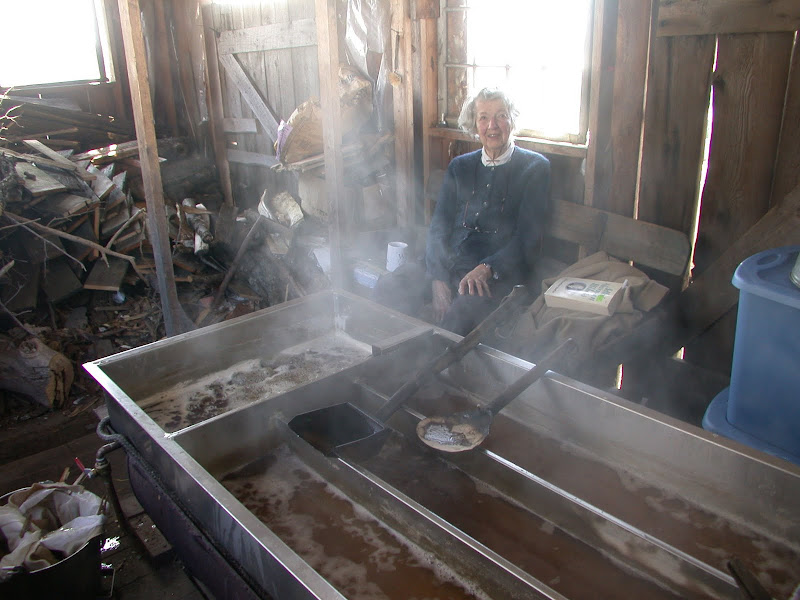
Edith Fisher Hunter, captured above by her son, Graham, at this year’s sugaring, is a powerful noticer. And she brought up four children to be noticers, and teaches the wider world to notice, too, through her books and her talks, Vermont Public Radio commentaries, and even through her preaching.

We began to exchange emails last September when I had the opportunity to tell her how much I enjoyed her VPR commentaries. There had been a recent one in which she had talked about sitting in her October garden among the overgrown asparagus fronds that had shot through them a volunteer tomato vine with tiny sweet tomatoes. Edith draws pictures with her voice, which crows and soars and teases as she brings to our  notice the natural world,  Aunts Mary and Margaret, Son Graham, Son William, Son Charlie, and Daughter Elizabeth.  They’re all pronounced without a comma, so that their proper names seem to include Son and Daughter.

I fancied it was an old fashioned kitchen chair on which she sat in the garden. A green one.

Wonder of wonders, Edith answered me by saying that she didn’t know what had possessed her to read one of my columns awhile ago – she had never, that she knew of, ever read a food column – and didn’t find it unpleasant. I was delighted.

Edith and her husband Armstrong Hunter published the Weathersfield Weekly for 15 years. They both had divinity degrees but Armstrong’s passion was for printing.  Weathersfield encompasses Ascutney and Perkinsville over in the eastern south-central edges of our state. The Weathersfield Weekly was very well thought of in Vermont and nationally, too. It made a community out of these disparate areas, and it made a center, too, right there on Center Road (which Edith pronounced “Centah” just as Hunter is “Huntah”).
Printing, and local newspapering, is all about community, isn’t it?

Once Armstrong submitted to a journalism contest an article Edith had written about the dairy industry in Weathersfield. As Edith tells it, “There were several classes to enter – publications with 100,000 circulation, those with 50,000, and those of 10,000 and under. We had 650! The winner in each class got $5 thousand  and a night at the Plaza and an awards dinner. Milton Freedman won in one class, and James Fallows in another, and I won in (the under) 10,000. Pretty good company! It built my garden house and back porch.”

Edith has written half a dozen books – one of which has been in print for 47 years. Armstrong joked that it put at least two kids through college! She’s written nature columns. She’s a historian and a genealogist. She’s 91 years old. There’s no sense in hiding one’s light under a basket when one has reached that great age.

In the meantime they reared their family. “I have three lovely sons who I see almost daily and we share such wonderful memories! And they have great senses of humor. And my daughter and I email everyday,” she wrote to me. And it seemed to me that the most amazing thing that Edith and Armstrong Hunter did was to encourage their children in all their varied interests, and act as such passionate advocates for them that each has evolved into an utterly idiosyncratic individual. It seems a rich and yeasty family, all writers, social activists, and I’m not quite sure how many ministers.

The oldest is Elizabeth, a writer, a teacher, a nature columnist, who lives in North Carolina. She’s the only one who lives out of state.  Graham is next – an architect, “the only one of the boys to be a Mr. Fix-It,” and the person who nursed Edith through an illness a year or so ago when she “almost flew the coop,” she told me.  “For almost a year he came over and made my meals and saw me off to bed and made my breakfast.”
Next is William, whom I knew of through his Peace and Justice advocacy. He is a lawyer, a writer, and a preacher. A community activist. “A saint,” his mother told me recently, but that was because on top of all his other duties he was finding me photos and mailing me things. Thank you, Will. Charlie is the youngest and has combined fine and graphic art with music managing. And  musical train tours. He’s in charge of Edith’s extensive gardens, too.

I’d been thinking about those gardens and in one email I asked Edith if I might  visit come spring. It was the end of February and Edith was looking forward to beginning sugaring with Graham. “You can come see me anytime,” she answered. “ I'll hope to be spending a lot of time in the sugarhouse starting next week - I hope, hope, hope.”

Days, no, weeks, went by, and I thought of Edith in the steaming sugarhouse with “Son Graham”. And then one morning I sat down with my coffee and opened the Herald and there, with plummeting stomach, I saw Graham’s obituary!

Edith wrote right back to my email. They were in shock. Graham, who was 63, had never been sick, it had been sudden and, to all appearances, peaceful. “He and I were in the middle of a great sugaring year. We had made 8 gallons when he died and since then I have made two more.” Altogether, they would make in excess of 19 gallons of syrup for the year. One keeps on keeping on. One keeps on noticing.

Before he died, Edith wrote, Graham had planted “what looks like 1,000,000 tomato/basil/rosemary seedlings. They are up and waving their little green leaves in the sun of my kitchen. Charlie came by yesterday and planted the cauliflower, broccoli, Brussels sprouts, and cabbage, and eggplant and lettuce. But the tomato seedlings are a lovely reminder of Graham, as are the little container after container of maple syrup. What an empty place he leaves against the sky.”
Graham at Thanksgiving with his grand niece. Photo by his sister, Elizabeth Hunter.

And then she added, “Come by sometime next week and you can see Graham’s wonderful pan in action.”
She had told me that two years ago, “when our old pan, which was very primitive, was giving out,” Graham designed a new one and had it custom made, and then “surprised me one day by taking me out to see it already installed in our sugar house.”

I did find my way to Weathersfield that week. I have to say the visit is pretty much a blur in my mind.  It was three days after Graham’s memorial service. I walked into the long east-facing enclosed porch and was greeted by a woman with the brightest blue eyes, and a sharp tongue, too. “You must be Sharon,” she said. And then, accusingly, “You don’t look anything like you’re supposed to!”

She was exactly what she was supposed to be! She wore a blue watchcap and an LLBean fleece and she was surrounded by the flats of tomato starts and, outside the windows, the birds at the feeders. Elizabeth was home and showed me the house, which appears not to’ve changed over the last century. Grandson Matthew was there. Will would wander by. Edith and I chatted and bantered. It is indeed a working, yeasty family.
Edith and I went to the sugarhouse, where I attempted to build a fire. I did not do as good a job as Graham would have done, but  I felt completely at home, very happy to be so insulted and so gifted.
I will go back in the summer, I hope, to notice more, to be taught by a master-noticer.


Tuesday, April 05, 2011

on not making a habit of anything

A 150 year old fern at Pierce's Store?

Mercury is retrograde so I put my writing Haflingers away, slip on my traveling Mucks and take off up Shrewsbury mountain to play with masa.

I keep thinking of everything in terms of Venn diagrams, how circles overlap and create a common center. So if we were to describe that day in those terms we would have the three circles of Maya, Lindsay, and me overlapping into a common center of = Tortillas! That’s oversimplifying, of course. We would have to have a big circle named Chet, and a little circle named Iris to be at all complete, and the Iris circle would have to be sliding into and between the bigger circles in a bubbly little way, occasionally even being osmosed into them with no rupture at all of any perimeter. I have no doubt that Iris is not a perfect three year old, but you couldn’t prove it by me!

Lindsay and I were there to learn about nixtamalization – soaking corn kernels in some kind of ash or lime treated water before grinding them into masa and making, well,  tortillas, for instance. Maya  had learned the technique in Mexico years ago and is generous with the knowledge.

So. There we were, in the back-of-beyond in a pretty much off-the-grid house, in a small kitchen with a roaring wood range, performing that time-honored dance of women slipping by each other in small spaces in order to achieve gargantuan tasks, comparing notes and solving the problems of community and world at the same time. We took turns lifting the kernels from the limewater, picking off loose hulls, and rinsing them. All three of us took turns grinding them, twice, while Iris, toes curled onto the edge of a kitchen chair, handed us balls of once-ground masa for the second grind.

(Oh, how I wish I had not forgotten my camera that special day!)

Maya added a good amount of coconut oil to a pot of beans and slid them into a scorching oven. We flattened small balls of masa in a tortilla press that Chet had made, and flipped them onto the hot range to cook. I kneaded some of the raw masa with buttermilk and leavening to make cornbread, slid it into the oven, and realized it was the kind of hot that I had not experienced since grandma’s wood range back in the good old days. Whew. We stripped off more layers.

When the tortillas were done and the cornbread had proven to be more of a corn pudding, we took them into the other room where a table was set charmingly with pickles and salsas and kimchi and cheeses to join the beans and tortillas and Chet joined us and we had a lovely repast with lively conversation. I don’t know when I’ve had a meal so delicious.

***
Manolo greets customers at the store recently

Another day, another Venn diagram. Leo and I drive up to Pierce’s store – located at the apex of Cold River and Lincoln Hill Roads, and at the entrance to the seasonal CCC road to Plymouth – to see what’s kicking.  Maya’s son, 12 year old Manolo, mans the cash register while Maya knits in the corner of the room. It is bustling and friendly and bright, as it has been whenever I’ve visited, and I sit down to talk with Maya while Leo gets himself one of Rob McKain’s blueberry muffins and some coffee and sits down at one of the tables in the back. Where there’s no shortage of people with whom to chat.

Pierce’s, of course, has come back to life, with only a few years of dormancy between this new life and the old one, which had lasted well over a century.

Some of us know that soon before she died Marjorie Pierce – the last in the family of Pierces who owned and ran the store – made a deal with Preservation Land Trust hoping to give the store continued life. A group of energetic people worked with PLT to decide what form the reincarnation should take.

Selling local products and making the store a community source of goods and gathering place – as it always had been – were in the lead. It would be a cooperative. It would not define itself as ‘organic’, particularly, but would serve the community, saving its members the long trek to Rutland every time they needed a cup of sugar or a loaf of bread. You’ll  find Bud Lite as well as Vermont brews, even a few packs of cigarettes, on the shelves, and a package or two of Purdue chicken in the freezer along with locally grown ones.

It’s worth noting, though, that the products from local artisans and farmers contribute a great deal to the well-being of the store, and to the entire community of Shrewsbury. Something like $13K stayed right there in the community last year as a result of farmers and artisans having a market for their product and customers the opportunity to buy it.

Win/Win!

As well, there was a nice over-all profit last year – its first year in this new life – which kind of belies its isolation, its far-from-anywhere location. Oh, I am reminded, it is not far from the center of Shrewsbury! And it has become a destination – a beautiful drive, delicious delicacies, and well stocked with one-of-a-kind gifts and foods.

Rob McKain bakes and cooks

Rob McKain – a chef of wide renown, especially in Shrewsbury – bakes breads and cookies and scones, and makes soups as well as a variety of other delicacies every day. Local cooks provide a take-out meal every Friday. Board members take turns staffing the store and each takes on a longer term project to fulfill. Maya, who is a newcomer to the board, is working on making the barn a presentable place for community gatherings.

Lindsay, whose last name is Arbuckle, and her partner, Scott Courcelle, co-manage the store, and have since a few months after it opened in August of 2009. See that new Venn taking form? Now Lindsay and Maya and I are circles surrounding a new center, which is Pierce’s Store. But oh yes, we are now joined by many other circles – Scott, for instance, and  Maya’s Chet, whose last name is Brigham, who was one of the early workers on getting that store reopened. And Manolo. I’m sure Manolo’s not the greatest 12 year old in the world, but you couldn’t prove it by me! Or Leo!

Scott and Lindsay were working for Americorps in Montpelier a couple of years ago. Scott grew up in Rutland and had some farm/garden experience. Lindsay, with Kansas roots, not so much; but she was interested in some of the garden lore other AmeriCorps friends were involved in. “I thought, that isn’t a bad thing to do with your life,” she told me. In the summer of ’08 they planted a community garden in Montpelier and liked the work, then looked into interning for a Rutland area farmer. They ultimately chose Paul Horton at Foggy Meadow Farm in Benson, “because we knew we’d learn a lot from him, and we did!”

At the end of that summer of ‘09 they learned of the need for live-in managers at Pierce’s Store from Rob McKain. “We immediately called the number he gave us, and went up to meet some of the members the very next day. On the drive, we brainstormed what we would say, what WE would want from a neighborhood store, a co-op, and that was community, convenience, and local food. We were SO excited, but we didn’t have any retail or managerial experience. Still, they got right back to us and said, ‘you’re the ones.’”

Last summer they planted a market garden at Greg Cox’s Boardman Hill Farm in West Rutland and sold from their booth, Alchemy Gardens, at the Rutland Farmers’ Market all summer. It was a good summer of hard work and juggling the Co-op and the garden, and a successful one, too.

Scott and Lindsay co-manage the store


They live where the Pierces did, in the house attached to the store, with the Pierce’s furniture and even a hundred and fifty year old fern. It really is like living in a museum.

I think that puts Lindsay and Scott into the center of yet another Venn diagram surrounded by overlapping circles of Americorps, local farmers, co-ops, the farmers’ market... food! And perhaps it makes them iconic of a new wave of Rutland area farmers who are going to be feeding us for the foreseeable future. They might not be the greatest young couple in the world, but you couldn’t prove it by me!

Pierce's Store can be reached at 802-492-3326
The hours are: Tuesday - Saturday 7am to 7pm
Sunday 8-5 
***
In Maya’s and Chet’s house there is enough electricity from a solar panel for electric lights by which to read in the evenings (a conscious choice not to support Vermont Yankee), but there is no computer, none of the other electronic time-sinks which sap our time and energies. There is no refrigerator in the house, just – in colder weather – a west-facing window-well where they keep milk from cows kept by Manolo and Grace, Chet’s sister.

Bone-broth soups bubble on the back of the range, and cooked food can be kept on the porch in cold weather. Jars of vegetables preserved in a naturally fermented state – kimchi and sauerkraut – stand in cool parts of the house. Thoughts and actions pertaining to food are a constant backdrop to lives like this, and when people ask Maya how she finds the time, she shrugs. Not too many years ago we all had to spend a considerable amount of time each day dealing with food, and look what’s happened to our food supply once we were relieved of the chore or, put another way, deprived of the pleasure.

Maya Zelkin is better known to the public as a thrower of elegant pots, which is the way I got to know her maybe ten years ago, and her potting shed is next door, still closed for the winter. A June firing is in sight.

One of the topics of conversation we had that day was how Maya liked to roast her own coffee beans. She likes her own coffee but she, unlike me, does not drink it every day. “I try not to make a habit of anything,” she said quietly.

Why, the very idea! It widens out the world.

***
This is the 100th Twice Bitten column to be published, and that puts me in the center of the most lovely Venn diagram of all, surrounded by fat circles of farmers and local food and food people, of eaters and doers, of co-ops and gardens, of readers and editors.

It’s a very happy place to be. Thank you.

Thursday, March 17, 2011

between now and green

a little dill'll do ya
Last year at this time we’d had spring for over two weeks – not terribly bright, perhaps, but in the 50s and low 60s sometimes – and green things were becoming apparent. All the green this year is at the Farmers’ Market.

Miller’s Farmstand has been offering dill and cilantro directly from growing flats for our delectation, other herbs already banded together, tiny bunches of romaine, and half a bushel of baby spinach if you get there early. Foggy Meadow has had micro-greens all winter – those baby sprouting greens that make such a difference to a plate all through these snowy days – and now has baby spinach, too, but, as with Millers, you need to get there early for a taste. They are in demand.  Jim Horton, Paul’s son, who has been manning the stand this winter, told me he hopes to have (shhhhhhh...) a bit of chard this coming market.

There’s no doubt that we’re missing Kilpatrick’s Farm this winter, they with their well-tended and well-planned plethora of winter vegetables as well as surprises all along the way.  In an email, Michael Kilpatrick told me, “...now at the (Saratoga) market we have lettuce mix, mesclun mix, baby spinach, regular spinach, Christmas spinach, boc choi mix, and  Swiss chard, for greens, (and) the kale will be back in a few weeks. Couple new roots this year, too –  Jerusalem artichokes, parsley root, purple and green kohlrabis, (and) a new yellow carrot.”

So, as I say, we miss them, but some of our larger farmers are seeing that they need to take up the slack – Paul at Foggy Meadow and Greg at Boardman Hill come to mind. How to do that sustainably is really the gnarly heart of the problem. Winter greens grown without petroleum? That would be the next breakthrough!

In my last column I said that you could find local mesclun – that mix of small-leafed greens – at the Co-op in Rutland. Mea culpa, you can not – they’re getting their mesclun from California! I’ve been buying it all winter, assuming it was from Benson’s Vermont Herb & Salad Company, because that IS available, and as we all know our Co-op is mandated to support our local farmers and provide us local produce when possible. So I emailed co-owner Heather McDermott to ask her where VH&S’s mesclun could be found. Not closer, she said, than Burlington! She is trying to get her herbs and salad mixes into Hannaford’s, however, so it wouldn’t hurt to put in a plug if you shop there.

Ironically, when Leo brought home a package of California mesclun from Price Chopper the other day I was like, Umm, I am NOT eating this stuff. What were you thinking?

(Over the holidays my daughter picked up two vacuum-packed packages of romaine lettuces. I popped one open to use in Caesar salad. The other got shoved to the back of the fridge and when I dug it out over a month later it was – guess what? – just as “fresh” and crisp as the first one had been. Now that is scary. “Don’t eat anything that won’t rot, or ferment” is a really good axiom.)

 “But it’s organic,” Leo said of this recent incident, “and I was at PC anyway.” Organic schmanic, I said, I’m not eating greens that were picked in California by who knows who, who knows how long ago!

 Sheesh. Who knew that’s what I’d been feeding us all winter. Lesson learned – I should never assume.

This demand for local food has just skyrocketed, hasn’t it? And nowhere can it be seen more clearly than in the success of Roots: The Restaurant down on Wales Street. Their business has been going lickity split ever since they opened – is it something like ten weeks ago already? I mean, reservations for lunch, please, as well as dinner (open every day except Monday at 747-7414). And the farmers whose product Chef Don Billings has contracted for are also doing well, able to plan the year ahead; having some idea of how many head of beef, how many rows of squash, and how much bacon to have smoked.

And the customer? The eater is in her glory – finally she can get a locally grass-fed beef hamburger! With hand-cut fries from local potatoes.  She can also get a shrimp cocktail with Bomoseen shrimp and Don’s own sweet salsa. Oh, you didn’t know Bomoseen had shrimp? Learn something new every day, don’t you?

Let’s face it – not everything can be local, and what would a menu be without a shrimp dish – these are delectable little Ecuadorian things, supposedly sustainably caught, very nicely presented in a champagne glass so tall that you kind of have to put in your lap to be able to eat out of, with said salsa and guacamole and some tortilla chips. Kudos to Roots for making a few exceptions to Local!

Because at this time of year our  tastebuds crave something out of the ordinary. And we’re finding it also in a burrito from Izapa Burrito Bar on Evelyn Street. The little purple structure is home to fiery – or not so – Mexican tastes a la the very gutsy Jillian Burkett, who has been open ALL WINTER (in that flimsy little structure) for lunch Monday through Friday. My burrito’s heat and content was perfect, I told her, and she murmured that she has a knack, the ability to judge, just by looking at them or listening to them on the phone (774-1001) a customer’s scoville unit preference.

And at home? What are we doing to enliven our winter-weary buds on that front?

Dukkah is the answer. I’m sprinkling this little nut and seed preparation on everything, from the yogurt and red lentils I have for brunch to the striped bass (Earth and Sea in Manchester)  I wrapped in parchment with drizzles of olive oil, panko, and the dukkah grind I made last fall, and salt and pepper, of course. I put that parcel into a 400° oven with the slices of sweet potatoes that had  lived there for 15 minutes already, and set the timer for 20 minutes.
In the meantime I remembered the brocc raab I’d bought a week ago at least. I parboiled it while I warmed some garlic and hot pepper flakes in olive oil in the old black skillet. What the raab would experience when it had drained and turned cool, was a warm spicy bath of olive oil that imperceptibly heated to flavor the raab in a process similar to that in which lobsters are said to be cooked starting in cold water – without alarm.

Dukkah
There are many mixtures of this but this pleasing one I found online
 from a woman by the name of Melissa Fernandez.
Feel free to double this to make it worth your time.
  • 2 tablespoons pistachios, toasted
  • 2 tablespoons hazelnuts, toasted
  • 1 tablespoon sesame seeds, toasted
  • 2 tablespoons coriander seeds, toasted
  • 1 tablespoon fennel seeds, toasted
  • ¼ teaspoon sea salt.
To toast the nuts and seeds put each kind separately into a small skillet over medium heat and watch them carefully, giving them an intermittent swirl, and when you begin to smell their toastiness they are done. Let them cool in a sauce dish and start on the next one. When they’re all toasted and cooled put them into a mortar and pestle and pound to a coarse consistency, or pulse in a food processor (I use a coffee grinder). Sprinkle them on everything.

Make some dukkah for yourself. It’ll pass the time between now and green!

published as Twice Bitten Column in the Rutland (Vermont) Herald 15 MAR, 2011

emptying the larder


I took out last year’s calendar just to look at the blank spot that ran through the last week of February into the first week of March of two thousand and ten. So clean and unmarked it was except for the straight line I’d drawn through it with the words “to SJU”. That is travel agentese for San Juan. Every last week of a Vermont February should have a similar line drawn through it, indicating that we are off having adventures, exotic or not. A certain energy is released when one goes journeying, certain plugs are exploded, a freshness in one invites new energy back. Lives change when adventures are spun.

My calendar this year does not sport that line through a couple of weeks, though it doesn’t have much else, either. So I have been enjoying my own home and village and walks as though I were a visitor, hoping for new eyes and appreciation. It almost works, and it has some enjoyable side effects.

The weather has cooperated. This is one of the more exciting winters that I can remember, with temperatures into the negative numbers and not single digit ones, either. There is a certain sense of accomplishment when your car thermometer shows -23° and you  have made it out for early breakfast with the governor. Or when you get to the Paramount in spite of heavy, wet, crunchy snow all day, to hear The Academy of St. Martin in the Fields, whose music is simply magnificent.

We were in our own private world there with those eight people on stage working as hard and perfectly as hummingbirds, with their wands and violas and violins and cellos to give us music that just smacked us in the face like a lovely Olympian ruffle – so powerful and transporting it was.  After the Shostakovich came intermission, when nature gave us just as powerful a rendition as the thick snowing sky turned to pouring February rain, pelting like liquid icicles on the street, and lightening and thunder, great rolls of it, blasted us back to the Academy for the mesmerizing Mendelssohn in the second half. The whole night was something like ecstasy.

We are some of the lucky ones: Everything works – though there have been some major complications – and our house is warm and the larder stocked.

That larder is being slowly depleted, which is as it should be: The growing season is coming again – we’ll soon be prying ramps out of the rocky ground and steaming fiddleheads – and it’s time to spend the luxurious currency we put up last summer.  The roasted corn we froze last August  is so incredibly sweet and tasty now! It’s as though our tongues had been blanded down over these white months to be shocked awake at what we took for granted in August. All those times that I threw twice as much corn as we could eat on the grill, all those times that Leo shaved the rest of it off the cobs and I froze it? Little chunks of time with a great payoff now!  I simply mixed it with faro one night, to side some grilled chicken breasts. Now there’s a nice combination – so nutty and so sweet.

I roasted broiler pans full of tomatoes last summer, and ladled them into freezer bags. When I thawed some the other day, took an immersion blender to them in the pan just to break up skins and seeds, and tasted, I was petrified with delight!! So vibrant, so sweet, that I simply ladled them into little bowls, put a spoonful of garlic olive oil on top, and imagined we were sitting on the August porch.

Then – it just keeps getting better – one very snowy Saturday we saw the signs for the Maine shrimp truck and scored 5 pounds of them. After beheading them and shelling them, 5 pounds of Maine shrimp is not an impressive amount. Nevertheless, they are delicious little things, and combined with the roasted corn and the roasted tomatoes, cilantro and chopped avocado, on a few leaves of mesclun, some lime juice squeezed over – they made a totally decadent and delectable salad.

Playful salads are our counterintuitive choice these days for supper –  a bed of mesclun, locally grown and available at the co-op, along with the micro-greens from the Farmers’ market, some leftover shredded chicken or pork, sometimes beef (also from the Farmers’ Market), perhaps some homemade fried croutons for crunch, a scattering of walnuts or pecans or pumpkin or sesame seeds that have been roasted or at least warmed in some butter, and some dried cranberries or diced dried apricots, or slices of fresh mango, come to that. A little vinaigrette of sherry or balsamic vinegar and garlic olive oil. Salt and pepper, sometimes some shavings of parmesan or cubes of mozzarella. These just totally hit the spot, full of intriguing tastes and textures.

We’ve started on the second batch of sauerkraut, too, and it’s wonderfully refreshing – tangy and crunchy yet, and full of microbes and live cultures that help our guts populate themselves with healthful things.. I dig out a dish of it in the morning and leave it on the counter to snack on all day. 

The pile of New Yorkers (not people, Silly, the magazine!) that I was too busy to read last fall is slowly diminishing, too, as I take some of these white hours to peruse them, finding some gems as I go along.  One of them was a fascinating article by Burkhard Bilger in the November 22 issue called Nature’s Spoils, which followed Sandor Katz, author of Wild Fermentation, on his rounds of making fermented foods such as my sauerkraut and along the way had some amazing things to say about the idea that “Americans are killing themselves with cleanliness,” as he quotes Katz saying.  Somehow Bilger segues from fermented sauerkraut to raw milk, and his discussion of that timely topic is perhaps the most balanced and unbiased that I’ve ever read. It’s too long and too complicated to summarize here, so I hope you’ll find the article and read it for yourself.

I say ‘timely’ topic because you may or may not have heard that the excellent organization, Rural Vermont, was stopped by our new  (and, we hoped, farmer-centric) Agency of Agriculture from conducting workshops teaching people how to make yogurt, butter, and cheese from raw milk. The Agency cited some confused wording in the raw milk law that prohibited farmers from selling raw milk to people who would use that milk in any but its fluid form. The solution would seem to be a simple one – the Agency should clean up the wording so that it makes some modicum of sense and get themselves out of our pantries – where they most obviously do not belong. Because it is none of their business (or my farmer’s business) if I drink my gallon of raw milk whole or skim the cream to make butter or heat it up to make yogurt.

Making yogurt from raw milk is something that I often (and illegally?) do. And there’s nothing simpler, really.  This is my technique.

***
Yogurt
  • 2 quarts raw whole milk
  • ½ cup good unflavored, whole milk yogurt (Butterworks Farm is a good one)
Ladle the milk into two quart jars and pour into a pan. Heat the milk slowly and carefully to 160° to 180°and let it cool to 115°. (Some recipes call for just heating the milk to 110° in the first place, but I do not have good results with that technique.)

Meanwhile, take a small hard-sided cooler (that the two quart jars can fit into) and fill it with hot water. Close it and let it warm up while you make the yogurt.

When the milk has heated and cooled to 115°, stir in the yogurt. and pour back into the quart jars. Screw the caps on loosely.

Empty the cooler of water, put the jars of milk/yogurt into it, close it, and place somewhere warm and out of drafts for 8 hours, at which time check the consistency and taste.  If it is still too thin, without any sign of setting, you can leave it for a few more hours or overnight. If it seems to be setting, put it in the fridge, and it will continue to thicken.  If you leave it for too long in the ‘cooler’ the tanginess will cede to sour.

Voila! That’s it.
***
Mark McAfee, C.E.O. and founder of the country’s largest raw-milk dairy, Organic Pastures, is quoted by Bilger in the aforementioned article as saying that dealing with the live cultures in any food, but in this case, raw milk, forces dairies to do what all of agriculture should be doing anyway: downsize, localize, clean up production.
“We need to go back a hundred and fifty years,” McAfee told Bilger. “Going back is what’s going to help us go forward.”

My question to the new head of the Agency of Agriculture, Chuck Ross, on VPR’s Vermont Edition one day was,
“Sustainable dairy –  meaning smaller herds, grass and pasture fed, sustainably milked, minimally and locally processed... How do we make this happen, and how do we quit encouraging farmers to get bigger at all costs, and how do we transition big farms to sustainable farms?
Thanks. I'll take the answer off the air.”
The recent action of the Agency of Ag was not the answer I was looking for.

published as a Twice Bitten Column in the Rutland (Vermont) Herald 01 MAR 2011

not a lot of solid evidence


It’s Sunday morning, so I’m trying to decide what to do instead of writing Tuesday’s column. I think I’ll wipe the kitchen down, even mop the floor.  Make some chicken soup – good for what ails you in February or any other time. And maybe I’ll clean out the fridge.

There is a commonality in opening the fridge and seeing it stuffed full with forgotten leftovers and other mysteries and realizing that it needs a good cleaning.  Nora Ephron has to take care of her own leftovers, probably, clean her own fridge. No one escapes that chore unless they have full-time housekeeping, or a wife, or a partner who does it. There is not a job I like less, except, apparently, writing a column.

Ah! I’d forgotten those Brussels sprouts I made on Wednesday. I was looking for recipes for the Co-op and asked around and Lindsay Arbuckle, of Alchemy Gardens and  Pierce’s Store, suggested Brussels sprouts steamed with dried cranberries, leeks and pecans. I formulated that into a recipe that I trust approximates the preparation she had in mind.

They’re delicious now, cold, salted and peppered. The sweetness of the pecans and the cranberries with the savory greenness of the sprouts is the perfect brunch snack.

Hmm, wonder how the Vermont Peanut Butter got pushed back behind the seldom-used jars of miso? I take a teaspoon full of it – it’s the chunky variety – and add a scraping of butter before taking it to my computer and staring at this screen. It’s an adult lollypop. Well, it’s a peanut butter lollypop, adult or not. And it reminds me of an article about  food allergies in children that I read in the Feb 7 New Yorker. 

The practice of anti-intuitively advising pregnant women and babies to avoid all kinds of foods, from peanuts to shellfish for varying amounts of time up to two years old in order to AVOID food allergies in children, seems to have backfired, and the number of food allergies has exploded!

My favorite quote is by a medical doctor/professor who said, “We in medicine are making a lot of decisions and recommendations based on not a lot of solid evidence.”
Read that again. “... on NOT a lot of solid evidence.” 

So the NEW thought on allergies is that “a child becomes tolerant to a variety of food proteins through exposure in the first six months of life.” You will notice that’s the exact opposite of what they have been advising the poor allergic dears all this time.

Nowhere in this article – The Peanut Puzzle, by Jerome Groopman – does anyone wonder if allergies might be due to the altered chemistry of the food because of the way it is now grown. Is it not reasonable to think  that the reason such an increasing number of people have ‘intolerances’ to so many foods – milk, wheat, soy, nuts –  is that their bodies do not recognize the food as food. It’s been genetically altered. It’s been grown or produced with a variety of chemical helpers that our bodies do not recognize as food. 

But they do note that in developing countries, where allergies are scarce, children “often consume solids, initially chewed by their parents, at two or three months.”  It’s the quickest and most convenient, and even, perhaps, the healthiest way of feeding babies solid food.  “Saliva is a rich source of enzymes that can help break down solid foods and of antibodies that might coat food proteins...” to make them less allergenic.  Don’t you just love it?

You know all those pronouncements about when to feed your baby rice cereal, and phase in this and that food?  It has NO basis in scientific evidence! And that’s according to a specialist in newborn nutrition quoted in the article. NO basis in scientific evidence. Who’da thunk?

This reminds me of a quote by Gary Taubes. In his book, Good Calories, Bad Calories,  he wrote, “The institutionalized vigilance, ‘this unending exchange of critical judgment,’ is nowhere to be found in the study of nutrition, chronic disease, and obesity...”  He adds, “(practitioners) certainly borrow the authority of science to communicate their beliefs to the general public.” In other words, it SOUNDS like science, but it is far from it.

How about that low-fat milk we’re advised to feed our kids? Who says? Well, for one, the new USDA guidelines say to. On what scientific basis are we advised? There is none. And to my mind, when in doubt follow Michael Pollan’s advice – Don’t eat anything your grandmother wouldn’t recognize. Why take apart a perfectly good food and recombine it to some know-nothing’s specifications? Eat the whole food. Drink the whole milk. Our cells need saturated animal fats. They don’t oxidize like vegetable oils do, and go rancid and create the dreaded free radicals. Cholesterol is an antioxidant.  It rushes to repair arteries and heal infections. It’s good for our brains, our nerves, and our adrenal glands. Forget the Kool-Aid! Drink the milk!

Oh my goodness, look what I’ve done! It seems I’ve written a column! Whether or not it’s readable remains to be seen. And just to be sure that it’s edible, I’ll include a recipe for Lindsay’s

Glorified Brussels Sprouts

•    1 pound Brussels Sprouts, trimmed and cleaned
•    Salt and pepper to taste
•    1/2 cup dried cranberries (or other dried fruit)
•    1 tablespoon butter
•    1 tablespoon olive oil
•    1 large leek
•    1/2 cup pecans
•    Optional: Sherry or Marsala  wine

Steam the Brussels sprouts until they begin to soften, sprinkle with salt and pepper and steam until fork tender. Meanwhile, melt the butter and olive oil in a skillet. Clean the leeks and slice lengthwise into thin strands about 2 inches long. Add the leeks to the butter and sauté over low heat until golden and tender. Add the cranberries or other fruit (shredded dried apricots are very good) and pecans and sauté a few moments more. A splash of sherry is nice here.
When the sprouts are done add them to the pan and combine. Correct the seasonings. Add more butter, to taste, just before serving.


published as a Twice Bitten Column in the Rutland (Vermont) Herald 15 February, 2011

Tuesday, February 01, 2011

Butz Redux


The sun is brilliant this morning, the thermometer is hovering at about +6° and it’s so beautiful I might even have to take a frigid walk as soon as  I can tear myself away from these seed catalogs. Seeds of Change, I’ve got here, from out west; and Pinetree Garden Seeds out of Maine, and Cook’s Garden from Manchester.

Everyone should have a garden, don’t you think? To keep us grounded, aware of what food is and how it gets here. We need to get those little dirt microbes under our fingernails and let them find a complementary home in our guts. They make us happy and healthy. We need the breath of trees, and their hugs, too.  Oh my goodness, I think I might be breaking out into a little sweat of exaltation here. What plethora. What bounty!

Well, it’s a good thing we can take pleasure in the simple things, because there’s enough to worry us on the larger front. There’s a little diffuse, niggling, gnawing ruffle of worry around my rosy satisfaction with the Farm to Plate Initiative, Vermont’s own ability to take care of its own self in the continuing food emergency, our ability to move forward agilely while the ship of state turns clumsily in a new direction, even as I dream of spring and eat up the pictures in the seed catalogs. Red Streaked Mizuna, anyone? A spinach called Indian Summer?

This unease comes from many directions. For example, a man named Atul Gawande, a prolific and intelligent thinker and writer about the nation’s health-care system, has begun to propound the idea that our future health care system should follow the pattern of the so-called “Green Revolution”. That, you will remember, was the child of Earl Butz, whom Nixon appointed in the ‘70s to design a food system. He was the guy who said to farmers, as Michael Pollan puts it so succinctly, “get bigger or get out, plant fence row to fence row, move toward monocultures, just crank out that corn and soy; and then he redesigned the structure of subsidies to encourage that whole program.”

Somehow Atul Gawande thinks that was a success. And it did bring down prices – we have unrealistically cheap (supermarket) food. Unfortunately it’s food that causes a variety of “Western Syndrome” diseases – obesity and diabetes, for instance. Those diseases cost us, oh, maybe around $250 billion a year. Not only that but we’ve put small and diversified farms out of business all over the country.  The environmental costs are stymieing.

Are you picking up on the irony here?

Thank goodness for those seed catalogs. Next spring I’ll plant hops to run up the utility poles, and white clover in my garden pathways.

But that reminds me that the federal government has deregulated Monsanto’s Round-Up Ready alfalfa. Not only does there not seem to be any good reason for this – alfalfa grows perfectly well on its own – but this stuff will almost surely cross-pollinate conventional and organic alfalfa. In the meantime, weeds have been adapting to be able to survive Round-Up, creating a whole other set of problems. And do you know how much of earth’s surface is covered with alfalfa? Do we need to make it all Monsanto’s? Remember – every time we humans screw around with Mother Nature we live to regret it.

Well, enough of this. I think I’ll have some breakfast. I like my breakfast about eleven o’clock in the morning, and I like it to be my lunch, too. I like it after I’ve read the paper and drunk 2 mugs of coffee, done all those personal morning things, worked a little bit, maybe taken a walk. I like maybe an egg, maybe some yogurt, perhaps some oatmeal. But, I simply can’t get out of bed and immediately sit down to  eat after having done nothing all night.

Tsk, tsk, my friends say. Don’t you know that breakfast is the most important meal of the day?

Well, Yeah, but ... can’t it be brunch, too?

Imagine my immense satisfaction at the new headline that said “Studies prove... (Never mind that studies can prove just about anything!)... that a big breakfast just adds calories to your daily total. Now I don’t care about calories but my friends do.

I might even have a banana for my brunch/breakfast. Which reminds me, if you’re a banana person you’d better eat ‘em while they’re still available. Because I’ll bet you’ve heard of the banana pest that’s killing the banana palms and threatening the entire industry. You see, banana palms are genetically modified – they cannot be grown from seed but must be cloned. Civilization’s favorite source of potassium is a vast monoculture, and if it falls ill we’re back to square one, as far as bananas go.

Okay, enough of the headlines. Back to the seed catalogs and the hope – nay, trust – that yet another spring will arrive in its own good time.

Let’s have brunch!

***
Ruth Reichl says this is the best waffle in the world!

Fannie Farmer's Yeast-Raised Waffles
Sprinkle 1 package of dry yeast (or ½ teaspoon bulk yeast) over a half cup of warm water in a large bowl and wait for it to dissolve.
Meanwhile melt a stick of butter, add 2 cups of milk and allow it to just gently warm up. Add it to the yeast mixture.
Mix a teaspoon each of salt and sugar into 2 cups of flour. Add this to the liquid and beat until smooth.
Cover the bowl and let it stand overnight at room temperature. In the morning beat in 2 eggs and a quarter teaspoon of baking soda, stirring well. Cook on a very hot waffle iron until crisp on each side.
This makes about 8 waffles, and will keep for a few days in the refrigerator.
***

And now, let’s celebrate bananas while we may:

James Beard’s Black Bananas
Take a hand of bananas (1 for each eater) and put them into a 350° oven for 15 or 20 minutes, until the skins turn black and the insides are soft.
For each person, slit the inside curve of the banana, and scrunch it open. The banana should be soft and fragrant. Top each with at least 1 teaspoon of butter, 2 teaspoons of maple syrup or brown sugar, 2 or 3 teaspoons of freshly squeezed lime juice, and a plentiful drizzle of dark rum. Serve hot.
***

Happy gardening!